



Success Was Just as Destabilizing as Failure, Until This Changed

Success Was Just as Destabilizing as Failure, Until This Changed

Success Was Just as Destabilizing as Failure, Until This Changed

How a Relationship with God Stabilizes Entrepreneurs Through the Highs and Lows

Steven is a serial tech entrepreneur in his 40s. Four kids. A venture studio that birthed a unicorn. A faith-motivated accelerator. A fintech co-founder who raised over $100M in venture capital.

By any external measure, he had made it. And yet, he felt off course.

“I thought we were successful, and we’re not,” he said. “You feel like you’re on a rocket to the moon and it turns out you’re not. You’re actually a failure.”

The pattern kept repeating. One exit wasn’t enough. The next comparison was always waiting. Success, it turned out, was just as destabilizing as failure — because Steven’s identity had quietly become inseparable from his venture’s outcomes.

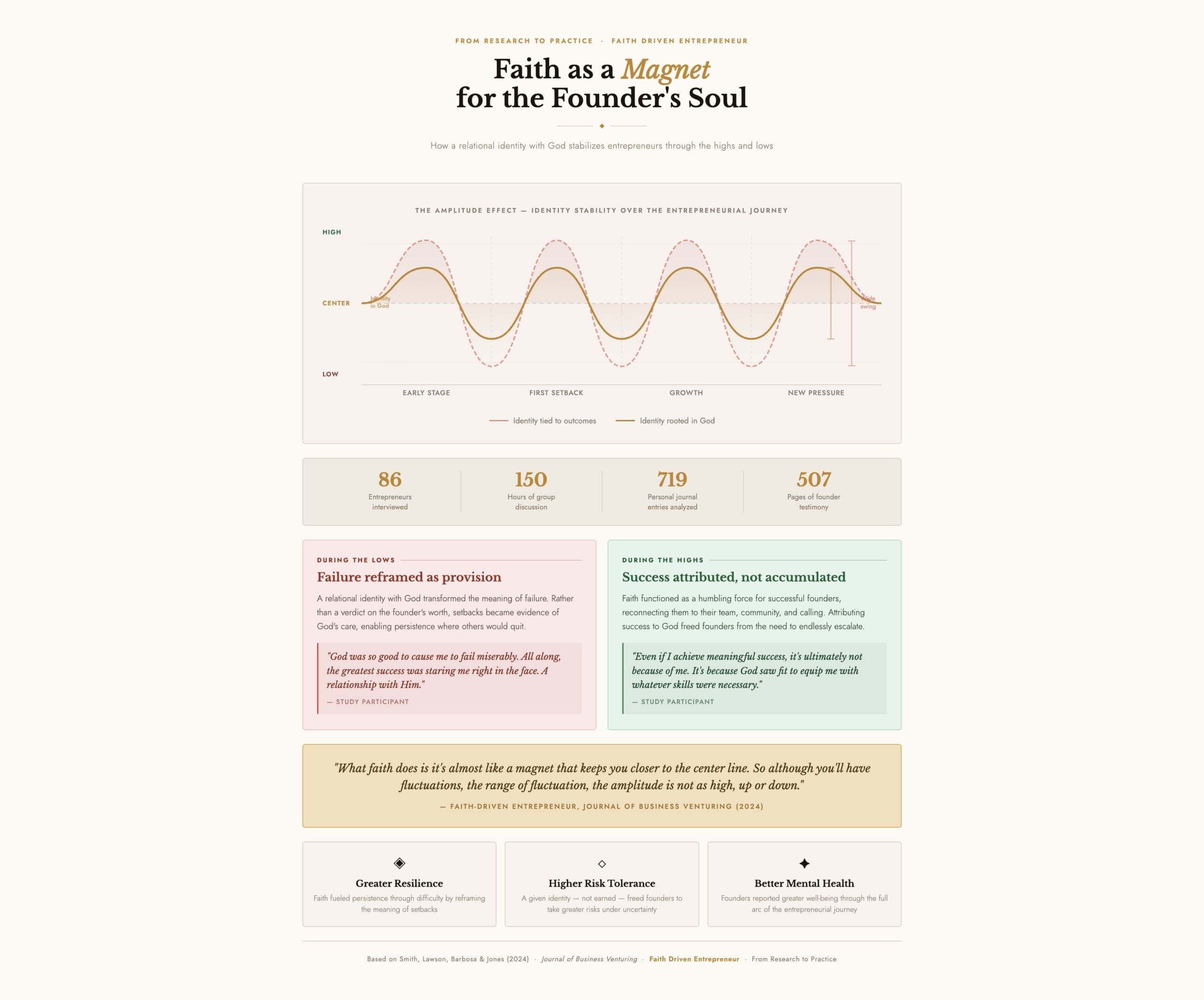
He’s not alone. New research published in the Journal of Business Venturing studied 86 entrepreneurs across 150 hours of group discussion and 719 personal journal entries. What the researchers found was this: a relational identity with God significantly stabilizes the founder’s journey — humbling entrepreneurs during the highs, affirming them during the lows, and anchoring identity to something that doesn’t move when the company does.
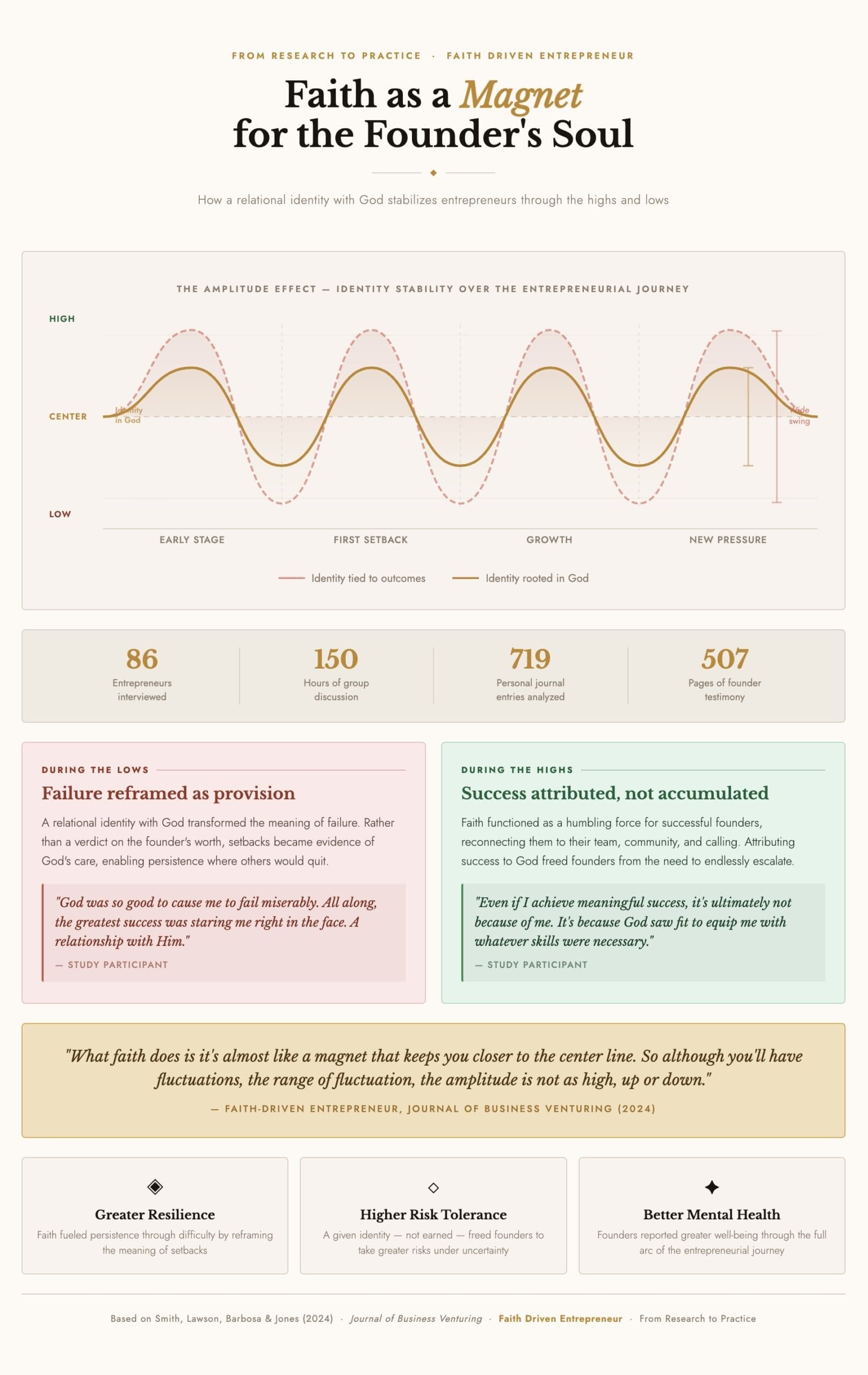
“The same journey, two different centers.”

The Problem No One Talks About

Entrepreneurs are unusually prone to becoming their ventures. The company succeeds, the founder feels worth. The company struggles, the founder feels worthless. This cycle isn’t a character flaw, it’s a structural feature of how deeply founders invest themselves in what they build.

Researchers Brett Smith, Amanda Lawson, Saulo Barbosa, and Jessica Jones set out to understand how the highs and lows of entrepreneurship affect a founder’s identity, and whether faith changes that equation. Their method was unusually thorough: 86 entrepreneur interviews, 150 hours of group discussion, and 719 personal journal entries totaling 507 pages.

What they found was a phenomenon they called “inter identity stability,” a faith-grounded center that reframes the meaning of both failure and success without denying the weight of either.

What Faith Does During the Lows

For entrepreneurs experiencing failure or stress, the research found that a relational identity with God reframed what the difficulty actually meant.

One entrepreneur described it this way: “God was so good to cause me to fail miserably. He knew my heart wouldn’t have been able to handle those things. I am so thankful. All along, the greatest success was staring me right in the face. A relationship with Him.”

This isn’t denial or spiritual bypassing. It’s a genuine reframe. Failure stopped being a verdict on the founder’s worth and became, instead, a provision from God. That shift changed what failure meant. And in changing the meaning, it changed how entrepreneurs responded to it.

Others drew on a received identity rather than an achieved one. One founder put it simply: “Just the thought of operating out of—you’ve already received it versus like you’re working to achieve this identity? That is a game changer.”

When identity is given rather than earned, setbacks can’t take it away.

What Faith Does During the Highs

The research found something equally striking on the other side of the curve. For entrepreneurs who did experience significant success, faith functioned as a humbling force that reconnected them to their team, their community, and their actual calling.

One founder said: “Even if I do achieve the levels of success necessary to accomplish something meaningful in the eyes of the world, it’s ultimately not because of me. It’s because God saw fit to equip me with whatever skills were necessary to achieve that end.”

This isn’t false modesty. It’s a theological reorientation of credit. When success belongs to God, the founder is freed from the need to endlessly escalate the next exit, the next valuation, the next comparison. The treadmill stops.

The research also found that a parent-child framework for understanding one’s relationship with God was particularly powerful. One entrepreneur described it this way: “I expect that God will guard, guide, discipline, and care for me in love with the intent that I grow in maturity and character, bearing a family resemblance to Him and the rest of His children.”

The Magnet Effect

One entrepreneur in the study captured the entire finding in a single image:

“What faith does is it’s almost like a magnet that keeps you closer to the center line. So although you’ll have fluctuations, the range of fluctuation, the amplitude is not as high, up or down.”

This is the core of what the researchers documented. Faith doesn’t eliminate the highs and lows of the founder’s journey. It compresses the amplitude. It keeps identity from swinging as far in either direction — from the paralysis of failure or the hubris of success.

The key takeaways from the research: a relational identity with God fueled resilience during difficulties, higher risk tolerance in times of uncertainty, and greater mental health and well-being through the full arc of the entrepreneurial journey.

How Steven Found His Center Line

Steven eventually found his center. He decided to mark the shift permanently.

“There was a shift in my understanding of my identity from ‘If it’s going to be, it’s up to me’ to what my tattoo says: ‘Not by my power and not to my glory.'”

“I couldn’t have been successful without God. He is my identity and He is a core part of my story as an entrepreneur. This is God’s story.”

Practical Steps

    Think differently about your identity:

    • Comparison is a root of entrepreneurial pain. When founders begin comparing themselves to their past performance, their projected future, or other entrepreneurs, identity becomes fragile. The risk is highest during significant highs and lows, when the emotional stakes amplify whatever story you’re telling yourself about your worth.
    • An active relationship with God is foundational to a healthy identity. The research is clear: those who see themselves in relationship with God navigate both success and failure with far greater stability than those whose identity is tied to outcomes.

    • Your identity in Christ changes the meaning of the journey itself. A parent-child framework, God as Father and you as child, allows entrepreneurs to trust, to communicate, and to receive direction. That given identity transforms both the goals and the meaning of every high and low along the way.

     Act differently in your venture:

    • Make space for faith in conversations about founder well-being. The evidence from this research shows that faith is overwhelmingly a positive influence on founders’ mental health. It deserves a seat at any serious conversation about founder resilience, not just a footnote.
    • Surround yourself with mentors who will speak into your God-given identity. Community matters. Relationships with people who know who you are outside of your company can anchor you when the company becomes the only thing you see.

    • Practice regular self-reflection on your core identity and motivations. As we speed towards scale, it’s easy to drift. Regularly ask: where am I deriving my sense of worth right now? The answer will tell you whether you need to be humbled, affirmed, or simply reminded of what has always been true.

    “When I Realized It Was Zero Percent Mine and 100% God’s, Everything Changed.”

    “When I Realized It Was Zero Percent Mine and 100% God’s, Everything Changed.”

    What Christian Impact Investors Teach Us About Identity, Calling, and Surrender

    Most investors measure risk in basis points. These investors measure it in obedience.

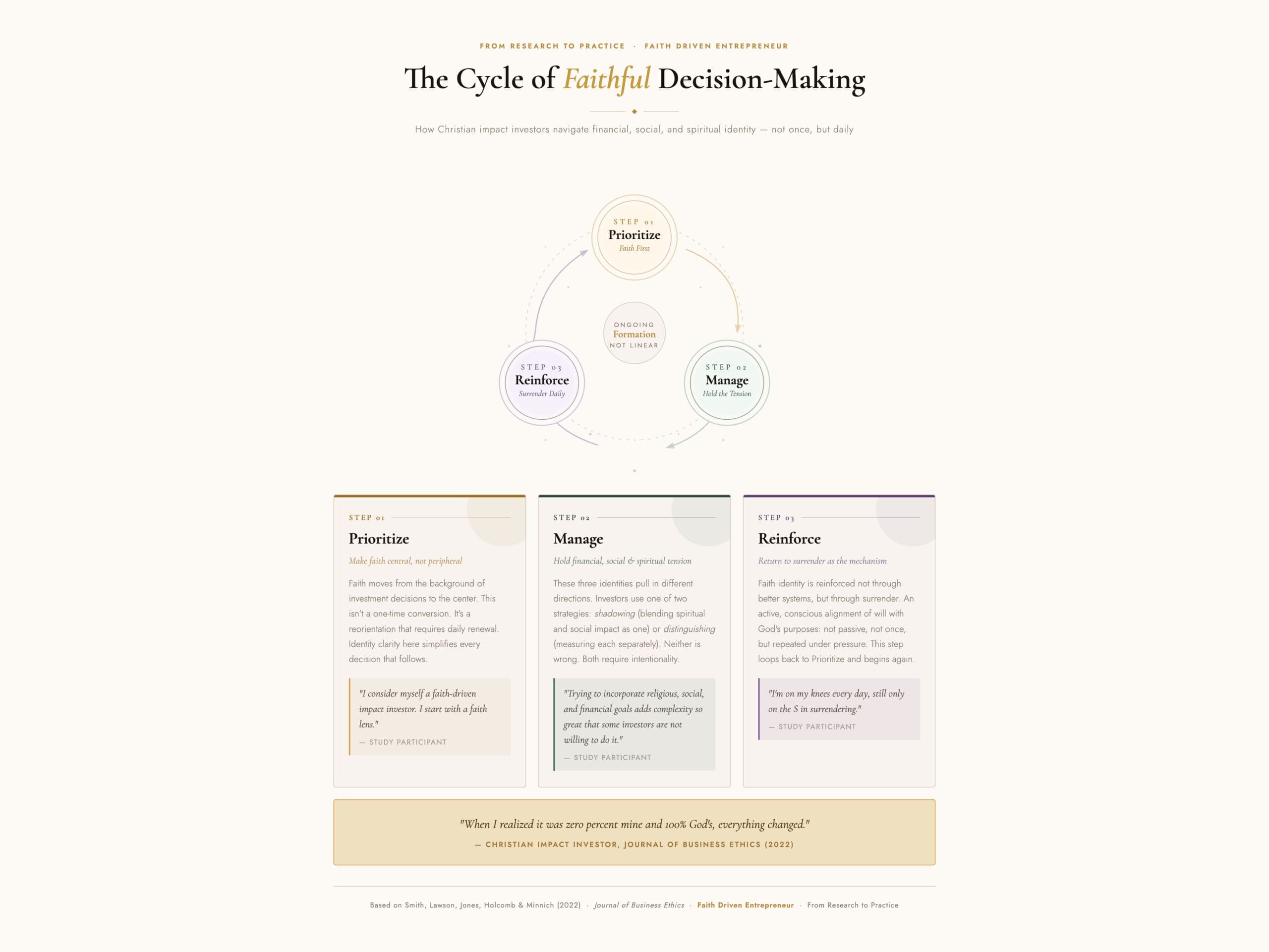
    A 2022 study published in the Journal of Business Ethics examined how Christian impact investors navigate one of the most demanding challenges in their work: holding financial, social, and spiritual priorities at the same time. What the researchers found wasn’t a sophisticated portfolio framework. It was something closer to a theology of surrender.

    And it has as much to say to entrepreneurs as it does to investors.

    The Question Nobody Asks Out Loud

    “People assume if you accept a lower return,” one faith-driven investor said, “then you’re a soft investor, or a stupid investor. Because why would you do that? Don’t you realize you can get an 18% return over here?”

    It’s a fair question. It’s also the wrong one.

    Researchers Brett Smith, Lawson Jones, Ashley Holcomb, and Minnich conducted in-depth interviews with Christian impact investors across firms, stages, and investment philosophies. They analyzed the transcripts using identity work theory, a framework from academic research that tracks how people prioritize competing identities when those identities come into conflict.

    What they found was a three-part model of faithful decision-making that doesn’t show up in any MBA curriculum.

    Step One: Make Your Faith Identity Central

    Many of the investors in the study described a clear turning point when faith moved from the background of their work to the center of it.

    “I consider myself a faith-driven impact investor,” one said. “I start with a faith lens.” Another described it this way: “I was a Christian for a long time, but it’s only in the last few years that this identity became central to all that I do.”

    But the researchers were careful to note something important: this isn’t a permanent arrival. It’s an ongoing practice. As one investor admitted, “This identity isn’t fixed. It fluctuates day to day.”

    That honesty matters. Putting faith at the center isn’t a one-time decision. It’s a daily act of reorientation.

    Step Two: Manage the Tension Between Competing Values

    Financial return. Social impact. Spiritual obedience. These three don’t always point in the same direction. The investors in the study had developed two distinct ways of handling it.

    Some chose to shadow, blending their spiritual and social identities into one. “I do not see spiritual impact as different from social impact,” one investor said. “They are the same thing.” Another put it plainly: “Lifting people out of poverty is a Kingdom outcome.” Shadowing reduces internal tension by merging motivations, but it increases complexity in measurement.”

    Others chose to distinguish, treating each identity as a separate, measurable category. One investor created a 1 to 5 scale for financial, social, and spiritual outcomes and required a score of at least 4 in all three areas for any investment to qualify. “It is critical to measure religious returns,” this investor argued. “Not only possible but necessary.”

    Neither approach is wrong. The research doesn’t endorse one over the other. What it does emphasize is the importance of choosing intentionally rather than letting the tension go unaddressed.

    Step Three: Reinforce Faith Through Surrender

    This is where the study’s most striking finding lands.

    The investors who had developed the most clarity didn’t reinforce their faith identity through better systems or smarter portfolio construction. They reinforced it through surrender.

    “When I realized it was zero percent mine and 100% God’s, everything changed.”

    “It wasn’t about building bigger barns for myself but building Kingdom impact with my wealth.”

    “Making the wrong investment isn’t the biggest risk. Disobedience is.”

    The researchers were clear that surrender, in this context, is not passivity. It is an active, conscious commitment to align one’s will with God’s purposes, even when better financial returns are available elsewhere. It is a choice made repeatedly, under pressure, often in rooms where that logic is considered naive.

    One investor described it with unusual honesty: “The thing that we need to sacrifice or surrender is really our will.”

    And another, reflecting on the posture the whole study seemed to circle back to, said simply: “I’m on my knees every day, still only on the S in surrendering.”

    What This Means Beyond Investing

    The research speaks directly to investors. But the framework it describes applies to anyone who has tried to build something meaningful while holding faith, financial pressure, and a desire for genuine impact at the same time.

    That’s most faith-driven entrepreneurs.

    The tension between these identities isn’t a problem to be solved. The research frames it as formation. What matters is not whether the tension exists but how you’ve decided to navigate it, and whether your faith is at the center when you do.

    Practical Steps

    Think differently about your work:

    • Let faith lead, not lag. When faith is genuinely central to your identity as a builder or investor, the purpose of your work shifts from personal achievement to Kingdom impact. That shift changes how you make decisions long before any specific decision arrives.
    • Expect tension and don’t fear it. Financial, social, and spiritual priorities will pull against each other. That friction isn’t a sign something is wrong. It’s often a sign something important is at stake. Pay attention to it.
    • Rethink what success requires. Surrender is not a concession. It is a strategic alignment of your will with God’s. The investors in this study weren’t naive about returns. They had simply decided that obedience was the higher metric.

    Act differently in your work:

        • Choose your model. Are you a shadower who sees social and spiritual impact as inseparable? Or a distinguisher who measures each separately? Neither is superior. But choosing intentionally, rather than letting the tension manage you, is the difference between clarity and drift.
        • Build metrics that reflect your actual values. Identify three to five indicators that capture not just financial return but spiritual and social flourishing. Then let those shape your decisions, not just your reporting.
        • Practice surrender as a habit, not a moment. The investors in this study didn’t surrender once and move on. They returned to it daily. Check your motives regularly. Ask honestly: am I pushing this because God is calling me, or because I want control? Then offer the answer back to God.

    One investor in the study captured something that doesn’t show up in return tables or impact reports:

    “We are programmed our entire lives to seek higher returns. You sit at the bar and say, ‘I made this investment and got these incredible financial results.’ No one says, ‘I fed people in Africa and got my money back.'”

    And yet, for those who have surrendered control, that second story is the one worth telling.

    Your Faith Could Cost You the Deal, Or Close It

    Your Faith Could Cost You the Deal, or Close It

    What New Research Tells Us About Faith in the Pitch Room

     You’ve been in that room. Pitch at the ready. Dreams laid out for all to see.

    Maybe you mentioned your faith and the energy shifted. Maybe you held back and wondered if you should have said something. Maybe you’re still unsure what the right call is.

    New research finally gives us a framework. And the answer isn’t “always share” or “never share.” It’s more nuanced and more useful than that.

    A 2024 study published in Small Business Economics looked at exactly this question: does religious language in a startup pitch help or hurt investor confidence? Researchers Jessica Jones, Christian Hymer, Ashley Roccapriore, and Brett Smith ran controlled experiments with both faith-driven and secular angel investor groups. Participants evaluated near-identical pitches, some with faith-based mission statements and some without, and shared how those statements shaped their perception of the founder and the venture.

    What they found matters for every faith-driven entrepreneur raising capital.

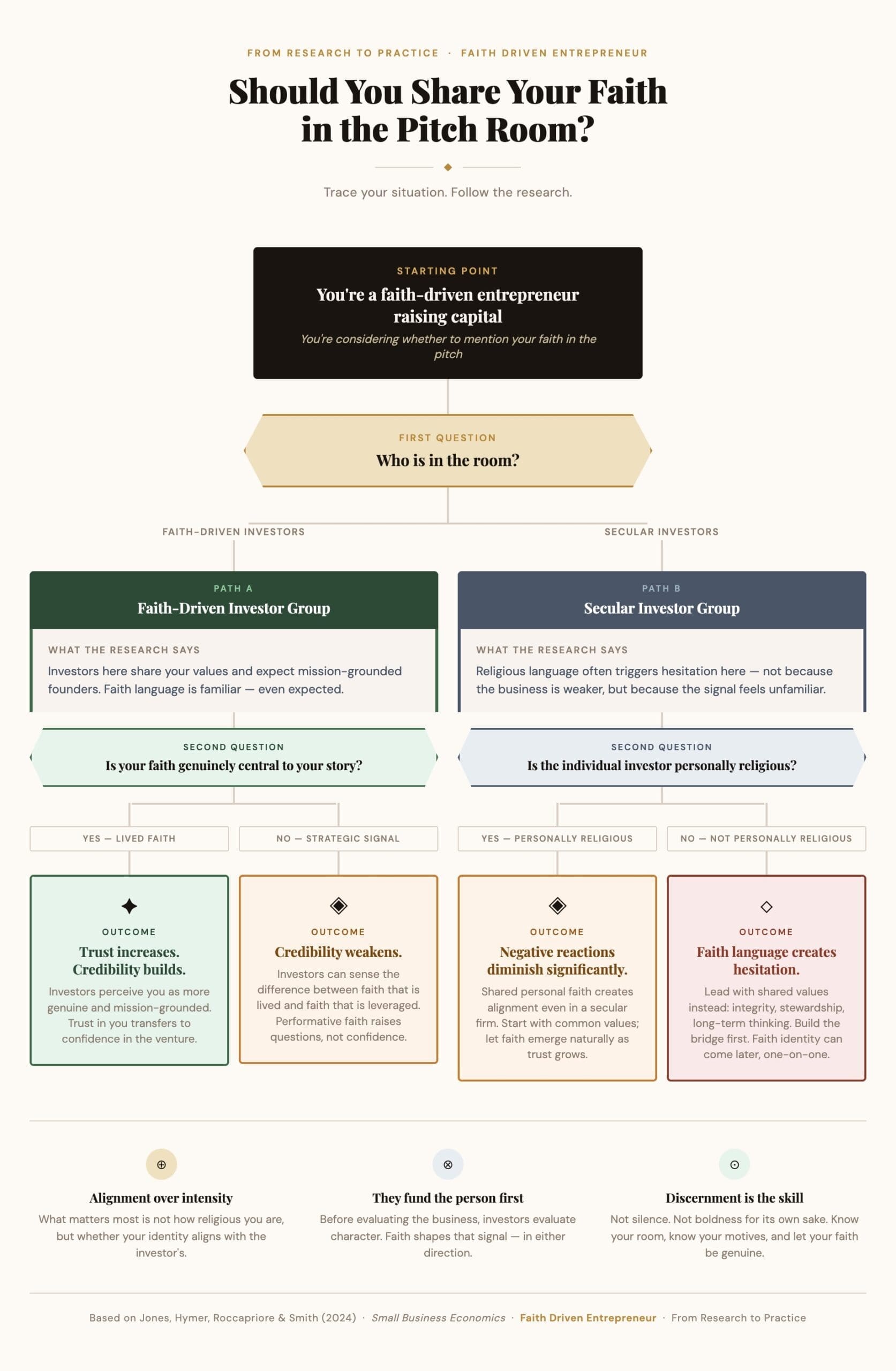
    Trace your situation through the research findings.

    Faith is a Double-Edged Sword in the Pitch Room

    The research confirmed what many of us have suspected: faith can help, and faith can hurt. It is not a universal advantage or a universal liability. It depends entirely on the room.

    The same sentence that builds trust with one investor can raise eyebrows with another. Faith functions as a signal, and people interpret that signal through the lens of their own identity, values, and expectations.

    That’s not a reason to hide who you are. It’s a reason to be wise about when and how you show up.

    What Happens in Faith-Driven Investor Rooms

    Here’s what the research found specifically: 

    When faith-driven investor groups heard religious language in a pitch, they didn’t automatically like the business more. But they did trust the founder more.

    The mechanism is authenticity. When a founder shares their faith openly in a room where that faith is shared, investors perceive them as more genuine, more sincere, and more mission-grounded. That trust in the person then translates into increased confidence in the venture.

    Faith didn’t sell the business. Faith revealed the person. And investors funded the person.

    What Happens in Secular Investment Rooms

    In secular environments, the dynamic reverses. Religious language often triggered hesitation, not because the business was weaker, but because the signal felt unfamiliar or out of place.

    The one exception: 

    When an individual investor inside a secular firm was personally religious, those negative reactions became much smaller or disappeared entirely.

    The implication is significant. It is not the setting that ultimately matters. It’s the alignment between your identity and theirs. A secular firm with one faith-driven partner is a different conversation than a room full of investors for whom faith is irrelevant to their work.

    What This Means For You

    Before the pitch, investors are not primarily evaluating your business. They’re evaluating you. Religious language works as a character signal, and investors use it to ask: Is this founder reliable? Grounded? Consistent? Mission-driven?

    The research makes clear: alignment matters more than intensity. A simple phrase rooted in genuine faith can inspire trust in one room and confusion in another, without changing your business model at all. What moves the needle is fit, not fervor.

    Authenticity is more persuasive than persuasion. Faith language works best when it naturally reflects who you are and not when it’s deployed as strategy. Investors can sense the difference between faith that is lived and faith that is leveraged. The former builds credibility. The latter raises questions.

    Practical Steps

    Think differently about your pitch.

    • Know your audience before you walk in the room. Faith language builds confidence with investors who share your values or who clearly prioritize mission and purpose. In secular or unfamiliar environments, it’s often wiser to start with shared values — integrity, stewardship, long-term thinking, ethical leadership — before naming your religious identity directly.

    • Check your motives, not just your message. Before you bring up faith in a pitch, ask yourself why you’re sharing it and what you hope it accomplishes. Discernment starts with honest self-awareness.

    • Don’t assume your faith will transfer to their decision. As a faith-driven entrepreneur, you’ve integrated faith and work. Your investors haven’t necessarily done the same. The research is clear: faith shapes how investors perceive you, not automatically how they evaluate your business.

    Act differently in the room

    • Tailor the pitch to the setting. Research who you’re pitching. Look for investor groups or individuals who care about values, purpose, or faith integration. This information is often available before you walk in. If it’s not clear, don’t assume mentioning your faith will help.

    • Let it be authentic, not performative. If faith is part of your leadership and your story, share it as part of your story and not as a credential you’re strategically deploying. The research is clear: sincere faith strengthens credibility; performative faith weakens it.

    • In mixed or secular rooms, build the bridge first. Start with the values that transcend religion: integrity, responsibility, long-term stewardship, care for people. As trust grows, your faith-grounded identity will become clear and land differently than if you’d led with it cold.

    Discernment is the skill. Not silence. Not boldness for its own sake.

    Know your room. Know your motives. Let your faith be genuine and trust that genuine things are recognized.