





Success Was Just as Destabilizing as Failure, Until This Changed
Success Was Just as Destabilizing as Failure, Until This Changed
How a Relationship with God Stabilizes Entrepreneurs Through the Highs and Lows
Steven is a serial tech entrepreneur in his 40s. Four kids. A venture studio that birthed a unicorn. A faith-motivated accelerator. A fintech co-founder who raised over $100M in venture capital.
By any external measure, he had made it. And yet, he felt off course.
“I thought we were successful, and we’re not,” he said. “You feel like you’re on a rocket to the moon and it turns out you’re not. You’re actually a failure.”
The pattern kept repeating. One exit wasn’t enough. The next comparison was always waiting. Success, it turned out, was just as destabilizing as failure — because Steven’s identity had quietly become inseparable from his venture’s outcomes.
He’s not alone. New research published in the Journal of Business Venturing studied 86 entrepreneurs across 150 hours of group discussion and 719 personal journal entries. What the researchers found was this: a relational identity with God significantly stabilizes the founder’s journey — humbling entrepreneurs during the highs, affirming them during the lows, and anchoring identity to something that doesn’t move when the company does.
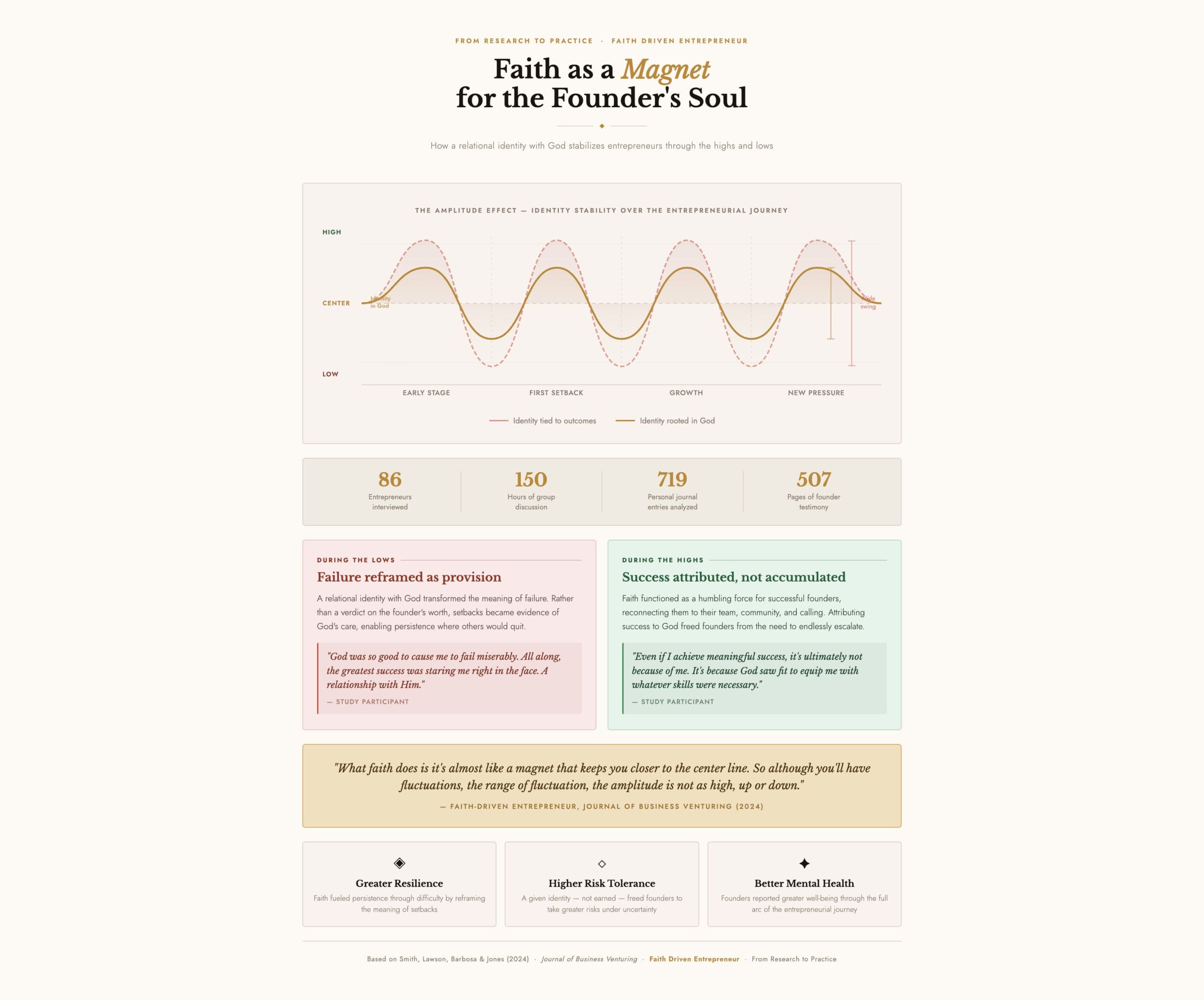
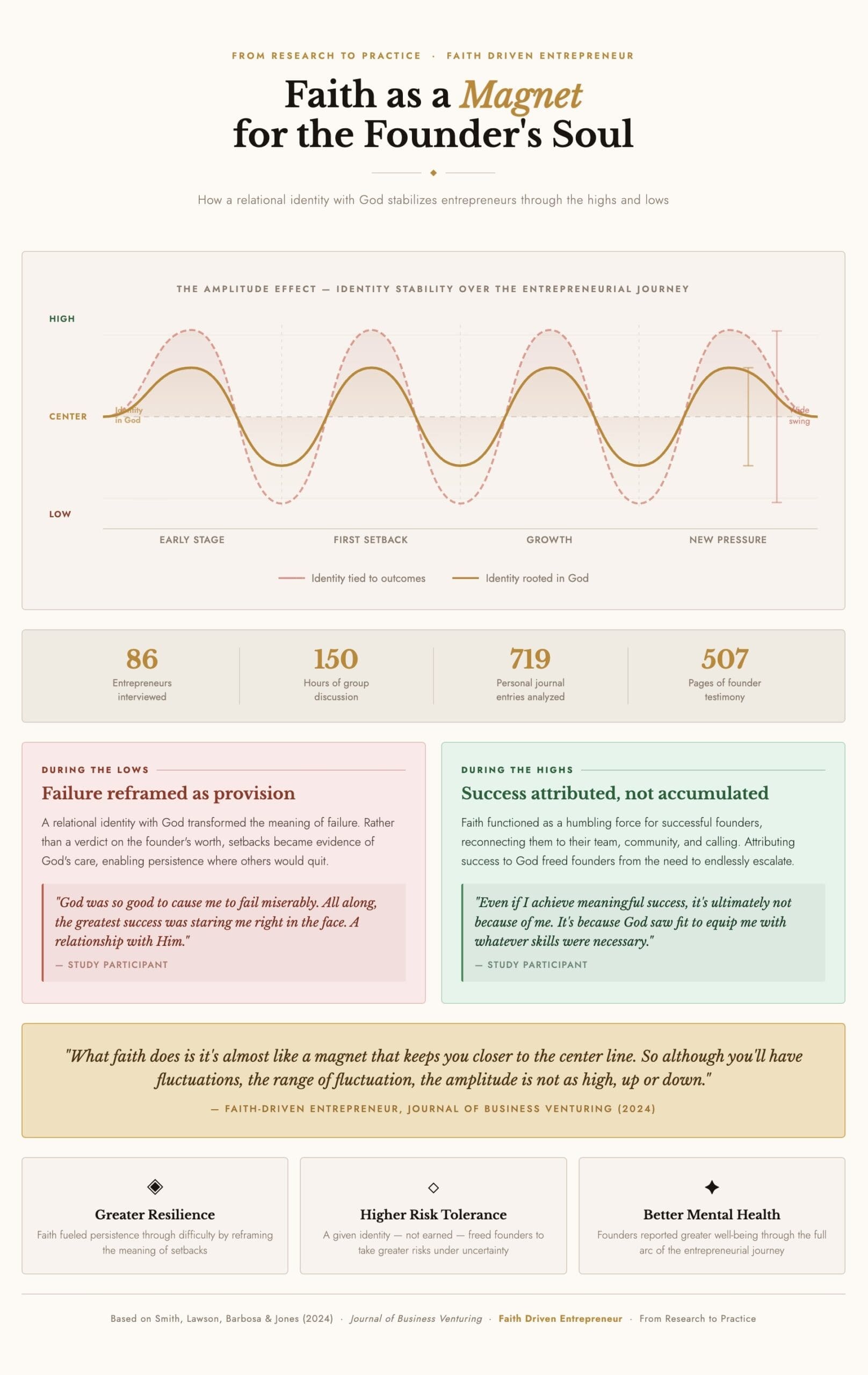
“The same journey, two different centers.”
The Problem No One Talks About
Entrepreneurs are unusually prone to becoming their ventures. The company succeeds, the founder feels worth. The company struggles, the founder feels worthless. This cycle isn’t a character flaw, it’s a structural feature of how deeply founders invest themselves in what they build.
Researchers Brett Smith, Amanda Lawson, Saulo Barbosa, and Jessica Jones set out to understand how the highs and lows of entrepreneurship affect a founder’s identity, and whether faith changes that equation. Their method was unusually thorough: 86 entrepreneur interviews, 150 hours of group discussion, and 719 personal journal entries totaling 507 pages.
What they found was a phenomenon they called “inter identity stability,” a faith-grounded center that reframes the meaning of both failure and success without denying the weight of either.
What Faith Does During the Lows
For entrepreneurs experiencing failure or stress, the research found that a relational identity with God reframed what the difficulty actually meant.
One entrepreneur described it this way: “God was so good to cause me to fail miserably. He knew my heart wouldn’t have been able to handle those things. I am so thankful. All along, the greatest success was staring me right in the face. A relationship with Him.”
This isn’t denial or spiritual bypassing. It’s a genuine reframe. Failure stopped being a verdict on the founder’s worth and became, instead, a provision from God. That shift changed what failure meant. And in changing the meaning, it changed how entrepreneurs responded to it.
Others drew on a received identity rather than an achieved one. One founder put it simply: “Just the thought of operating out of—you’ve already received it versus like you’re working to achieve this identity? That is a game changer.”
When identity is given rather than earned, setbacks can’t take it away.
What Faith Does During the Highs
The research found something equally striking on the other side of the curve. For entrepreneurs who did experience significant success, faith functioned as a humbling force that reconnected them to their team, their community, and their actual calling.
One founder said: “Even if I do achieve the levels of success necessary to accomplish something meaningful in the eyes of the world, it’s ultimately not because of me. It’s because God saw fit to equip me with whatever skills were necessary to achieve that end.”
This isn’t false modesty. It’s a theological reorientation of credit. When success belongs to God, the founder is freed from the need to endlessly escalate the next exit, the next valuation, the next comparison. The treadmill stops.
The research also found that a parent-child framework for understanding one’s relationship with God was particularly powerful. One entrepreneur described it this way: “I expect that God will guard, guide, discipline, and care for me in love with the intent that I grow in maturity and character, bearing a family resemblance to Him and the rest of His children.”
The Magnet Effect
One entrepreneur in the study captured the entire finding in a single image:
“What faith does is it’s almost like a magnet that keeps you closer to the center line. So although you’ll have fluctuations, the range of fluctuation, the amplitude is not as high, up or down.”
This is the core of what the researchers documented. Faith doesn’t eliminate the highs and lows of the founder’s journey. It compresses the amplitude. It keeps identity from swinging as far in either direction — from the paralysis of failure or the hubris of success.
The key takeaways from the research: a relational identity with God fueled resilience during difficulties, higher risk tolerance in times of uncertainty, and greater mental health and well-being through the full arc of the entrepreneurial journey.
How Steven Found His Center Line
Steven eventually found his center. He decided to mark the shift permanently.
“There was a shift in my understanding of my identity from ‘If it’s going to be, it’s up to me’ to what my tattoo says: ‘Not by my power and not to my glory.'”
“I couldn’t have been successful without God. He is my identity and He is a core part of my story as an entrepreneur. This is God’s story.”
Practical Steps
Think differently about your identity:
- Comparison is a root of entrepreneurial pain. When founders begin comparing themselves to their past performance, their projected future, or other entrepreneurs, identity becomes fragile. The risk is highest during significant highs and lows, when the emotional stakes amplify whatever story you’re telling yourself about your worth.
- An active relationship with God is foundational to a healthy identity. The research is clear: those who see themselves in relationship with God navigate both success and failure with far greater stability than those whose identity is tied to outcomes.
- Your identity in Christ changes the meaning of the journey itself. A parent-child framework, God as Father and you as child, allows entrepreneurs to trust, to communicate, and to receive direction. That given identity transforms both the goals and the meaning of every high and low along the way.
Act differently in your venture:
- Make space for faith in conversations about founder well-being. The evidence from this research shows that faith is overwhelmingly a positive influence on founders’ mental health. It deserves a seat at any serious conversation about founder resilience, not just a footnote.
- Surround yourself with mentors who will speak into your God-given identity. Community matters. Relationships with people who know who you are outside of your company can anchor you when the company becomes the only thing you see.
- Practice regular self-reflection on your core identity and motivations. As we speed towards scale, it’s easy to drift. Regularly ask: where am I deriving my sense of worth right now? The answer will tell you whether you need to be humbled, affirmed, or simply reminded of what has always been true.
Further Reading from Faith Driven Entrepreneur: Jeff Haanen, “Who Am I? The Identity of an Entrepreneur” · David Park, “Fireproofing Your Identity” · Brett Hagler, “Abiding Over Striving” · Henry Kaestner, “Identity: More Than What You Do” · Adam Metcalf, “God Saved Me From Success”