






Your Faith Could Cost You the Deal, or Close It
What New Research Tells Us About Faith in the Pitch Room
You’ve been in that room. Pitch at the ready. Dreams laid out for all to see.
Maybe you mentioned your faith and the energy shifted. Maybe you held back and wondered if you should have said something. Maybe you’re still unsure what the right call is.
New research finally gives us a framework. And the answer isn’t “always share” or “never share.” It’s more nuanced and more useful than that.
A 2024 study published in Small Business Economics looked at exactly this question: does religious language in a startup pitch help or hurt investor confidence? Researchers Jessica Jones, Christian Hymer, Ashley Roccapriore, and Brett Smith ran controlled experiments with both faith-driven and secular angel investor groups. Participants evaluated near-identical pitches, some with faith-based mission statements and some without, and shared how those statements shaped their perception of the founder and the venture.
What they found matters for every faith-driven entrepreneur raising capital.
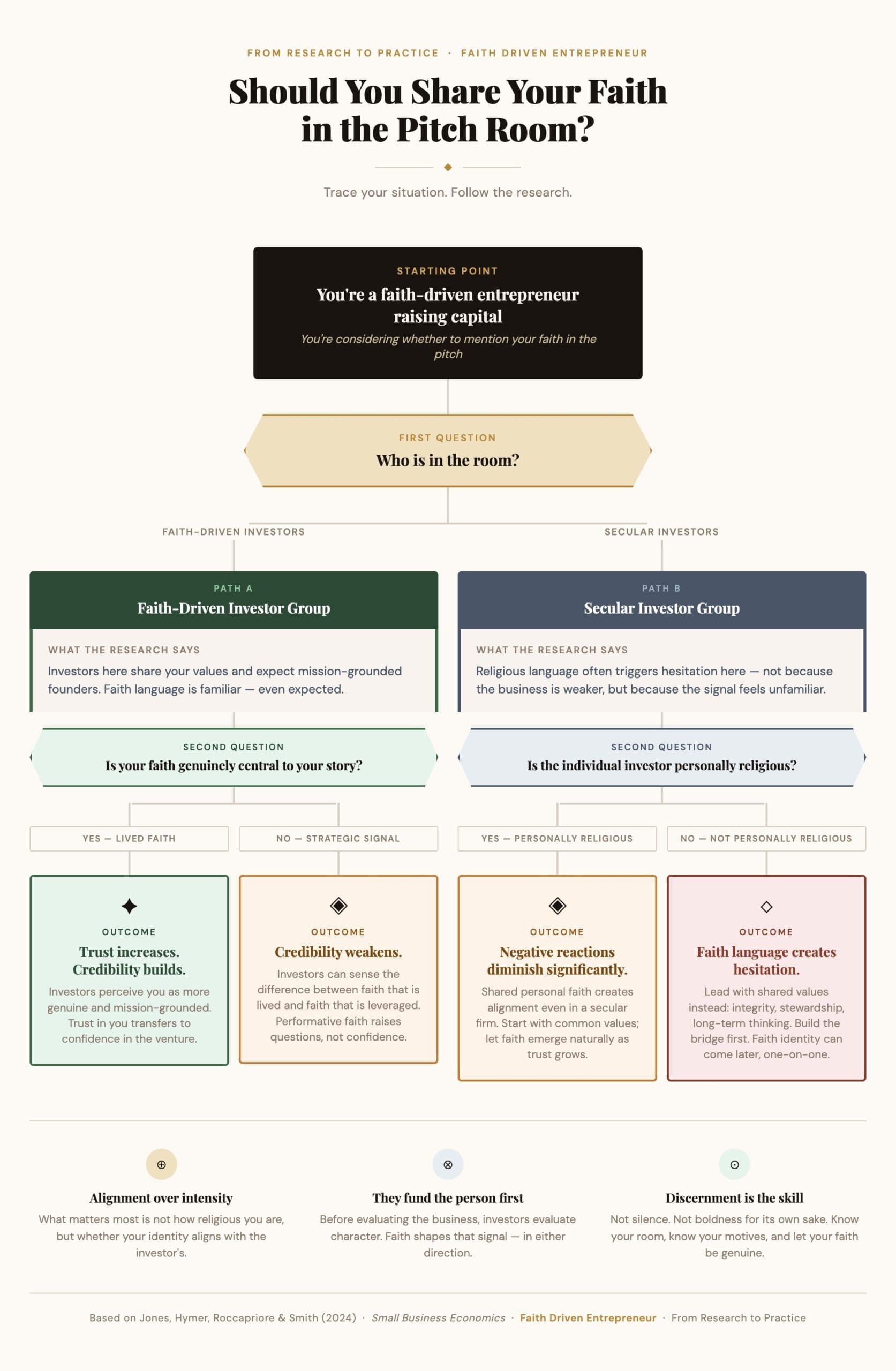
Trace your situation through the research findings.
Faith is a Double-Edged Sword in the Pitch Room
The research confirmed what many of us have suspected: faith can help, and faith can hurt. It is not a universal advantage or a universal liability. It depends entirely on the room.
The same sentence that builds trust with one investor can raise eyebrows with another. Faith functions as a signal, and people interpret that signal through the lens of their own identity, values, and expectations.
That’s not a reason to hide who you are. It’s a reason to be wise about when and how you show up.
What Happens in Faith-Driven Investor Rooms
Here’s what the research found specifically:
When faith-driven investor groups heard religious language in a pitch, they didn’t automatically like the business more. But they did trust the founder more.
The mechanism is authenticity. When a founder shares their faith openly in a room where that faith is shared, investors perceive them as more genuine, more sincere, and more mission-grounded. That trust in the person then translates into increased confidence in the venture.
Faith didn’t sell the business. Faith revealed the person. And investors funded the person.
What Happens in Secular Investment Rooms
In secular environments, the dynamic reverses. Religious language often triggered hesitation, not because the business was weaker, but because the signal felt unfamiliar or out of place.
The one exception:
When an individual investor inside a secular firm was personally religious, those negative reactions became much smaller or disappeared entirely.
The implication is significant. It is not the setting that ultimately matters. It’s the alignment between your identity and theirs. A secular firm with one faith-driven partner is a different conversation than a room full of investors for whom faith is irrelevant to their work.
What This Means For You
Before the pitch, investors are not primarily evaluating your business. They’re evaluating you. Religious language works as a character signal, and investors use it to ask: Is this founder reliable? Grounded? Consistent? Mission-driven?
The research makes clear: alignment matters more than intensity. A simple phrase rooted in genuine faith can inspire trust in one room and confusion in another, without changing your business model at all. What moves the needle is fit, not fervor.
Authenticity is more persuasive than persuasion. Faith language works best when it naturally reflects who you are and not when it’s deployed as strategy. Investors can sense the difference between faith that is lived and faith that is leveraged. The former builds credibility. The latter raises questions.
Practical Steps
Think differently about your pitch.
- Know your audience before you walk in the room. Faith language builds confidence with investors who share your values or who clearly prioritize mission and purpose. In secular or unfamiliar environments, it’s often wiser to start with shared values — integrity, stewardship, long-term thinking, ethical leadership — before naming your religious identity directly.
- Check your motives, not just your message. Before you bring up faith in a pitch, ask yourself why you’re sharing it and what you hope it accomplishes. Discernment starts with honest self-awareness.
- Don’t assume your faith will transfer to their decision. As a faith-driven entrepreneur, you’ve integrated faith and work. Your investors haven’t necessarily done the same. The research is clear: faith shapes how investors perceive you, not automatically how they evaluate your business.
Act differently in the room
- Tailor the pitch to the setting. Research who you’re pitching. Look for investor groups or individuals who care about values, purpose, or faith integration. This information is often available before you walk in. If it’s not clear, don’t assume mentioning your faith will help.
- Let it be authentic, not performative. If faith is part of your leadership and your story, share it as part of your story and not as a credential you’re strategically deploying. The research is clear: sincere faith strengthens credibility; performative faith weakens it.
- In mixed or secular rooms, build the bridge first. Start with the values that transcend religion: integrity, responsibility, long-term stewardship, care for people. As trust grows, your faith-grounded identity will become clear and land differently than if you’d led with it cold.
Discernment is the skill. Not silence. Not boldness for its own sake.
Know your room. Know your motives. Let your faith be genuine and trust that genuine things are recognized.
More Insights from Faith Driven Entrepreneur: Marks of a Faith Driven Investor • The Most Important Factor in Faith-Driven Investing is Your Heart • Investment Ideals • A Hope Based Approach to Money • God’s Investment and Ours