





“When I Realized It Was Zero Percent Mine and 100% God’s, Everything Changed.”
What Christian Impact Investors Teach Us About Identity, Calling, and Surrender
Most investors measure risk in basis points. These investors measure it in obedience.
A 2022 study published in the Journal of Business Ethics examined how Christian impact investors navigate one of the most demanding challenges in their work: holding financial, social, and spiritual priorities at the same time. What the researchers found wasn’t a sophisticated portfolio framework. It was something closer to a theology of surrender.
And it has as much to say to entrepreneurs as it does to investors.
The Question Nobody Asks Out Loud
“People assume if you accept a lower return,” one faith-driven investor said, “then you’re a soft investor, or a stupid investor. Because why would you do that? Don’t you realize you can get an 18% return over here?”
It’s a fair question. It’s also the wrong one.
Researchers Brett Smith, Lawson Jones, Ashley Holcomb, and Minnich conducted in-depth interviews with Christian impact investors across firms, stages, and investment philosophies. They analyzed the transcripts using identity work theory, a framework from academic research that tracks how people prioritize competing identities when those identities come into conflict.
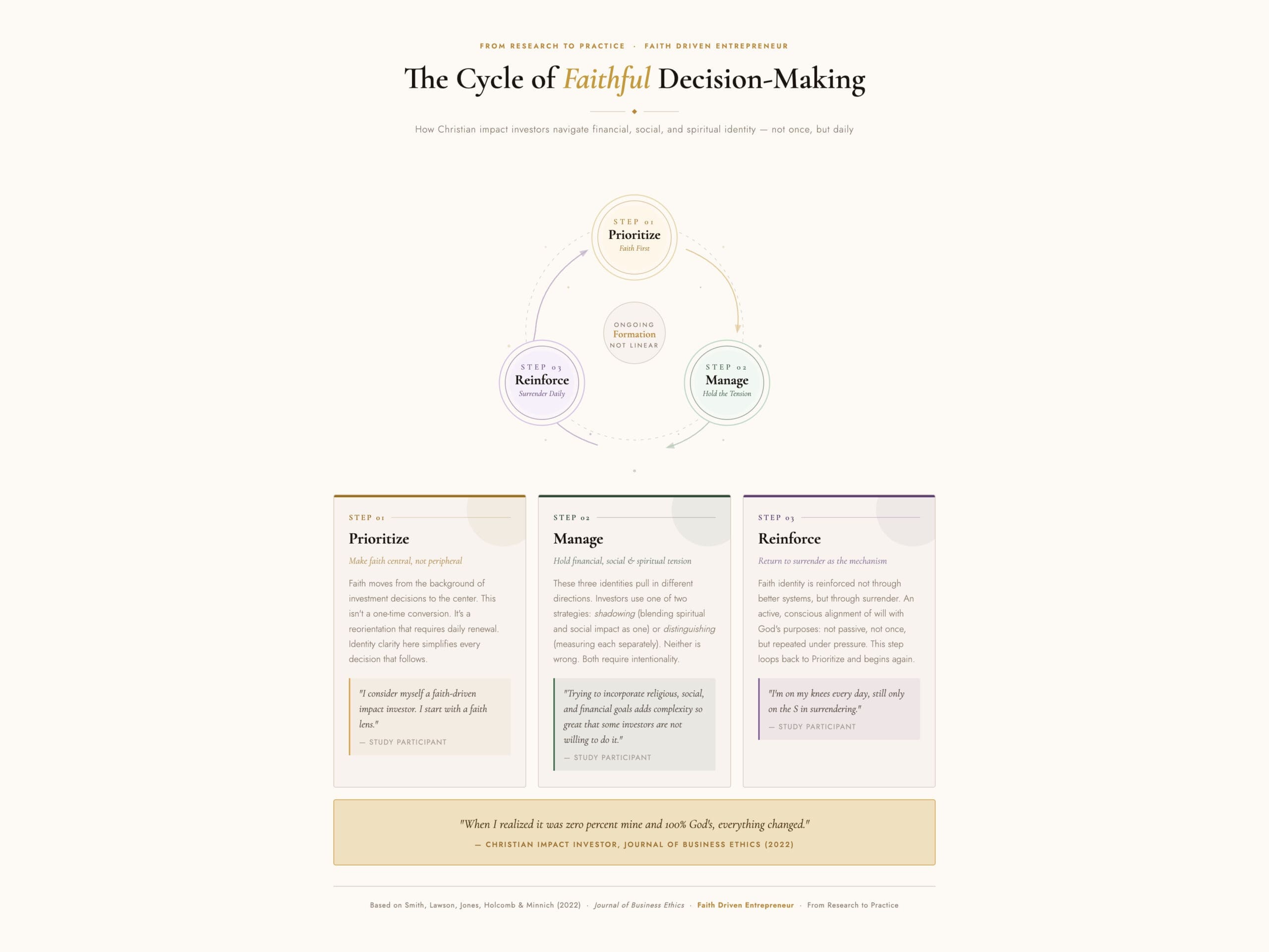
What they found was a three-part model of faithful decision-making that doesn’t show up in any MBA curriculum.
Step One: Make Your Faith Identity Central
Many of the investors in the study described a clear turning point when faith moved from the background of their work to the center of it.
“I consider myself a faith-driven impact investor,” one said. “I start with a faith lens.” Another described it this way: “I was a Christian for a long time, but it’s only in the last few years that this identity became central to all that I do.”
But the researchers were careful to note something important: this isn’t a permanent arrival. It’s an ongoing practice. As one investor admitted, “This identity isn’t fixed. It fluctuates day to day.”
That honesty matters. Putting faith at the center isn’t a one-time decision. It’s a daily act of reorientation.
Step Two: Manage the Tension Between Competing Values
Financial return. Social impact. Spiritual obedience. These three don’t always point in the same direction. The investors in the study had developed two distinct ways of handling it.
Some chose to shadow, blending their spiritual and social identities into one. “I do not see spiritual impact as different from social impact,” one investor said. “They are the same thing.” Another put it plainly: “Lifting people out of poverty is a Kingdom outcome.” Shadowing reduces internal tension by merging motivations, but it increases complexity in measurement.”
Others chose to distinguish, treating each identity as a separate, measurable category. One investor created a 1 to 5 scale for financial, social, and spiritual outcomes and required a score of at least 4 in all three areas for any investment to qualify. “It is critical to measure religious returns,” this investor argued. “Not only possible but necessary.”
Neither approach is wrong. The research doesn’t endorse one over the other. What it does emphasize is the importance of choosing intentionally rather than letting the tension go unaddressed.
Step Three: Reinforce Faith Through Surrender
This is where the study’s most striking finding lands.
The investors who had developed the most clarity didn’t reinforce their faith identity through better systems or smarter portfolio construction. They reinforced it through surrender.
“When I realized it was zero percent mine and 100% God’s, everything changed.”
“It wasn’t about building bigger barns for myself but building Kingdom impact with my wealth.”
“Making the wrong investment isn’t the biggest risk. Disobedience is.”
The researchers were clear that surrender, in this context, is not passivity. It is an active, conscious commitment to align one’s will with God’s purposes, even when better financial returns are available elsewhere. It is a choice made repeatedly, under pressure, often in rooms where that logic is considered naive.
One investor described it with unusual honesty: “The thing that we need to sacrifice or surrender is really our will.”
And another, reflecting on the posture the whole study seemed to circle back to, said simply: “I’m on my knees every day, still only on the S in surrendering.”
What This Means Beyond Investing
The research speaks directly to investors. But the framework it describes applies to anyone who has tried to build something meaningful while holding faith, financial pressure, and a desire for genuine impact at the same time.
That’s most faith-driven entrepreneurs.
The tension between these identities isn’t a problem to be solved. The research frames it as formation. What matters is not whether the tension exists but how you’ve decided to navigate it, and whether your faith is at the center when you do.
Practical Steps
Think differently about your work:
- Let faith lead, not lag. When faith is genuinely central to your identity as a builder or investor, the purpose of your work shifts from personal achievement to Kingdom impact. That shift changes how you make decisions long before any specific decision arrives.
- Expect tension and don’t fear it. Financial, social, and spiritual priorities will pull against each other. That friction isn’t a sign something is wrong. It’s often a sign something important is at stake. Pay attention to it.
- Rethink what success requires. Surrender is not a concession. It is a strategic alignment of your will with God’s. The investors in this study weren’t naive about returns. They had simply decided that obedience was the higher metric.
Act differently in your work:
- Choose your model. Are you a shadower who sees social and spiritual impact as inseparable? Or a distinguisher who measures each separately? Neither is superior. But choosing intentionally, rather than letting the tension manage you, is the difference between clarity and drift.
- Build metrics that reflect your actual values. Identify three to five indicators that capture not just financial return but spiritual and social flourishing. Then let those shape your decisions, not just your reporting.
- Practice surrender as a habit, not a moment. The investors in this study didn’t surrender once and move on. They returned to it daily. Check your motives regularly. Ask honestly: am I pushing this because God is calling me, or because I want control? Then offer the answer back to God.
One investor in the study captured something that doesn’t show up in return tables or impact reports:
“We are programmed our entire lives to seek higher returns. You sit at the bar and say, ‘I made this investment and got these incredible financial results.’ No one says, ‘I fed people in Africa and got my money back.'”
And yet, for those who have surrendered control, that second story is the one worth telling.
More Insights from Faith Driven Entrepreneur: The Day I Transferred 51% Ownership to God • Episode 305: Surrendering to Trade Up • Taking Greed Off the Table • Episode 167 – What It Takes to Change with Chip Ingram • Stewardship as Surrender