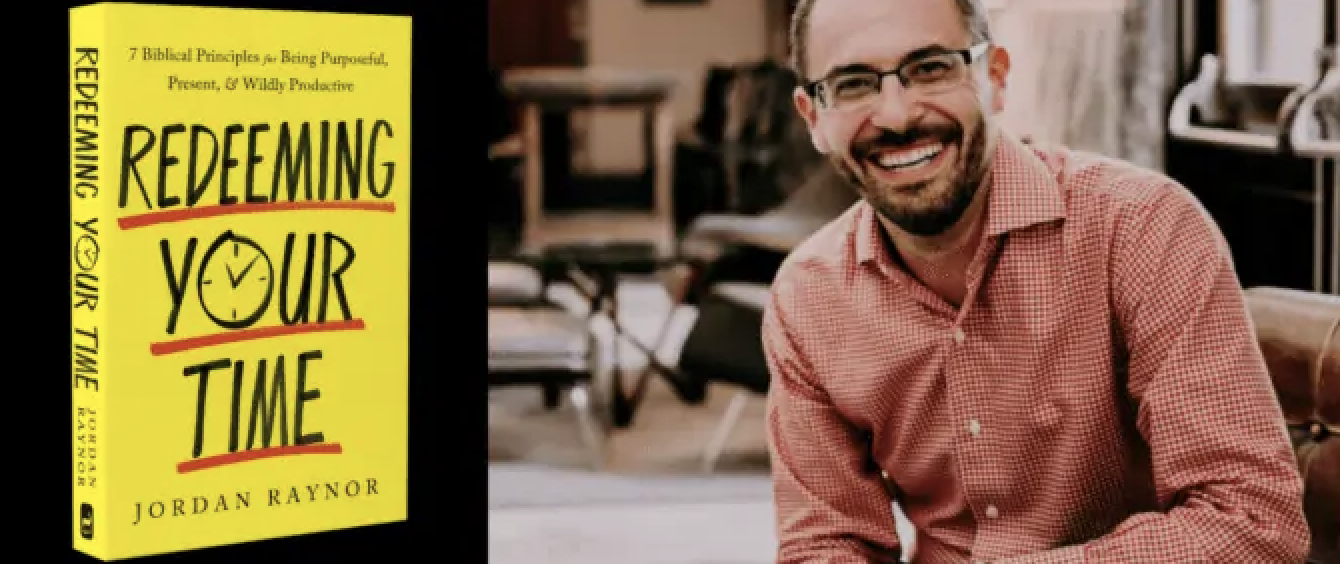





Episode 244 – Developing Holy Ambition With Chip Ingram

Do you ever feel a tension between your faith and your ambition?

Entrepreneurs are naturally driven. We want to innovate, change, and improve.

But as Christians, it can be tricky to balance those desires and gifts with our call to be faithful to God’s will. 

So how do we navigate that tension?

Chip Ingram tackles this question on our latest podcast episode. There, he explains the concepts behind his book “Holy Ambition” and helps us understand how we can faithfully pursue our callings in a way that honors God.


All opinions expressed on this podcast, including the team and guests, are solely their opinions. Host and guests may maintain positions in the companies and securities discussed. This podcast is for informational purposes only and should not be relied upon as specific advice for any individual or organization.


Episode Transcript


Transcription is done by an AI software. While technology is an incredible tool to automate this process, there will be misspellings and typos that might accompany it. Please keep that in mind as you work through it.

Rusty Rueff: Hey there and welcome back to the Faith Driven Entrepreneur podcast. Today, we’re going to tackle a pressing question for any founder or any leader. How do we handle ambition? You know, as entrepreneurs, we’re naturally driven. We want to do big things and seek excellence in all of our work. But sometimes those desires can cause us to enter into a place of willfulness instead of faithfulness. We start striving for greatness instead of operating from a place of peace or knowing that God’s in control. So how do we balance our God given desire and drive without grasping for that control? Well, today’s guest, Chip Ingram, helps us wrestle through these questions by talking about the principles of his book, Holy Ambition Turning God Shaped Dreams Into Reality. Chip is a very experienced pastor and a longtime friend of the show who always provides us with great insights. So let’s dive in.

Henry Kaestner: Welcome back to the Faith Driven Entrepreneur podcast. We are back in our virtual studios together. I’ve got Rusty. I’ve got William. Gentlemen, good morning.

Rusty Rueff: Good morning.

William Norvell: Good morning, indeed.

Henry Kaestner: I met a guy Rusty, on Friday night who had a Purdue sweatshirt on at the New Canaan Society annual retreat. And I said, I want you to know that everybody everybody I’ve met from Purdue is an awesome person. And maybe I feel that way about Baylor, too. There are probably some other institutions, but I thought of you. Just want you to know that I wanted to say that maybe I should have said that before we went on air. I’m not so sure that our audience cares, but here’s what the audience is going to care about. We got Chip Ingram back.

William Norvell: So it’s always fun.

Henry Kaestner: And which is always fun. And if you’ve been listening to the program before, you’ll be familiar with Chip. Chip has been very, very generous with his time and has spent a lot of time with us. He has spoken at our events. He’s been on the podcast several times. He is a great mentor and friend to me. I remember meeting him about 12 years ago or talking about reference and things with regards to generosity, and then his work came out in Romans 12. And just what does it really look like to be a Romans 12 type of disciple? That was formative in my life. He has heard about the different ministries we’ve been involved with over the years, and he says, please, please, please tell me that it’s hard. It’s going to be about discipleship. And that rings in my mind and has for the last decade. And so I’m grateful for that. But he’s back today to talk about something were probably overdue. I mean, if we had 250 episodes and this is the first time we’ve really kind of like dived into ambition. Shame on us, right? because

Rusty Rueff: Shame on us for not having enough ambition to do the right thing.

Henry Kaestner: Yes.

Henry Kaestner: Yes, yes. What were we thinking? So. And Chip wrote the book on Holy Ambition. It’s been formative in my life, has been formative in the lives of several of the companies we’ve invested in, has given me a language to ask the companies that we had invested in at Sovereign’s Capital about how would you talk about your holy ambition? It gets at our why there’s so much there. Chip Welcome back to the program.

Chip Ingram: Henry and my fellow brothers here, it’s good to see you guys.

Henry Kaestner: It’s awesome to have you. And we’re going to talk about ambition. Ambition is something I think that we all struggle with. And if I’m and I’ve said this before publicly and it’s clearly not scientific, I say that the majority of Christian businesses that I come across are not as good as their secular counterpart. And people look at me like, What do you mean? Which of course also means that 20% of businesses, I think, have a distinct advantage over their secular counterparts. And we’ll get into that and hopefully you’ll find yourself after listening to this in that latter camp. But I say that in my experience, some number of Christ following businesses cannot reconcile their ambition and find their desire to grow their business, potentially at odds with their Christian faith, because they see these competing things coming in about money and the trappings of success and metrics. And they say, Oh my gosh, no, no, no, no. My real business, my life really should be about just leaving work at 5:00 and volunteering at Young Life. But that kind of cognitive, spiritual dissonance reverberates throughout their business because they’re not really comfortable talking about ambition that God has given to all of us. And since they’re not comfortable talking about it, people pick up on that and it becomes kind of a disadvantage. But an Elon Musk or Mark Zuckerberg have no problem talking about their ambition and their singularity of mission. But Christ follower struggle with that is that your experience Chip?

Chip Ingram: Yeah, I often say I don’t think many Christians have enough ambition, you know, but there’s a good kind of ambition and there’s a not so good by way of definition. You know, this is a profound book that I use occasionally called a dictionary. And ambition is a strong desire to achieve something, typically requiring determination and hard work. And then, you know, the second definition is the desire and determination to achieve success, fame, power and wealth. And so you can see why Christians, when they see that definition and I would say a holy ambition is a passionate pursuit of fulfilling a clearly God directed agenda that he’s uniquely prepared you for. And so when the disciples on the very last night with Jesus were arguing, Are you ready for this? Yeah, For three years they’ve heard all the sermons, seen a few people raised from the dead. I mean, they’ve seen it all and they’re arguing about what? Who’s the greatest? And Jesus does not say, Oh, my gosh, what a failure, you bums. What’s with you guys? You want to be great? He said that desire. I think what he says sort of implicitly is God given. Now, let me tell you, there’s a whole different way to get there. You want to be great, be a servant. You want to be number one, be the last. In other words, align your ambition around taking how I made you the season that you’re in, the gifts that you have, the wounds that you possess, and align that around a God directed agenda. That brings honor to me in many times that’s running a absolutely great business where employees flourish, where products are great, where God gets glory, because what you do and why you do it is so well done and helped so many people. I think that secular sort of spiritual dichotomy is where we really lose sight of things. Does that make sense?

Henry Kaestner: It does make sense. And I find myself in my life that I’ve struggled with this and I’d like to just kind of level set it a little bit as I get ready, because Rusty, William and I, we had talked about this a bit. I know that they’ve got some thoughts about it, too. I have struggled with at various times ambition, because for me, wrapped up in my own personal story is this desire to find peace, joy and happiness and success. And they’re all conflated in my mind and Chip, during when I was a secular person working on Wall Street, I was looking for success in the trappings of what I thought that would deliver me in terms of the sense of peace and joy. And I was looking for those in all the wrong places. Proverbial God shaped hole came to faith at 28. But when I came to faith at 28, I shifted my ambition and the way I thought about pursuing things a bit to another extreme maybe, and you can maybe you can help me to reconcile these things, but it was more along the lines of, okay, so I’m a Christian now. I’m living for a different purpose and a different reason, but I need to take up my cross and I need to follow God. I need to kind of deny myself and deny and kind of repress this kind of earthly ambition to just be what I thought was successful. And we could talk maybe about the definition of success, maybe in here somewhere, too. But what end up happened is for a long time, I kind of tried to repress and kind of dying itself, but it’s only recently that I’ve kind of embraced this vision or embraced this thing about, Actually, no, I do what I do and I have this unapologetic ambition. I want to know God. I know that may sound overly Calvinist by sentence, but I want to know God and enjoy him forever. And this whole thing that God and plan to me at the very beginning. That type of ambition of knowing God and then as a result of that, enjoying him forever. That’s not necessarily just a dying to self, which doesn’t mean that the Scripture is wrong or anything like that. It’s just in the entire narrative actually lean into that there is an ambition and a delivery and a promise that that ambition will be fulfilled. And now I’m on a different type of pursuit. Does any of that make sense?

William Norvell: Henry, I want to jump in for one second, because I want you to answer this and I want to Chip and answer both. You said earlier a phrase that we kind of ran over. Sometimes you find that secular counterparts are better, right? I want to define that a little bit. And then I want Chip to define it like, well, what does that mean? Is that profit, is it culture and how they treat their customers? Is is it everything or is it just profits? Right.

Henry Kaestner: So that’s a great question. And then part of that comes down to, well, what’s the definition of success? And so in this, I’d say on one hand, it’s twofold. One hand is success in the world’s eyes, which has some conformed to the patterns of the world mashed up in that. So we’ve got to be really careful, but it’s in the achievement of the mission. So if a secular entrepreneur says we’re going to go ahead and we’re going to seize the opportunity in this market, we’re going to deliver a product and service to this group of people. And this is why. But it’s not a godly ambition. It’s their ability to achieve that. But the singularity of mission and purpose without any type of the dissonance that might otherwise come from a Christians who’s trying to reconcile with, is my ambition good or is it bad that person can achieve that unless they then bridge the gap and come to understand a holy ambition that delivers this kind of a power that Elon Musk or Mark Zuckerberg can’t touch right now? So that’s kind of one of the thing. But Chip, just riff on that a little bit.

Chip Ingram: Yeah a couple things I think that bring clarity and where, you know, we’re talking about fruit, but we’re also we kind of have apples and oranges being entertained. Ambition has at least two big issues from God’s perspective. The Apostle Paul would say, you know, I make it my ambition to be pleasing to him. So there’s a vertical God’s work in us and there’s a horizontal God work through us. And so I think for every believer, our personal ambition is to know him, to enjoy him. You know, it’s Philippians three. I consider all things lost compared to the surpassing value. And the word for knowing is experientially, intimately knowing the power of his resurrection in my everyday life and even in my suffering and in my struggle. But then in Ephesians 2:10, you know, we all have a general purpose for our life. You know, the great Commission love our neighbor as ourself. But in Ephesians 2:10, after it talks about our salvation by grace through faith, it says for you are his workmanship. It’s we get our word poem from it or masterpiece, or You are my precious possession that I’ve created, created unto a good work that God prepared for you from the foundations of the earth. And so I think ambition is about, yes, vertically. I want to know God. I want to love my neighbor as myself. And then my horizontal ambition is, what do you want to do through my life and not split it? My life, Not just my work, you know, my family. What do you want to do through my life? What are the passions and the pursuits? My wife’s holy ambition, out of a painful path, was to raise kids that would really love God and propel them, help them discover their gifts and make a huge difference. And she’s fulfilled it. And it’s been very private. My holy ambition has been a calling from God that the short version is to actually help Christians live like Christians. So lost people. What have a credible thing to say? There is a difference and that those of us that are Christians wouldn’t go through just religious motions. And I think that, you know, this whole book is geared around a business person. You know, the subtitle of the book is How Do You Turn God Shaped Dreams into Reality? I think God birthed dreams or passions, and it can be Faith Driven Entrepreneur It can be a way to raise kids. It can be, you know, launching orphanages because you were an orphan like some of that I work with. There’s certain passions. It can be developing a company that produces this because I know another fellow whose child died of, oh, what’s it called when they die in the crib and they can’t figure out why? He ended up creating the monitor that everyone uses because if he could have heard his baby grasping, that baby would not have died. And so God takes our wounds, our backgrounds, our gifts, our talents. Our relationships. And as we’re walking in the vertical and in what you are doing with community is so important. You never discover your calling alone. And it’s in those relationships God starts to birth sort of this agenda. This ambition, I think, is a part of the big picture. And a lot of that has to do, especially with entrepreneurs. He’s going to do it. Yes. In your family, in your life, this can be through your work.

William Norvell: And this is making me think. I want to throw in one of my favorite commentaries, Clay Christensen, which probably a lot of people know. Here are this amazing article. And I sent all kinds of people taught how to measure life. He ended up writing a book about it, too, but I think the six page article gets the gist of it. And I’m wondering if this applies to entrepreneurship or if it’s a little different because this nuance, some of the biggest points he makes are he joined. I forgot it was Bain or BCG, one of the big consulting firms, And he said, I sat down with Mr. Bain. When I joined, I said, Hey, I want to be super clear. I love Jesus and Sundays for the Lord, so don’t expect me here. And second. I love my family. I’ve got four kids. I’m not going to be here on Saturday. That’s when I spend time with my family. And then he has this great line, he says, however. I was under no illusion that I was going to be the CEO of Bain. I thought I could have a productive career there, but there was someone who was going to outwork me, but I was totally comfortable with that sacrifice. And I feel like that’s a little of bit nuance sometimes. And I’m I love a story, right? Because it’s like, yeah, he was ambitious, but he put limits on it because of his faith, but God still rewarded it. Pastor us.

Chip Ingram: You know, the thing you’re touching on is one is there is certainly a high correlation between our effort, our work and outcomes, but it’s not a 1 to 1. And God has a different economy. And there’s a thing that he values more than all of our hard work or religious activity or even honoring. You know, it’s like without faith, it’s impossible to please him. What God longs for us to do is to trust him. And what’s that look like in different seasons of your life? For an entrepreneur, often trusting him is. I know some of my competitors are going at it seven days, 16 hours a day, and there may be what I kind of look at the big charts. They may be up into the right a little faster than I am, but I’m going to trust that as my priorities are what God wants them to be, because life is more than just about your company. It’s holistic. We all know lots of people that have gotten to the top of whatever mountain whose marriages, children. It’s a crash. It’s a burn. So, you know, I think it’s working hard, trusting God, but also with open hands, realizing outcomes belong to him. At the end of the day, there’s not always a 1 to 1 correlation that you do X, Y, and Z, and it equals, you know, X to the third tower. You know, I think for most entrepreneurs, if you’re really an entrepreneur, the hardest thing is, you know, this phrase that you all use in your book, willfulness versus faithfulness, I think it’s they look a lot alike of getting up in the morning.

Henry Kaestner: You said your book, did you say your book?

Chip Ingram: It’s your book.

Henry Kaestner: Rusty. What do you think?

Rusty Rueff: So I’m fascinated with this a little bit, what William is talking about with Clayton and then Chip, what you just said. But, you know, you say in your book you don’t get to holy ambition just by showing up. There are conditions like there are six conditions that are really important. And they they hit me, you know, dislocated heart, broken spirit, radical faith, strategic plan, personal commitment, courageous soul. Right. That these are conditions. The one that really strikes me is the one that’s in the middle. This strategic plan like that, you have to have a strategic plan to get from here to a holy ambition, which actually should resonate with all of our listeners to certain resonates with me. If you have an entrepreneurial spirit because you know that you can’t just wake up one day and say, Oh, there’s a problem to be solved now I’m just going to go do it. I have to have a plan. So can you unpack the strategic plan part of that a little bit?

Chip Ingram: Before I go to strategic plan, let me pause and go back one, because I think behind this is it willfulness? What part is faith? What part is work? This is the story of a businessman who changed the course of history. And I think we start with what dislocates your heart. I mean, what do you feel so passionate you have to do? But you gave those conditions. The second one is a broken spirit. And the reason I want to touch on that is because before you come up with the strategic plan, we’ve all developed great strategic plans with a real group of smart people and we’re going to make this happen. And a broken spirit is a season of prayer where you humble yourself before God and you realize, I can’t do this. It’s this amazing, it’s one of the most amazing prayers in all of scripture. And it’s out of that brokenness, out of that. This is so big, I can’t do it. And then he takes this radical step of faith to get in the game. Then it’s okay. Then he gets out of white board and gets in a private room and he evaluates what’s the depth of the problem. And then he develops that strategic plan that makes all the difference in the world.

Rusty Rueff: Just for those who haven’t read the book you’re talking about. Nehemiah Yes, that’s right. Yes. Nehemiah, the great builder, the great entrepreneur in some ways, right. You know, he’s a cup bearer that goes, hey, there’s a problem to be solved, and I think I should go do it.

Chip Ingram: Exactly.

Henry Kaestner: And so my favorite part about Nehemiah, sorry to interject. Now, part of that, Nehemiah, is the thing that I overlook so much as an entrepreneur myself is that when Artaxerxes is there, he sees Nehemiah all kind of stressed out about the fact his hometowns in shambles and he says, What do you want me to do about it? It says, Nehemiah prayed, which probably wasn’t, Hey, Artaxerxes, hang on, I’m going to go over to my prayer room or I’ll do that my devotions tomorrow morning. I’ll pray like, you know, like right then, like it probably a quick prayer. Like Heavenly Father, speak through me because he king just asked me a really big question. Maybe you’re. Words. Right. And I think that there’s so much of an opportunity for me to incorporate that more in my life. That kind of like constant real time prayer.

Chip Ingram: And I would add if I can, when the book opens, when he hears about the devastating situation, it says, I sat down. He actually stopped, hard for entrepreneurs. He emote. He actually weeps. And if you check it, you find out there’s about a four month period that he gets some other people and he repents and he weeps. Talk about, you know, revivals and how they actually occur. It wasn’t a smart guy who had a big thunder called a king who came up with a great plan, who said, I’m really going to make something happen. It was a guy in the right place who had a great thunder who realized this is so over my head. Only God can do this, so I’m going to deal with my junk. And He repents of his sin and the past sins and other people’s sins. And then by the time he gets to the end of the prayer, he goes, You know what? And this is a key. This is your people and your plan and your agenda and your city. In other words, what you realize is, is this isn’t about me, so I’m going to risk my life. And then that’s why little short prayers make a difference. When you spend four months fasting, praying, emoting in community to say, I will do whatever you want me to do, then you bring the brains in and develop a strategic plan. Because now God can show you what he wants you to do.

Rusty Rueff: All right. So I’m I want to ask one more question. We’ll turn it over to Henry William. So let’s say we’re on the path to holy ambition, right? And we are working in ourselves and through the conditions and making sure that we’ve surrendered it all and we’re trying to get there. How do we evaluate? And it’s a little bit what Henry said at the beginning of the conversation, How do we evaluate the difference between what is my ambition and what is holy ambition? Because. That’s not always easy to discern, right? You know, that’s the voice inside of us, the voice around us, all those things. How do I […] that out?

Chip Ingram: One is, I think there’s a personal aspect where I’m commanded for me. Watch over your heart with all diligence for from it flow the issues of life. It’s me meeting with God and asking that question. I think second, it’s why you guys do groups. We all lie to ourselves and we lie to other people. And if you have close knit people who will really tell you the truth, this is what I want to do. This is why I do it. And someone who really cares looks in you goes. This doesn’t sound like it’s really all about God to me. And then I think the third thing is then how do you respond? Because this always happens when you have a holy ambition. As far as you know, this is really for God. It’s his agenda. You’re making great sacrifice and then all hell breaks loose or it looks like failure. If it’s all about you, it crushes you. If it’s really his. I actually had an interesting conversation with Henry at a moment when one of the stock markets just imploded here in the last several months and we were having coffee and I asked him, well, how are you doing? And if you don’t mind me sharing this.

Henry Kaestner: Bring it.

Chip Ingram: Yeah. He said, Well, I don’t remember the exact numbers, but, you know, well, if the stock’s at 140 and it’s down to 25. If that doesn’t, you know Bobbie too much, I’m doing great. And then his next comment and his countenance didn’t change. And it was one of those where, you know something, over time it was like, well, that certainly might limit what I thought I could do and some things I could find and some of my ideas. And very calmly, if God wants me to do some of those things, I’m figuring the stock will go up or he’s going to bring it from someplace else. But it wasn’t like, Oh, my, you know, after all I’ve done for God and now he drops my stock, How could God do that? You know, I think how we respond to the disappointments, opposition barriers and struggles. And by the way, I think, you know, it’s very interesting. And Psalm I think it’s Psalm 105: 19 it says until the time that God fulfilled his dreams to Joseph, the word of the Lord tested him. And part of this journey that we have to remember is the big agenda is not that you fulfill your holy ambition. That’s the second big agenda. The big agenda, God’s big agenda is to make you like his son. And he, in his kindness and love and mercy, often brings about challenges, difficulties, pain, suffering, injustice, Betrayal allows those things not causes in a way to just keep sharpening you to trust him. And if you look at anything that’s been very significant, whether that’s in the secular world or we might call it ministry or I think even better, those of us that feel like there’s not a big difference, it is in the perseverance and the trusting of God over time and things happen where you see the outcome and you recognize I couldn’t have worked any harder, but in my wildest dreams, I could have never made this happen. And part of this, you know, Rusty, you know, I’m hearing myself talk, thinking there’s some mystery to how God’s doing this. And there’s some, you know, I don’t know really, you know, my heart is deceitful. I still lie to myself. So I think it’s a bit of.

Rusty Rueff: You mean there’s no there’s no algorithm.

Henry Kaestner: Chip, one thing on that just struck a chord is it’s Proverbs 16:2 all of a man’s ways impaired him, but his motives are weighted by the Lord. And just like am I lying to myself, ostensibly, we’re running faith driven entrepreneur to honor God and maybe a selfish part because I want to know God more fully. And I get a chance to do that through this program. And what we do at faith drivn and enjoy it forever. And yet Proverbs 16 two continues to come back to convict, not haunt me, but maybe convict me. I think that part of your answer is what you said before is getting together in community people and you just don’t stand a chance to be able to figure this out on your own. It has to be in community.

Chip Ingram: Well, ten years ago and this is not a pitch or a commercial, but just real quickly, a little over ten years ago, I found myself in an environment with a bunch of high capacity leaders. And over time, we developed a thing called prime movers to help high capacity leaders discover their holy ambition. We did it in a facilitated manner. We never had more than five or six people, and they all had affinity, you know, they all were very successful or wealthy or whatever. So it was a time where they could be honest with one another because, you know, they didn’t you know, you didn’t work for them or they couldn’t disinherit you. And everyone had a lot around the table. And we we what we found was it was in that environment. Now, we’ve had well over 500 people go through that in a decade and here in places around the world. And it’s in the interaction of that where people speaking the truth in love in a safe environment that I think has at times challenged them to, you know, wait a second. You know, when we were talking about business, you wanted franchises all over America and we’re talking about God. You want to these three little things or the flip side, it’s been, you know, people being able to be honest where it’s safe. I think that answers your question maybe as much or more than anything. Rusty, how do you really know? As I was in a meeting last weekend and we’re in the midst of making some really, really big decisions. And, you know, when you’re the point person of an organization, and especially most entrepreneurs are founders, which I am as well. And I remember going into that and it was like I had prayed we’d done all this stuff, and I went into it realizing. I think this group is going to tell me what the will of God is. And that’s a bit scary. You know, here’s option A, here’s option B, here’s my personal processing. What do you all think? And I had a, you know, left to me, I think I would do this. And then the very next comment was by someone I really love who’s really smart, who really cares about me. I understand. And it was I totally disagree with that which started, I think at our board level was the most and we’re very open. One of the most truth and love grace oriented conversations all around. And I think eight people walked out of a room all looking over their shoulder going. I don’t know that we would have thought. That is what we would do. And eight people were completely aligned, absolutely clear. This is what God wants us to do. But they came with this palms up, openness and the freedom. I mean, that guy I actually when I got done, I said, Guys, can I pause? Because you just as a board, this is one of the healthiest board meetings I’ve ever been to my life. And I turned to the guy who took me on because, you know, you have to remember, if you’re the entrepreneur and the founder, people are always a little fearful of, you know, can I really? We all tell them I’m open. You can say this. You can say that. How we respond when they say things like that is what either creates a culture or kills it. So anyway, I think there’s something to this as entrepreneurs are listening to us right now, you know, since you guys might not say this, let me say it. If you’ve never done the eight week foundation or get with a group of other guys and all you want to do is listen to podcasts to get you revved up and get you inspired and and oh, this really neat speaker, you know, like someone like really famous or really great business person. I got two good ideas from him and I’m going to do my thing. I’m just telling you, you are missing it, missing it, missing it, and after that you’re missing it. If you don’t get with other people, you may be successful and deluded and even say with all your heart and believe it that you’re doing what you’re doing for God and you will wake up in ten years and you will just wish you could turn back the clock and say, Why didn’t I really do life with people that I would be really honest with that would really speak into my life that I would listen to because. No one outgrows that.

William Norvell: Amen so good. And so we’re going to move towards our last question here. But when we have a pastor on, you know, we want to give you a full 5 to 7 minute pastoral minutes here. Usually we give people like 30 seconds, but we feel like there might be something that comes up here that lasts for a little longer. So, as you know, we always love to ask at the end, you know, what is God teaching us? What is God teaching you specifically from his word and from the Scripture? And we like to bring it back to his word. But you’ve done numerous times through this, but anything specific that you think he’s bringing to light in your world today?

Chip Ingram: Very specific, I think. You know, I’ve had my holy ambition since it happened in a very unique way in 1999 at a retreat. And it was very clear the most mystical experience I’ve ever had with the Lord. And although I had lots of great Pentecostal and charismatic brothers that I work with here and around the world, that’s not my tradition. So it was so bizarre and it was that Chip. I want you to be a catalyst to transform how America thinks about God. Pastors think about preaching, churches think about the community. And every day believers live out their faith at home and at work. What saved me as Catholics, you don’t have to be big, you do not have to be famous. High view of God. Pastors teaching through God’s Word in relevant ways. Churches not building their kingdom. And partnering with churches to transform communities and everyday believers living out their faith. Well, after that shocking, I realized there’s always drift. And I started to look at that and I realized, you know, I’ve done some things to give people a high view of God and teaching. And, you know, after reading Tozer and J I Packer, you know, wrote a book on the real God. So but then it was like Chip, you know, it’s not about just doing a thing. What are you doing constantly to give people an accurate, clear picture? It’s the greatest need in the world. And, you know, I was studying the life of Jesus the last two years in a bit of a fresh way. And I wanted to go from the moment he was baptized into the moment he ascended. I wanted to mentally walk through. Where is he? How long was he there? What did he say? So that I could follow his path. And what did he ask the disciples to do? And then what I realized, what I started studying was there’s a Jesus of the Gospels and obviously the same Jesus, but there’s a Jesus of the Epistles and Jesus of the Gospels is the arc, the narrative, His teaching and what he did, the Jesus and the Epistles are describing. This is who He was. This is what He accomplished. And so in Colossians one, he is the image of the invisible God, the first born of all creation. Everything was made through him, you know, heaven and earth, visible, invisible Thrones, dominions, powers. He sustains all things. He’s the head of the church, Philippians two. He’s the Jesus who descended into greatness, became a bond servant, made himself nothing, and God exalted Him, king of kings. And then in Hebrews one, he’s the final prophet. God has spoken in many ways, in the verse ways through prophets. But in this last day he has spoken through his son. And then in Revelation one you have he is the returning judge. You know, his eyes are a flame, his feet of bronze. There’s a robe that goes to his feet. He’s the high priest is the king. He’s coming back, is going to make all things right. And I began to think that faith is not do I need more faith? According to Jesus, I’ll have the faith of a mustard seed, I can say to that mountain. And I think what he was saying is it’s the object of your faith. When you clearly see Jesus and Jesus as you’ve seen me, you’ve seen the Father. John one says, He Jesus explained to him, We get a word exegete. He exegeted God. And so the Jesus of the Epistles gives us this picture of this sovereign almighty creator. King, this priest who comes in humility and says, Follow me and descend into greatness, that God will exalt you. And he is the final message. He is the actual revelation of God. And here he is now appearing to John at a time of the greatest persecution in the history of the church and saying, I will make all things right. Justice will come. You have hope. And by the way, all the injustice, all the things you see, the corruption, the things that burn your heart, I will bring about what is fair and right once and for all. And here’s the future. And so, yes, I’ve been studying the Jesus of the Epistles to get a clear picture of what God is really like. And what I realize is it’s a lot easier to trust someone who spoke in the world came into existence. It’s easier to trust the one that looks at all the nations like a small drop of on the side of a bucket. It’s with all the devastation and earthquakes and sexual slavery and corruption. Yes, we all make a difference where we are each and every day. But it’s never going to be right until he. Makes it right. And I can trust a sovereign, all knowing, all powerful, compassionate God in the midst of time where a lot of it doesn’t make sense. And I can anchor my hope in who he is. And I don’t have to be fearful about my grandkids and the world they’re growing up in. I can help them be salt and light and help them know it’s a challenging world and a falling world. And we’re here to make a difference. So that’s what I’ve been studying, and it’s been helping me a lot because I think there’s a lot right now that challenges our faith and really, I think, causes those who don’t know the scriptures and don’t know who God is. I think a lot of the consumer and I’m not talking about even prosperity gospel, I think the level of consumer orientation, especially among Western or American Christians, is so in the air. And so in the culture, we have people deeply disillusioned because I did X, Y, and Z for you, God. And a drunk driver hit my daughter. Or my wife got cancer. Or I gave away this money and my company went belly up five years later. And it’s this anger at God as though somehow, some way, the American dream of you making my life work out the way I think is really your agenda. And I think a lot of people between that and a very faulty epistemology, that how I view and feel things is how I evaluate. Truth has a lot of Christians deconstructing their faith and their lives. And that’s a whole nother topic we might talk about sometime. Anyway, that’s more than 7 minutes. Probably. So I’m sorry.

Henry Kaestner: No, it wasn’t. It was actually it was not 7 minutes. It was a great blessing to us. And Chip, I’m grateful for your friendship, your partnership with the movement, the book, Holy Ambition. Check out any Chip’s books, a common thread. We’re talking about this a little bit before we went on the air. A common thread. The Chip’s work that I’ve picked out is his quest to help people to have a right understanding of God. And at a time when there are revivals that a lot of people are talking about, how do I have an encounter with God? It seems to me that there are two things that I hope you picked up in today’s episode. One is just knowing God in His Holiness and how much He loves us from one hand and on the other hand is understood how far we have fallen from his glory and how sinful we are. But when we confess our sin to one another, hopefully you heard the theme about community groups in here, but when we do confess our sin to one another, we endevour, we much closer to being holy and being able to touch the mountain with clear hands and a pure heart that we never get to [….] where we want, that he might use us magnificently. And I’m grateful for Chip and his work. Check out any book from Chip Ingram and you’ll see elements of that. He’s got great work of generosity, great work on now, as you know, ambition and a whole bunch other things. Chip, we’re looking forward to having you back. Thank you for being with us.

Chip Ingram: Thanks, Henry. William Rusty. Enjoy.

Mental Wellness: The Unspoken Pandemic

— by William Norvell

“Our soul is like an inner stream of water, which gives strength, direction, and harmony to every other element of our life.”

— Dallas Willard, Renovation of the Heart

Let’s Define Mental Wellness 

According to the Global Wellness Institute, when we talk about mental wellness, we are focusing not just on our mental or cognitive functioning but also on our emotions; our social relationships; our ability to function in daily life; and even our spiritual, religious, and/or existential state. 

One of the most misunderstood points regarding mental wellness is that the absence of mental illness does not equate to the presence of mental wellness. Simply because someone is not diagnosed with a specific condition does not mean they exhibit mental wellness. Similarly, the absence of disease in the body does not equate to a healthy body. 

It’s hard to open up a newspaper or turn on your phone without seeing a report on the mental-illness crisis in the world, but I think that is only part of the problem, and we need to focus on the bigger mental-wellness issue. 

We need to find resources for those in crisis, yes, but we also need to focus on everyone up and down the spectrum—from crisis to health. This is mainly because, for most people, life is lived on a continuum—moving from crisis to health and every spot in between. 

As Christians, we are uniquely equipped to understand the human condition because Jesus is the Author of that condition. For this reason, I think the pursuit of mental-wellness solutions is a call that all Christians should answer loudly, as it will be the defining pandemic of our time. 

People are often scared to admit that we are in the midst of a mental wellness pandemic. Why don’t we admit it? It is partly because of fear and partly because of misunderstanding and stigma. I have been calling it the Unspoken Pandemic and have recently dedicated most of my waking hours to working on a solution.  

We must strive to help people understand that it’s who they become that matters, not what they do. We are all being formed—intentionally or unintentionally—each moment of each day, but we must understand that in order to flourish and bring flourishing to the communities to which we are called. 

The Greatest Commandment Commands a Pursuit of Mental Wellness 

In the Gospel of Matthew, the responsibility of the Christian life is summed up beautifully by none other than Jesus:  

“Teacher, which is the greatest commandment in the Law?” Jesus replied: “‘Love the Lord your God with all your heart and with all your soul and with all your mind.’ This is the first and greatest commandment. And the second is like it: ‘Love your neighbor as yourself.’ All the Law and the Prophets hang on these two commandments.” – Matthew 22:36-40 

I have heard this command so many times in so many situations, but it was not until recently that I read this in light of the mental wellness pandemic. When you really look deeply into this command, it is a command to pursue mental wellness and then love God and others out of that place of wellness. 

If we are lacking mental wellness, how could we possibly attempt to live out this command? In my own life, I have never once thought that my ability to love God and others is correlated to my mental wellness. Increasingly, I’m trying to see that everything should be an instrument to make this possibility a reality… and then love can flow freely. 

Contributing Factors to the Crisis 

While there are many contributing factors to this crisis, I do see a few factors rise above the rest. 

Home/Work Life Merged

People have historically been able to easily separate their home lives from their work lives and look to integrate them into a holistic vision of what they are called to. However, with the advances of technology and the “always on” culture, holistic calling no longer exists, and people have no idea how to integrate (or separate) their home/work lives.  

Community Dissipated

Prior to the last few decades, people found themselves part of communities that gave them belonging and safe places to discuss and process life. Neighbors, shop owners, local run-ins—these opportunities have all shrunk, leading to a bottling up of emotions and thoughts. Remote work has also caused many professionals to feel disconnected from community. Increasingly, there is not enough time and space to form deep friendships that lead to deep soul-changing conversations.   

Note, meaningful communities are spaces I feel that Christians take for granted. Many of us do have a small group or community group or whatever your church calls it. Think of the gift of having 10–15 decently well-intentioned folks come to your house every week to ask how your life is and to offer prayer and support in many ways. Non-Christians routinely have nothing that resembles this construct and are struggling even more than we know. 

  Need community? Join a Faith Driven Entrepreneur group and connect with like-minded professionals.

Need community? Join a Faith Driven Entrepreneur group and connect with like-minded professionals.

Stigma of Mental Problems

While sigmas related to mental health have started to change during the pandemic, we still have a long way to go until it’s “ok to not be ok.” Additionally, even though this has changed a bit, people are not comfortable in this space, and others do not know how to engage when people share uncomfortable details. 

The “Aiight” Gospel

I first heard this in college and have never forgotten it. The majority of people in this world, when asked how they are doing, especially from a mental and/or spiritual perspective, say they are just doing “aiight” (slang for “all right” when you are from Alabama). It takes a really strong person to push hard to get to the root of issues when they continually get this response.

Hurry

Potentially the most significant factor is the fact that we simply cannot slow down our lives anymore. Does anyone remember boredom—those times when you literally had nothing to do, maybe for an hour, or a few minutes, but sometimes for ENTIRE DAYS! You’d wake up, nothing was on the agenda, and you would just figure the day out—create games, reflect on life, pray, let learnings set in, and generally live in freedom for many moments. 

These factors above (along with many others) have created an atmosphere that is not conducive to mental wellness. It will take proactive, not reactive, changes to alter the course of mental wellness in the world. 

Employers Bear Some Responsibility for Mental Wellness

98% of CEOs in a recent Deloitte study agreed that employee mental health and well-being will be a priority well after the pandemic ends. That is obviously a staggering statistic, and it points to the fact that employers are realizing that employee well-being is no longer a benefit but a necessity. 

Whether it is a good thing or not, people are finding more and more of their life’s mission at the workplace. Younger workers are increasingly seeking belonging and a sense of mission with each and every job that they take, which ups the stakes on what employers need to provide to motivate employees. 

The trappings of the modern-day office—full of snacks, fun, and SWAG—are simply not enough anymore.   

In response to this crisis, I and a few others set out to study and figure out a potential solution to this crisis – a crisis that is admittedly not leaving any time soon. After many months, we decided the answer harkens back to the greatest commandment—we need to deeply understand our souls so that we can love God, love ourselves, and then love others. 

SoulCare as a Solution to the Current Mental Wellness Crisis

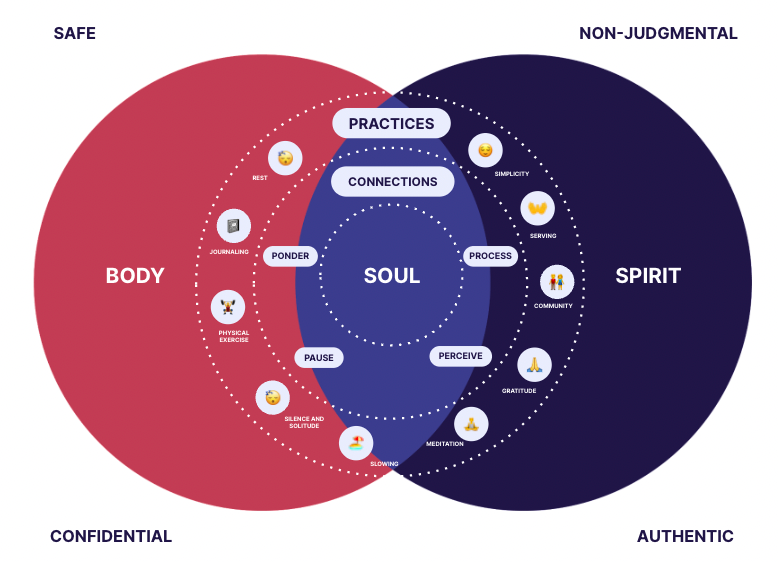
What exactly are we made of, according to the Bible? If you study carefully, it is said that we are each a body (which connects to the material world), a spirit (which connects to the immaterial world), and a soul (which is the integration point between the two, not our silhouettes floating up into the sky like a cartoon). 

The soul is our mind, will, and emotions. It is our personality. It’s the essence of who we are and who we interact with when we speak to each other. Ultimately, it is my (and my co-founder’s) belief that ministering to the soul is the ultimate way to lead people to mental wellness and, therefore, give them the ability to either

  1. Live out the great commandment if they are a Christ follower, or…

  2. Allow them the opportunity to feel there is something greater than themselves that they should seek to understand—ultimately bringing peace to their lives in hopes that they will seek the Truth, of which Jesus is the only ultimate answer.  

It is for this reason that we founded Paraclete, the world’s first SoulCare platform, to aid in helping this crisis come to an end.  

In its simplest form, SoulCare is the practice of Whole Human Integration: integrating life, work, and everything in between. We need to all remember that we are human beings, not human doings. While this is easy to say, it is much more difficult to practice.   

Human Connection as the Backbone of Mental Wellness 

As I have studied the mental wellness pandemic, I have seen so many recent studies that suggest that feeling disconnected from others is as significant a health risk as smoking, excessive alcohol consumption, and a lack of physical activity.  

One of my favorite neuroscientists (perhaps my favorite as the only one I read), Curt Thompson, likes to say that we can only know ourselves in relationship to another human being. I only understand myself as a brother, father, husband, and co-worker by experiencing and seeing how other human beings live these roles out in their lives and by discussing my observations with them.  

In fact, from his book The Anatomy of the Soul … “When a person tells her story and is truly heard and understood, both she and the listener undergo actual changes in their brain circuitry. They feel a greater sense of emotional and relational connection, decreased anxiety, and a greater awareness of and compassion for others’ suffering. Using the language of neuroscience, [a fellow neuroscientist] Dr. Siegel labeled the change ‘increased integration.’” 

Turns out, God created humans to need other humans

It is for this reason that we created SoulCare, the ability to connect with someone trained in integration practices to help people on this journey to wholeness. For it is our sincere hope that all people in this world would have a human to connect with, to listen to their stories, and to approach them with no judgment and only curious, empathetic, and mindful listening. We believe this, alongside some integration practices (i.e., silence, solitude, sacred rest), will make a significant dent in the mental-wellness pandemic that the world is facing today. 

We call this journey the Paraclete Pathway, and you can see below how it attempts to bring wholeness to brokenness. It consists of SoulCare Connections and SoulCare Practices to help individuals live a more integrated life.  

We are facing a pandemic of not only mental illness (which is a severe problem) but also an even bigger one of mental wellness. We can’t simply solve the most immediate, surface-level problems, but we should address the overarching problem, which is a lack of integration in people’s souls. This will predominantly be done through increasing opportunities for human-to-human connection and helping people discover that who they become is all that truly matters, not what they do. 

However, the true secret is that once we understand who we are becoming, we can do things from a renewed vigor that is unmatched, and we can unlock creativity, energy, and solutions that we once only dreamed of. The truly well person—the truly integrated person—is something I hope all people have a chance to uncover this side of heaven. 

Related articles

Episode 243 – Why an Experienced Entrepreneur and CEO Chose to Live at a Sacred Pace with Terry Looper

Have you ever noticed how unhurried Jesus seems to be in the gospels? He always shows up for the people who need him, but he never seems to panic or rush to get there. 

Entrepreneurs can sometimes do the opposite. Even the words we use imply hurry: we sprint. We hustle. We flow. These aren’t inherently bad things, but they can have negative effects on us if they go unchecked.

That’s what happened with today’s guest: Terry Looper. Terry is the Founder and CEO of Texon LP, an energy company with over $6 billion in revenue. He’s also the author of the book, A Sacred Pace which tells the story of how his unchecked ambition led to burnout and how he redirected his life by slowing down and aligning himself with God’s will. 

He joins the show to talk about his book A Sacred Pace, share how entrepreneurs can create better boundaries around their time, and give us a 4-step process we can use to hear from God.  

Make sure to follow the show for more great content from global leaders and give us a rating if you enjoyed the content.


All opinions expressed on this podcast, including the team and guests, are solely their opinions. Host and guests may maintain positions in the companies and securities discussed. This podcast is for informational purposes only and should not be relied upon as specific advice for any individual or organization.


Episode Transcript


Transcription is done by an AI software. While technology is an incredible tool to automate this process, there will be misspellings and typos that might accompany it. Please keep that in mind as you work through it.

Rusty Rueff: Welcome back, everyone, to the Faith Driven Entrepreneur podcast from wherever you find yourself around the globe today. Have you ever noticed how unhurried Jesus seems to be in the Gospels? He always shows up for the people who need him, but he never seems to panic or rush to get there. Well, we entrepreneurs, we have a tendency to do just the opposite. I mean, even the words we use imply hurry. We sprint or we hustle or we flow. Now, these aren’t inherently bad things, but they can have negative effects on us if they go unchecked. And that’s what happened with today’s guest, Terry Looper. Terry is the founder and CEO of Texon L.P., an energy company with over $6 billion in revenue. He’s also the author of a fantastic book, A Sacred Pace, which tells the story of how his unchecked ambition led to burnout and how he redirected his life by slowing down and aligning himself with God’s will. He joins us on the show today to discuss his four steps for hearing God and to talk to us about how we can live at a sacred pace. Let’s get into it.

Henry Kaestner: It is amazing the way that God will use his word and experiences in my life to point me to something that I need to be talking about. If I talk at a conference or on a podcast and today our audience won’t know this, but you all do. I showed up 12 minutes late and just behind I just sloppy. Just if I’m honest, just bad calendar management. Part of it may have something to do with my pace. We’re going to talk about that. But the conversation I had right before, this is a concept of optimal growth rate. And many of us are in Silicon Valley, and there’s this sense of just faster, faster, grow, grow, grow. And it’s the pressure from investors, entrepreneurs is good out there by customers is about size, is about market share. And yet our guest today will tell you that there is a different way to think about the optimal growth rate. What our concept of hurry is. He’ll speak from an experience of being super successful. So we’re not just talking to a hermit. This decided to just kind of like check out of everything and just be contrary to the patterns of the world. And and he’s going to be on his own time. This is a guy who’s been very, very, very successful. But in the process of doing so, he’s also learned some things that I think it would be really helpful for us. And it’s amazing that we’ve had as many episodes of this podcast as we have without having Terry on board. And so, Terry, thank you very, very much for being with us, for being willing to share your life’s work. The book, The Concept of Sacred Pace, just being with us today.

Terry Looper: Great. I look forward to it and I’ll enjoy visiting about even the subjects you’ve already mentioned.

Henry Kaestner: So Terry, you’ve had an experience yourself where everything sort of came crashing down. Yeah. In your book, you describe it as a collision course. Give us a quick summary about what was going on when you decided that you couldn’t live the fast paced life that you’re experiencing.

Terry Looper: Well, if you back up just a little bit, I helped start a company that I was the minority partner of it, and I started getting dizzy and went to the doctor and he said it was stress related and I’d never heard as you get dizzy from being stressed. But nonetheless, I continued to go. I could function. It wasn’t like vertigo or anything, so I could function. It didn’t happen all the time, just when I was extra stressed. And then I got to where I couldn’t make big decisions. And then I got to where it couldn’t even make small decisions. So I started hiding the fact that I couldn’t make decisions from my employees. I was the COO and the minority partner. Well, on a Saturday morning was the collision course you talked about. My wife was home. My two daughters were home. I knew who they were, but my brain shut down and I knew where I was. But it just shut down in a way that it was not going to make any decisions of any sort. And I actually thought I had a nervous breakdown. I didn’t know I didn’t know enough about the medical situation to know. But I found out later I had burned out. But in the middle of that, I asked my wife to help me get to the bedroom and just let me lay down and then pray. And so she did and shut the door. And I prayed and thought I was losing. My most prized possession, unfortunately, was my brain instead of my wife or my kids. Probably if I was real honest with myself. And in the course of that, I finally said to the Lord, Would you take control of my life? I clearly have screwed this up. And so I got on my knees and prayed that, and I didn’t know it for many months later, but I was born again. And that morning, at that moment, and the reason I didn’t know I was born again is I was absolutely convinced I was a Christian. I prayed. I believed in Christ. I believe in the Lord. I truly thought I was a Christian, I was deacon getting ready to be an elder. And so I thought in a whole lot of other people thought I was a Christian. But it turned out I look back now is I had a relationship with him like a six year old does with a Santa Claus. I told him what I wanted and expected him to do it and kind of had it reversed of who was in charge. And then out of that, I did a bunch of therapy to try to find out why I was so blooming driven, falsely driven, crazy driven, and learned all about my childhood and how that had driven me to want to succeed.

Henry Kaestner: Where were you in the business life cycle then?

Terry Looper: I was 36 when I crashed our company. We were in the middle of selling it and part of the reason I crashed right at that moment is I was catching my false God money and we had our company is only about three years old and it was extremely fast paced. And so they crashed for two reasons. One, I thought I was catching my false go, and two, I was a huge people pleaser, just incredible people pleaser.

Henry Kaestner: So presumably as a part of it, what I didn’t expect to talk about is the people pleasing part. I think that a number of people that are listening to this right now can identify with the fact that we’re just going really fast and at risk of burnout.

Terry Looper: Right? Yeah.

Henry Kaestner: Tell me a little bit about the people pleasing part and how they contributed.

Terry Looper: Yeah, I mean, I’m a recovering people pleaser now. Kind of like you would call somebody a recovering alcoholic. I still have a tendency to want to be nice, but now I get the courage to speak the truth and I don’t have any more manipulation going on in my life. Relatively no more hidden agendas, no more. And I had all of that because that’s the only way I could get what I wanted which I had to manipulate to have hidden agendas and wear myself out all the time trying to get where I wanted to get with success at the expense of. And I deluded myself thinking I was nice and it was such a crock and it was very debilitating, very distracting. Huge amount of time, distraction of my mind playing, you know, thinking how can I accomplish what I want without having to really confronting. It was unbelievable.

Henry Kaestner: So we’re going to get some more of the practical implications of the concept of pace and maybe even people pleasing and what our motives are in just a little bit. But you mentioned something there in passing that I think is super, super important because you had this born again moment at age 36, but it sounds like it wasn’t maybe there are some aspects of it being sudden, but you mentioned going through some amount of therapy to help unpack why certain things were happening. Yeah, I don’t think we talk about that enough in this program. Can you explain that a little bit? What happened in the moment when you went to your bedroom and then what happened over this next period of time?

Terry Looper: Well, just in the bedroom. It was just I just like I said, everyone said, you know, please take control. And and and so I got on my knees and prayed that, well, that’s in esence, you know, found out being born again because I finally, finally gave him control of my life, best I knew how. And then I went to therapy and said, you know, burned out and he gave me a book on it. And so I came back and actually I recovered.

Henry Kaestner: What was it like to just I’m sorry to interrupt you. Was it like I say, you go to your room, you have this. You’ve been going so fast, you may or may not have been Think about there was your pastor, was it your wife? Was there something like, oh, my goodness, something’s going on here? How would you go? Cause a lot of people will intellectually here. Yes. It’s important to be able to address the issues of my upbringing, my family of origin, etc. But you made the courageous step of just going ahead and connecting the two. As busy as you were, You decided, I’m going to make a commitment and I’m actually even though I don’t have time for it, I have to. How did you make that jump to where you end up getting the help you needed?

Terry Looper: I’ve learned that pain is one of God’s greatest gifts, and pain is one of my best friends. I am not willing to change almost anything in my life until the pain of it exceeds my perceived pain of change. It’s incredible. The pain of the situation has to get greater than my perceived pain of change because no one likes the change, really. And so that one was the worst one I’ve ever had in my whole life. So I was worried based on what psychologists said, I would burn out again because nothing had changed other than I’d been born again, didn’t even know it. And so I said, No, we’re not doing that again on my watch. He said, Well, no, that’s going to take a hell of a lot of work. I said, Well, I’m in. I am not going through that fear, scared thing again.

Henry Kaestner: Okay. Okay. Thank you. At a similar point in life. I ended up going through two and a half years of therapy, and I identify with that the pain of not going through therapy and the pain of what I was going through led me to choose the lesser of the two pains, which is the interruption to my schedule and whatever reputational risk I had as not working on a trading floor at the time, I needed to take time off to go to my therapist. I thought, Oh my goodness, the most embarrassing thing ever and I’m so glad I did. I presume that you are as well. Thank you for sharing that.

Terry Looper: Oh, huge, huge blessing to me.

Henry Kaestner: It seems that almost all entrepreneurs go through a similar journey at some point. This is a story that many of us are going to be familiar with and where most of our fellow church members struggle with hating their jobs. We struggle with loving them too much.

Terry Looper: Exactly.

Henry Kaestner: And it’s you know, we’re driven by an ambition of growth and scale. And each of these are gifts, but we have to steward them well. How do you now balance that tension between faithfulness and willfulness in your own life?

Terry Looper: Pain.

Henry Kaestner: It’s more pain. Yeah.

Terry Looper: I mean, you know, prayer boundaries have taught myself a lot of boundaries. God’s taught me a lot of boundaries. Faith. But what ultimately gets me to shift more to the faithfulness versus willfulness is when the pain finally gets great enough in certain areas of my life. And then I’ll surrender some more in that area and become more faithful in those particular areas. I’ve still got plenty of areas left in my life where our willfulness wins too often, but it’s just I would say that kind of in a nutshell.

Rusty Rueff: Terry, I just look back, I actually read a sacred pace at the end of 2019, which was sort of the end of the we all went as hard as fast as we could before we came to a grinding halt in 2020. You know, and I remember in your book, you had a number of examples about, you know, missing dinners and missing, you know, special things like sporting events for your kids. And and, you know, I know you’re not alone, right? Because every every one of us have had that happen. And where we felt like we were absent from something that was really important. But it seems like every time there’s a good reason for it, right? It’s like, Well, yeah, but I had to do this. I had to do that. So what do you tell entrepreneurs and even driven leaders, people who are really driven type-A personalities, you know, what do you tell them to help them not tell themselves the excuses and not to have that kind of behavior in the moment and maybe even silence those voices in our head that says, you know, no, this is okay. I’m only missing this one time, help them with that.

Terry Looper: Well, first speak to my own situation. I would have probably gone to my deathbed believing I loved my family and my wife and my children more than success. But as they say, you pay more attention to someone’s actions in their words. And the truth is, the priority of success was greater than my family. That’s just the simple truth. And so there was learning from there. Catch up my jump curves to get from a feeder to interstate highway to get to the sports event. I mean, whatever. But I’ve had to look back with the Lord’s help and therapy. That success was more important to me. I’m not saying that’s the case with all the people. Obviously it’s not. But you need to try to get real honest with yourself, and then from there you can probably improve.

Rusty Rueff: That’s good. You know, I’m going to read a quote from your book, if it’s okay to do that. So you write, I understand now that at the root of my perpetual discontentment was the perpetual fear that I wasn’t good enough, that no one my parents, my business partner, my wife or daughter or anyone else could ever accept me unless I kept achieving and accumulating. I kept achieving and accumulating. One of our 12 marks that we have for Faith driven entrepreneurs is around where we put our identity and that our identity has to be rooted in Christ. Can you talk a little bit about how your relationship with Christ changed this idea that you had to constantly be proving yourself or achieving or accumulating or proving to others to be able to earn their love? Because somewhere in there seems like there was an identity shift that you probably didn’t want to have happened but happened to you.

Terry Looper: They are the best thing that ever happened to me. I mean, it was a great lie. You know, it’s the great lie. My wife loved me and my children. It didn’t have anything to do with achievement. It literally didn’t. My parents probably had some conditional love around achievement, and that’s how I got driven like I did. But, you know, once Christ entered my life, I mean, everything changed. Everything changed. And the burn out with me driven to get whole with his leading and help. And then I was blessed, oh, probably about a year into my new identity and on vacation with Dawes. And he overwhelmed me with his love. Deep in my heart, I could probably cry right now about it. And that was 30 something years ago. He penetrated my soul in my heart of his love. And I contend when I talk to a lot of men, that most men have never been blessed with, that they know it in their head. But when you get it in your heart, just like a Bible verse, honestly, when you goes from your head to your heart, it changes you. And now I’m more loving and more lovable, and my identity shifts when I feel his love to the level I can feel it not near to the level he offers it, but to the level I can grasp it. It has changed me.

Henry Kaestner: Terry, you remember what happened is precipitated because I think that so many of us do want to go beyond this intellectual thought that, gosh, Christianity is one that has most explanatory power, or this buy into the Pascal’s Wager that will lead some level of people to faith, and they want to have that type of this sense where it permeates to their heart. Do you know what it was that allowed you a year after you’re born again moment to get that? Was it the work that preceded it? Was there something that just kind of triggered that for those that are listening, just like I wanted to see Christ is more alive and show up more? Just share a little bit more about that.

Terry Looper: But probably got two answers. One is the answer to your question is no. I do not, I think, though, I did so much deep therapy that I was renewing my soul, so to speak, renewing my subconscious, reprogram my subconscious to truth that I think he just blessed me. I don’t even remember praying for that, but he just blessed me that it was all knowing it was a totally overwhelm. I cried like a baby. What I say now when I meet with someone one on one around this very subject and they’ll get the courage to know, probably haven’t really ever felt it in my soul. I kind of have a little ritual I go through and got a more extensive six page one by a man that had ALS and learned to really tap into the Lord. And I got him to write that for me of how to get set up to actually be able to get in a state. But mine was a lot simpler than that. And I would just, you know how you can dream anything. You can imagine anything. I would imagine sitting with Jesus at my favorite chair or bench in my favorite part of the world and ask him to hold me, ask him to help me understand how much he loves me. I would. Visit with him. And I would imagine that and to the point that it would start penetrating my soul.

William Norvell: Hmm. Amen. Amen. Well, as the resident crier on the FDE podcast, you are welcome to join me later on.

Terry Looper: It really happened.

William Norvell: I’m quite known for it around here. So you’re in good company. So I feel like we’ve been holding everybody in suspense here. So everybody knows the book Four Steps to Hearing God and aligning yourself to his will. But, you know, everybody’s just waiting. We’re going to get to them. Some jumping in quick, you know, walk us through what are the four steps from your life journey that help us hear more from God? Everybody wants to do that. I’m ready.

Terry Looper: Well, I say, well, I laid them out as steps. It’s more of a homogeneous process. It’s not the only process by any means. Even my best friend has somewhat of a different approach, but the concept is still very, very important, very valid. So in my steps, the first one is consulting your friend Jesus. And I said that because I developed best I could tell a friendship to allow He ask in John 15:15 to be your friend says he’s your friend. So I said, okay, I want to be your friend. And so I would consult him in business deals, consulting on management style management issues. But the process of these four steps, the key is to start praying and start discerning, trying to discern what Christ and the Lord wants for you. And that’s what I call consulting my friend Jesus, and he’s a great friend. The second one is gathering the facts, just like you do due diligence on a project business deal. That one’s pretty definable, with a couple exceptions, along with you doing pro con list. Another thing I realized is a lot of people think their opinions are a fact. So as you’re praying and consulting your friend, he starts revealing the truth to you. Some around your opinions aren’t facts. The other thing I had a tendency to do around manipulation or whatever is when I’d hear a fact that I didn’t like that didn’t get me what I wanted, I would discount it. And when I’d hear a fact that really elevated some good news about what I wanted, I would give it more weight. And so through prayer, I started ahead and start saying, okay, no, I got to give everything away. I got to seek the truth because the truth will set me free. And those are a couple examples of how to seek the facts other than the ordinary way. Right. The third was watching for circumstances and everybody says, well, what’s that mean? I mean, we’ve got a thousand circumstances. Well, if you’re really trying to seek God’s will, I think Psalm 37:4 which says delight in the Lord, he gives you the desires of your heart, I believe if you’re going to be trying to do his will, I think that’s the lighting in the Lord so I think he’ll show you in your heart what circumstances really matter and the timing of it all. And then the fourth step, I got a chapter on each one of these in the book. So obviously we’re going fast here. But the forth step is what I coined way back, getting neutral, and it’s somewhat similar to obedience, surrender, whatever. But for some reason, the nonreligious term registers a lot better with people of getting neutral, where it really means I want God’s will more than my own and you got to get it from your head to your heart or it doesn’t work. And George Mueller, a great missionary back in the 1800s, has six step process of discerning God’s will. But he said 90% and I can attest to this 90% is when you finally, finally, finally want God’s will more than your own. So in that process, when you finally, finally really want is convinced, you jump off the cliff without knowing what is over the cliff, Then he would reveal to me in my soul and in my heart, in my gut, as I call it, his will. I would get a peace that was beyond understanding. It was very convicting. It was usually scary because he wants me to become more whole. So it’s usually not what I want at the moment because I want easy street. I want quick answers, quick success, whatever. But as you remember Jesus in the Garden Gethsemane said to the Lord, I don’t want to go to the cross for humankind, but I will do your will. So he stayed neutral. He was always neutral. The bigger the decision, the more weeks it takes me to get neutral. So it’s a simple process, but it is not easy. It is painful to give up on what you really think you want and what’s best.

William Norvell: Hmm. I believe that I’m hearing that, and that sounds fantastic, but difficult.

Terry Looper: Right, I had one thing that you have to decide who God is to you. If he’s not worth giving up what you want for something that you don’t even know what it’s going to be. You got to decide who God is to you. And what I finally decided to do. He was to me in my heart, everybody’s got to decide their own is that he sees the future. And I don’t. He knows best. And I just think I do. And he loves me and everybody around me unconditionally. 1000 times, 100,000 million times better than I can. So when you finally get in your soul that he’s worth the risk, that’ll help you get there.

Rusty Rueff: We interrupt this broadcast to ask you an important question. You like when others help you find good things, right? Well, if you made it this far in that episode, chances are you think something about it was good and you can easily spread it around if you follow three easy steps. Rate. Follow and share the podcast. That’s it. Thanks for the support. Now back to the show.

William Norvell: So I heard this great quote years ago that said, you know, there’s no greater job in the world for a workaholic than ministry because you can always justify more and more when somebody is in trouble. I feel like that can really be applied to Faith driven entrepreneurs ship. So many faith driven entrepreneurs feel they’ve been called feel that God has pushed them on this journey and [….] myself of signs and partners show up out of nowhere and into my mind saying, I mean, how do you think about being neutral to God’s will? How did you get into this journey? I don’t think we’ve got I know Rusty did the intro to your background. We hadn’t talked about the large enterprise that you were running at the time, but it was quite large and you could talk a little bit about that. But my question is, how do you separate God’s calling and, become neutral to, you know, a business that you feel like you have been given to steward and then obviously a family that you’ve been going to steward and then other responsibilities in the community and your church. And I’m curious how the sacred pace framework helped you think about those roles and how you prioritize them, even on a day to day basis, how you walk through decisions on where to go and what to do.

Terry Looper: Well, obviously, prayer I mean, it’s a journey. You know, it’s a journey still for me today. But prayer, obviously, whatever boundaries, I put several boundaries in the book to help. And I believe I’ve been blessed now to believe in my soul that God cares more about my soul than my ministry. If he gets my soul right. My ministry will soar. I tell a lot of ministry leaders that he cares a lot more about my soul because then he can work in me and through me. If my soul is bruised or clogged up, I have an image of my soul, or heart is like a conduit pipe. And the greater the faith, the wider the diameter. But within there I got dysfunction and I got sand. So the wider the pipe, I can get it with his leading and then less sand less dysfunction in my business. I believe truly long term will be actually better. I will make more money, I will be a better leader. I’ll be a better manager if it works. I’m telling you, I’ve got 33 years of proof and it just works with these really tight boundaries about my hours and other convictions.

William Norvell: That’s good. Did you go into that a little bit, You know, and I know you know where a one size fits one community here. You know, no one’s life is identical to someone else’s life, but it’s always still great to just hear once again, you ran a $6 billion revenue company and it’s always encouraging to hear someone say, you know, this is how it actually worked. And God still showed up because I’m in the thick of it. I’m the young entrepreneur here and I’m like, That sounds great, But when did you actually put that into practice? Were you the chairman by then? You know, it’s kind of what our mind wants to say, but I’m curious.

Terry Looper: Well, I was the founder and principal, and I put up all the money, which wasn’t that much money in today’s terms, but it was, you know, a significant portion of mine, I’ll say that. But in doing that, I was absolutely not willing to go back to my old ways. I had succeeded prior to that, but I absolutely was willing to forego success versus a life of a relationship with my Lord and my wife finally, and my kids finally. He had convicted me of that. So in order to start my own company with my own money and I’ve never started my own company, he convicted me to start it with a maximum 40 hours a week and a completely trusting not so, I don’t know, one entrepreneur that started a business then our sense that 40 hours a week he said, Well, in essence you trust me or you don’t. And I jumped off that cliff and I said, All right, I really believe you can make it successful. 30 hours a week. 40 I can handle and know I can still have time for my family. And the other thing he convinced me of is not to have a false god of metric goals. So we’ve never had metric goals and we became the largest private company in Houston based on revenue. I think 15 years into the company, it would never happen. Any metric goals, you know, Jesus, I don’t think had any and I don’t think he disciples had any. And, you know, they had some pretty good results. So I think through surrender, prayer, wisdom, patience, humility, it really worked. I’m still [pitiful].

William Norvell: Ok Rusty got one. And I have to go one more layer deeper because I’m setting my annual goals right now. Are you really mean you led this [….] of it you showed up to the all I then you’re like we’re just we’re just going to work our best and I. That sounds awesome. I just want to double click on that.

Terry Looper: Yeah. And some of our guys have goals, metric goals. I said, Sure, you know, that’s okay, but I don’t believe in them. I think actually the eight players, if I give them a goal, I think it’s short changes in the C players. It doesn’t matter, you know. So I think they perform better without me overland them. My metric goals.

Rusty Rueff: It’s fascinating. I’m just kind of blown away that the disciples didn’t have KPIs. I thought everybody had KPIs

Terry Looper: Yeah i know you think about it.

William Norvell: Oh. He’s been around a long time.

Rusty Rueff: Yeah, that’s right. Okay. Yeah, exactly.

Terry Looper: And they really had some pretty good results, you know, kind of set the world on its ear.

Rusty Rueff: Yeah. Okay, so you’ve been at this for a while. You found your sacred pace, but you just made a little statement there before William jumped back in that you’re still pitiful at it, You know, you’re still trying to get better. Talk to us a little bit about what does getting better look like and and what are you continuing to learn? Because I think that you can kind of get a false sense of, well, I can get to this place where I’ve got it all under control and then it just, you know, my boundaries are set and always good, but it never quite works out that way. Does it.

Terry Looper: No, I was just before we started this show I was talking about my book was published four years ago next month, and the last two years I was doing exactly what I said you’re not supposed to do. That he cares more about my soul than my ministry. Well, the book turned into my ministry that I would not expecting, and it got a little out of hand. I was meet with too many men and trying to help them and helped too many to where. Finally, the pain got too great, and so I’ve changed again. So it’s an evolution of doing something that really in the line with the Lord to some degree of usually trying to overdo and then wait until the pain gets great enough. You say, I’m I’ll change and we’ll go back to the Lord’s pace, in the Lord’s way, in the Lord’s will.

Henry Kaestner: So I’m struck as I listen to this about the back to the KPI’s in the [….] and you coming out of this experience with a sense that you didn’t need to have goals and trying to think about the production and what people like Paul went through, I mean, the shipwrecks and the imprisonments and all of those things. And I’m also been wrestling with John Wooden’s teaching and definition of success. You know, he kind of turned the concept, the success on its head a little bit. I’m wondering what that means for Faith driven entrepreneurs and just kind of a mash up of all the different things we’ve been talking about. And I think that one of the truth it’s impacting me is that the fear of God is the beginning of all wisdom, the knowledge of God, the pursuit of him. When we do that, everything else flows from that. So how do you get a guy like Paul who is shipwrecked that many times and went through all the different challenges he had and be able to have God use him so magnificently? Or are you at Texon or any of us? It seems that it all starts from the right view of God if we have an encounter with the living God. In an endeavor to understand or come to understand depths to which he loves us and what he’s done for us, then that provides us with this nuclear source of energy that transcends any KPI’s. It makes a mockery of just what we might otherwise expect from ourselves, and we just do it just naturally because we’ve had an encounter with the living God and it’s gone from intellectual to this heart level. And with that comes peace. With that clearly comes success in your case. But with that comes peace. But my sense is that for faith driven entrepreneurs, listening to this and trying to figure out what are some of the things to take away from Terry’s story. Well, number one bUy the book of Sacred Pace. That’s a good place to start. But beyond that is, gosh, Terry seems to really have endeavored to know God since the age of 36. Am I on the same type of quest? And what is my encounter with the living God? Tell me about pace. My motives. How I manage. How I lead. What is important? What is not? We’re going to go through something we call Lightning Round here a little bit. Just get some very quick answers to some of the other questions we’ve been thinking about before. William closes out. You mentioned before, and I think that you spoke to two of these which are boundaries, one of which is not to be laboring under these kind of these goals that may be arbitrarily set or not. And they don’t work for A the players, don’t work for the C players. I love that distinction because I think we can get around that. You also talked about the 40 hour workweek. Before we get to the lightning round, which Rusty or William will lead us through. Can you just talk about what some of those other boundaries might be?

Terry Looper: Sure. One is this one, probably, I tell people, is probably the best tip in the whole blowing book is when somebody asks you to do something. Wait till tomorrow to give an answer. When they first ask me. I either have a reaction of pride or people pleasing or being wanted or whatever. And if I’ll just wait till tomorrow. The objectivity is incredible of how busy am I, is it really aligned with my purposes? Hey, maybe what my wife or significant other says about it. You can actually come up with objective answer and give a yes or no. That’s been a huge blessing to me. And when I deviate, I’m usually sorry that I deviated. Another is I always come up with ideas like, Oh, entrepreneurs, it’s endless. So when one is going to really impact my employees or my company or pocketbook or the family, I park it for a week and I don’t even pray about it. I just try to park it and kind of forget about it. And a week later I never celebrate it, really. But on average, I’d say 80% of them were bad ideas. A week later, one week in God’s answers in his program, are always very slow in our eyes. So one week is not going to cause a problem. Even if it’s God’s calling. He will honor the fact that you’re just trying to lift it up for one week and come back and see. I’m amazed at how often they’re bad ideas. And I didn’t draw my boys crazy or my wife. That’s another huge one. And then when I’ve had a life changing event of selling the division, we sold several divisions. Over the years, I’ve learned that I can’t trust myself, that my pride gets in the way and I need to wait one year before I invest any of that money or buy anything. So those are three significant ones that I really, really work hard at work have been huge blessings to me. And as a sidebar, there was a not necessary a boundary, but I saw a video the other day, about 11 minutes long, that I realized what we do here is what they had proven worked in the business world is if you love your employees first, you love your customers second, and you love making money. Third, you will smoke the companies that put making money first. They had a study of S&P companies that were similar competitors, and they did a study over like ten years. And the ones that love the employees first, love the customer second and put money last, that they had tremendously better results than the ones that put money first. So that’s one of my messages.

Henry Kaestner: Great truth.

Terry Looper: Yeah.

Henry Kaestner: I remember telling the guys at Chick-Fil-A who, you know, are so great at delighting customers. Like, tell me, I mean, how do you delight customers? Like, we actually don’t focus on delighting customers. We focus on delighting our employees, but we can’t have somebody look someone in the eye and say, it was my pleasure unless they really feel that they’ve been delighted.

Terry Looper: Exactly. And I tell my employees, you know, our mission statement to be best service provider in our industry. And I tell all my employees, there’s no way we can be the best service provider if my management team and I aren’t the best service provider to them, there’s no way.

Rusty Rueff: I’m going to jump into the lightning round and get it started. But I have to ask one question about this. Waiting one year with any money you’ve gotten. Does that include like philanthropic or tithing? Do you set it away for a year?

Terry Looper: No that doesn’t.

Terry Looper: I’m glad you asked that. No, I’ve been giving away 50% of my money since 1998. So when I have a big liquidity event, I don’t think it’s advisable to give it all away in one year. So I’ll put it in a donor by phone or my foundation and whatever. But I will try to guard my heart in terms of me giving an unusually big gift to somebody in that year. Yes, I will try to enlist. There’s no time left. I will definitely postpone any big out of the ordinary gifts because of my pride.

Rusty Rueff: Yeah, a lot of wisdom there. A lot of wisdom. Okay, so we have this thing called Lightning Round. They’re just fun little questions that we ask you, and you just answer them quickly and we run through them. I’ve got two, William have one or two, and then Henry will have one or two. So my first one starts in the book. You, you actually said you grew a mustache so that people would take you more seriously as a negotiator, but then you shaved it off. You don’t have a mustache now? No, no. So how long did it last? And did people take you more seriously?

Terry Looper: Probably in my perceived delusion. I thought they did, but I grew it at 25 because I had a pretty good role and I’d shaved it. January one, 2000, the day of Millennial, I shaved as I think 52. And I shaved it because people were starting to think my mustache was gray and people were starting to think my blond or brown hair, I was dying it. And I got tired of answering people. No, my hair is not bad. They have not colored my hair, so I shaved my bloomin mustache off.

Rusty Rueff: Yeah, I have that problem with this thing on my chin. Yeah. Bright white. Now I get it all the time. All right, that’s good. That’s good. Okay, my second one. Last one. So setting boundaries means being able to say no. Give us a couple examples quickly of the best way to say no.

Terry Looper: Well, that’s a wait till tomorrow. That’s my best one. So, you know, just give me till tomorrow and I’ll give you an answer. That’s my best one so I can get I can’t trust myself on the firing line. So I had to buy time so I can get away and see what makes sense. You know, what’s happened is, like I said, I used to be huge people pleaser. But I’ve learned that I’m just really big on speaking the truth now. And so I just have learned that I’ve just got to speak the truth and have the courage to do it or otherwise. I’ve slid back in my old ways.

William Norvell: Amen you’ve given so much advice so far, but one other, you had one or two other piece of advice for next generation FAITH DRIVEN ENTREPRENEURS What would it be?

Terry Looper: Amazed that you cry and I cry, but I might be crying over this, but I’m telling you, it works, I’m a much better businessman. I’m way more successful in business as a leader, as a father, as a grandfather. I mean, I’m doing a Bible study on Wednesday mornings with my granddaughter who’s in college. I mean, what a gift. And that’s not the only one I’ve done with, but it works. He’s got it figured out. He’s got it figured out. He loves us so much. He wants us to succeed. He didn’t have anything against us succeeding. So it works. I’m telling you, I’m a better business man because of my generosity. Because I no longer swing for the fence out of greed. And I no longer hide the money under a bucket because I’m scared of losing it. I’m just now make better business decisions.

William Norvell: Amen. Well, speaking of great place for my last lightning round, we love talking about amazing nonprofits and ministries here. Speaking of your generosity, favorites, the wrong word, but an exciting nonprofit that you’re given to today that you’d love to share with others.

Terry Looper: Well known nonprofit. I’m own now board is Young Life Board. I went off and then they asked me to come back on. So I’ve come back home. But I said, I’m only coming back home. To pour in to the staff if we can get the staff back to their soul. We get the souls of the staff right then. A lot of things that happened in terms of high school kids coming to know Christ. So we’ve started a soul care program there for the staff. That’s been a lot of fun and it’s been a real gift to me to be involved in that.

William Norvell: Amazing. I’m heading out on a family trip to Young Life camp in California here in a few weeks.

Terry Looper: Ok.

William Norvell: Couple of our families are all heading out there, so that’s amazing operation. Okay, so lastly, we love.

Henry Kaestner: Nope nope nope.

Henry Kaestner: I’m going to throw one in there.

William Norvell: Nope never mind.

Henry Kaestner: No, the last one that you’ll ask is going to be the most important one, but kind of just a random one. Is there an author, an actor or an athlete that you admire and then come into contact maybe with their work? Maybe this makes it easier for an author or an actor, but you come to know God more fully because of their cultural influence in your life. You’ve written a book, Sacred pace. You’re an author, whereas some are. Give me another cultural influence that you would recommend to people as they endeavor to know God more fully. And you can’t say the Bible.

Terry Looper: I would say books by far. I’m really not much of a sports fan, to be really honest. And I would say a really good one is, well, Andrew Murray with humility is a good one. But Jesus calling by Major Ian Thomas, He’s got two real simple short books. They’re powerful. They’re powerful.

William Norvell: So where we do love to end speak, we have the greatest author ever. We love pointing back to Scripture and just always learning from God’s Word. And we love to just invite you to share maybe a piece of God’s word that’s working on you today or in this season, or maybe something you’ve been meditating on your whole life, but some piece of God’s word that you feel God telling you to share with our audience.

Terry Looper: Well, lately I’ve been blessed for the last five, seven, eight verses of Romans one really impacting me. And it’s basically he’s saying when you turn away from God, he turns you over to a depraved mind and that goes nowhere south. And it kind of reminds me of our culture. And he tells us not to judge them because that’s his role. And for some reason, it’s taken away a lot of frustration and a lot of my judgment of our culture. And I feel very blessed to be freed up from that, to say, I don’t have any frustration. That’s not true. And just, you know, to say I’m free of judgment, that’s not true. But it’s been a quantum leap. He just said that’s what he’s going to do and that’s what they’re doing. So we all worked up about it. We’re right on track. So it’s been a real blessing for me.

William Norvell: Amen Amen. Well, I know. I’m just so grateful for you stopping in what is an incredibly busy schedule to spend time with us and our audience, and.

Henry Kaestner: They are so busy. It’s only 40 hours we’ve already established.

William Norvell: I know that makes it more busy. I mean, you’ve got 39 left. We’ve got to work overtime.

Henry Kaestner: Terry I’m grateful for you. Thank you for your leadership, your humility, the lesson of just endeavoring to know God more fully, making it really practical for us all. And yes, indeed, I’m poking fun at my mustache friend down there, but thank you for blessing us in our audience.

Terry Looper: Your blessed us. Thank you for your ministry in blessing others. I hope this will bless many. Thank you.

Terry Looper

CEO and Founder | Texon LP

Terry Looper is the CEO and founder of Texon LP, a midstream energy company that was founded in 1989. Texon was voted #1 in Houston revenue for private companies in 2011at $6 billion. In 2019 and 2021, Terry was named best leader for small businesses and Texon was named one of the regions “Top Workplaces” by the Houston Chronicle. Texon views its core values and employees as the key to its mission of being the best service provider in its industry. Terry and Doris, his wife of 54 years, have two married daughters and five grandchildren. Terry’s passion is discipleship and liberating souls. He is the author of Sacred Pace – Four Steps To Hearing God And Aligning Yourself With His Will.

PODCASTS FOR THE FAITH DRIVEN ENTREPRENEUR

Faithful vs Willful

Canlis was about to shutter as a restaurant until they made a faithful decision to follow God’s will for their business. The result was truly transformational, and you’ll watch their story of faithfulness unfold. Discuss these 3 questions:

  1. Striving is characterized by an internal pressure that “I have to make this happen” in my energy. In the timeframe I want. And by the means I think are best. How are you trying to make everything happen on your own?

  2. Are you surrendering yourself and your business to God on a daily basis or only when it suits your purposes? Are you pursuing the sinister cousin that looks like you’re doing God’s will but it’s actually with your own energy and agenda?

  3. Are you able to be honest and transparent with others by leaning on them to point out your shortcomings and affirm your strengths?

This guide is intended for personal reflection and to help facilitate a meaningful group discussion. Take a moment to watch the video and read over the guide before your group meeting. Be prepared with some personal examples to help encourage discussion. If helpful, before you meet, print out or email a copy of this guide to all those who will attend the meeting.

5 Ideas to Explore the Mark Further

There’s no limit to the ways you can explore the Marks of a Faith Driven Entrepreneur. What we provide below are five ideas we think might lead each one of us to an even greater understanding of our God-given call to create.

  1. Journal: It can be hard to tell the difference between faithful and willful, especially when you think you’re doing the right thing. But here’s the litmus test. If we find ourselves thinking, “I want to do God’s will, but I just want to do it my way,” we might be in trouble. In one column, write down the many ways you find yourself being willful. In a second column, determine who you can choose to be faithful.

  2. Interact: Grit and perseverance can be seen as altruistic characteristics of an entrepreneur. But these traits can also be a sign of willfulness. How do we know the difference? Ask someone who has line of sight to see your true motives. Invite others into the process.

  3. Consider: King David faced significant adversity throughout his life. And we have the Psalms as a result of his many trials and tribulations. From his words we can learn much about the importance of trusting in the LORD always, especially when times are tough. Spend extended time reading David’s poems of lament. Consider how his words can be your words.

  4. Act Differently: What we need to recognize about willful versus faithful is that we are constantly adjusting and recalibrating our hearts to pursue the glory of God rather than our own. It takes patience. Grace. Time. And most of all, it takes a humble and contrite spirit. What can you do to pursue this posture of faithful obedience?

  5. Learn From Others: Visit faithdrivenentrepreneur.org to learn more or join the conversation by listening to our weekly Faith Driven Entrepreneur Podcast.


Entrepreneurs can travel a lonely road. But you’re not alone. You’re sitting next to a group of like-minded business owners right now. One of the best ways to grow the Faith Driven Movement is to multiply your group.

Is someone in your group ready to raise his or her hand to start a Faith Driven Entrepreneur Group at a local church? Apply at faithdrivenentrepreneur.org/lead-a-group

Insightful Business Wisdom From the Bible, Research, and Business Case Studies

— by Hannah Stolze

At its best, business is both purposeful and profitable, dynamic and gainful, commercial and rewarding. Far from being opposites, good business and good behavior go hand-in-hand, and biblical principles can align with best practices. In Wisdom-Based Business, I apply my expertise as a Christian supply chain scholar to draw principles from the Bible’s wisdom literature and from evidence-based research to create a framework for business that is oriented toward excellence and sustainability. This book addresses important issues such as:

  • The virtue of profit

  • Servant leadership

  • Wisdom-based values, such as long-term over short-term, stakeholders, and quality

  • Beneficial outcomes of wisdom-based business, including reputation and comparative advantage and the ultimate outcome of eternal impact

Written for business students and working professionals alike, Wisdom-Based Business demonstrates how to pursue profitability to the honor and glory of God. Unique among Christian books on business, it helps listeners make the right decisions in business by presenting:

  • Biblical Principles. Drawing upon the Bible’s wisdom literature, each topic addressed is undergirded by insights from Scripture.

  • Evidence-Based Research. Recommendations are thoroughly grounded in the best and latest research in the field.

  • Case Studies: Each chapter demonstrates how the principles can be lived out in the real world, amid the inevitable challenges and competition all business confronts. 

Any Christian who works in the marketplace or is training to work in the marketplace will benefit from Wisdom-Based Business’ practical guidance on how to reflect Christian values in their corporate tasks and strategies – and on how those values can be not hindrances but keys to success.

Excerpt from Wisdom Based Business – Pages 123-124

The Wisdom of Quality

So whether you eat or drink or whatever you do, do it all for the glory of God. 1 Cor. 10:31

Interestingly, the Bible has a lot to say about the quality of our work and the value we put on it. In order to provide a quality product, not only must the customer feel like the product’s benefits are greater than the costs, but they should feel as though the benefits of the product far exceed the cost. The definition of customer value is simply objective benefits + perceived benefits > cost. When a product provides customer value, the value perceived by the customer accounts for the product quality, the service quality, and the price of the product. All three of these components must be in sync. A great quality product can provide a customer with a bad experience if delivered with poor service or if the customer doesn’t know the product well and has a bad user experience. Great customer service will be devalued if the product itself doesn’t meet the customers’ expectations. Finally, price is easily a go-to proxy for quality. We assume that more expensive wine is better quality, that the $2 Cadbury chocolate bar is going to taste better than the $.5 Hershey’s chocolate bar. 

 Proverbs 20 alone discusses the valuation of a product 4 times. Not only should we pay what the product is worth (see Prov. 20:14,17), but we should also charge what a product is worth (see Prov. 20:10, 23). Proverbs 20 speaks to how we buy and sell products. We should expect to pay what a product is worth (honoring the person selling us the product) and charge what a product is worth (honoring the person buying a product from us). In both of these scenarios, whether we are selling or buying, Proverbs has a standard of win-win exchange. Neither the supplier nor the customer should loose in a transaction with a wise person. 

Proverbs 20:10 Unequal weights and unequal measures are both alike an abomination to the Lord.

Proverbs 20:14 “Bad, bad,” says the buyer, but when he goes away, then he boasts.

Proverbs 20:17 Bread gained by deceit is sweet to a man, but afterward, his mouth will be full of gravel.

Proverbs 20:23 Unequal weights are an abomination to the  Lord, and  false scales are not good.

This seems like fairly straightforward common sense on paper. However, unequal weights and false scales may be one of the practices I have seen play out most consistently in Christian and secular spaces. Many of my friends in the church have worked in real-estate over the years. A friend who was a successful agent, inevitably sold houses to people in the community as well as people in our local church community. Many times church friends would negotiate the price of a house they were purchasing so low, that it was clear the seller was going to lose out on the deal. In some cases, this is reasonable and there could be a logical argument for it. However, the testimony to the seller was that the Christian buyer did not care whether they benefitted from an exchange with them at all. The Christian buyer would go away and praise God for a deal they felt was blessed, while the non-Christian went away feeling cheated. This is a simple principle in Proverbs that I don’t ever think I have heard preached: 

Pro 3:27-28 Do not withhold good from those to whom it is due when it is in your power to do it.

There is a key phrase in this verse, whenever it is in your power to do it. In our western mentality of inalienable rights and individual property rights, we get lured into thinking everything we earn belongs to us… because we earned it. However, this is not a kingdom principle. It is a cultural principle in the USA. In 1 Cor. 10:26 Paul quotes Psalms 24:1 when he states, 

Psalm 24:1 The earth is the LORD’S, and all it contains, the world, and those who dwell in it.

All that we have is God’s and all that we do and say is commanded to communicate his love and demonstrate his will. There is no better way to reflect the love of Jesus than to lay down our own, hard-earned resources for the blessing of others. Our right to what is ours was not a right that Jesus claimed for himself. He had earned the favor of God and the throne he sat on in heaven. He was perfection, yet he laid it down and freely gave us a righteousness that we did not deserve and definitely had not earned. 

Perhaps the reward of blessings as wealth for the righteous is somewhat misunderstood, thus, it is important to keep reflecting on Prov. 3:27b, when it is in your power to do it. This does not mean that you buy products or property at a loss. However, I do strongly believe that it means if you have a profit margin, you have a margin to be a blessing. If there is enough margin between your revenue (the price of the product) and cost (what you paid for the product + cost of logistics), then there is a margin to be a blessing to others…

Jesus challenged the disciples and the Pharisees to live the kind of life where the quality of what they gave to others was not measured by the value of the other person to them. Jesus calls us to love others extravagantly in what we say and do.


Want more business wisdom from the Bible and Faith Driven Entrepreneurs?

Related articles