



Sustaining Business as a Ministry (BAAM) in Perpetuity

This is one of the 2020 CEF Whitepapers. For more information on the Christian Economic Forum, please visit their website here.

— by Brandt Brereton

Role of BaaMs in the United States

Approximately 2,000 private businesses in the United States are currently owned by committed Christians who provide varying levels of support for domestic and international ministry and missions within and outside the company. Because most of these business owners believe that God is the actual owner and that they are merely stewards, the title of Businesses as a Ministry (BaaM) has been adopted to characterize them. The profits of these companies fuel giving to the Kingdom both directly and through owner tithing to local churches and mission budgets. BaaM owners are stewards that view the operation, culture, and rich ministry within and through the business as something to be preserved.

The owners of BaaMs face unique financial difficulties as they manage their business because of the importance of maintaining owner control in order to continue ministry support both during and after their involvement in the business. The provision of shareholder liquidity and funding the retirement of owners is complicated by the difficulty in obtaining capital from traditional sources because of a portion of profits being diverted to ministry support both inside and outside of the company. BaaMs require access to a type of capital that does not require them to give up control of their business.  

Private Equity Acquisition Trend

Of the approximately 100,000 companies in America that employ at least 100 employees, it is estimated that an average of 4,000 of these companies have been acquired each year by private equity firms since the early 1990s. It is reasonable to infer from these numbers that 30% to 40% of private companies with at least 100 employees are now owned by secular private equity firms focused exclusively on profit. This trend will continue for demographic reasons as Baby Boomer private business owners reach retirement age.

Owners of private businesses who want to liquidate all or a part-interest in their company typically sell to a private equity firm. This prevalent practice is a consequence of one of two unfortunate situations. The first is that the typical owner and management team are not aware of any alternative means of obtaining significant liquidity while maintaining control of the company. The second is that most of the outside financial and legal advisors providing guidance to management are typically not familiar with any alternative to a business sale to a third-party private equity firm or strategic industry buyer.

Liquidity Options for Business Owners

When a business that allocates a portion of profits to ministry support (BaaM) is acquired by a private equity firm or industry buyer, the diversion of a portion of profit to ministry support will be immediately terminated as will any ministry occurring for employees within the organization.  

There is an urgent need for private business owners to be made aware of an alternative to the prevalent practice of selling a business to private equity firms or industry buyers in order to obtain the liquidity necessary to fund the retirement of owners. This alternative liquidity option would provide the following advantages:

  • Fund the retirement / major liquidity distributions for owners

  • Enable continuation / succession of owner control of the company

  • Permit the diversion of significant profit for charitable purposes

  • Facilitate beneficial employee stock ownership without cost to employee   

  • Enable permanent reduction or elimination of corporate level taxes

In addition to the above benefits, significant personal tax advantages would be available to cover costs of implementing and taking advantage of such an alternative.


Inception of the Employment Stock Ownership Plan

The employee stock ownership plan (ESOP), also alternatively known as the employee share ownership trust (ESOT), was conceived in 1956 by Louis Kelso, a San Francisco attorney and investment banker. A book written by Louis Kelso and the author and philosopher Mortimer Adler, and published in 1958, The Capitalist Manifesto, explained the macro-economic theory upon which the ESOP initiative was based.   

The thesis of the book is that democracy is the only method of government worthy for human beings and that capitalism is the only system that can sustain democracy, because only in the possession of the means of production can a person be truly free. The authors also wrote (over 60 years ago!) that we faced a real and present danger from the progressive socialization of our economy. They recommended that tax policy should be implemented to encourage beneficial ownership of stock by employees to supplement their income and preserve our capitalist system.

As a consequence of the work by Louis Kelso for nearly two decades, his proposals were finally incorporated into a major reform of retirement law known as ERISA (Employee Retirement Income Security Act of 1974). Among the beneficial provisions are the following:

  • ESOP-owned companies receive tax deductions for payments to employees

  • Employees receive beneficial stock ownership at no cost

  • ESOP trusts could borrow money to buy company stock

  • Loans can be repaid out of tax-deductible corporate contributions

  • Deferral or elimination of capital gains for certain sellers of stock to ESOP

National Center for Employee Ownership (NCEO)

The National Center for Employee Ownership (NCEO) – a private non-profit membership-based information and research organization – was founded in 1981 by Corey Rosen, who had worked as a professional staffer in the U.S. Senate where he helped draft ESOP legislation. The purpose of the organization is to educate business owners on employee stock ownership and managers of ESOP-owned companies on measurement and improvement of their ownership cultures. NCEO also produces publications and ESOP sample documents for the benefit of their membership. 

The ESOP Playbook

In 2017, my partner, Jared Hanley, and I wrote and published the ESOP Playbook. Jared and I are the two principals of Brereton Hanley, a boutique investment bank in Silicon Valley. Our objective in writing was to utilize our extensive experience in advising companies for more than two decades regarding ESOPs to accomplish two purposes. The first was to explain what an ESOP is and how a typical sale to an ESOP is conducted. The second was to provide an introduction to the many tools and alternatives that an ESOP can provide to a business. Because business owners can sell even 100% of their shares and still retain control of the company indefinitely, our hope is that this expertise can be taught and focused on the attrition of BaaMs problem.

A unique and very helpful feature of the book is the comparative analysis of the three most common corporate finance transactions: (1) the M&A (industry buyer) sale, (2) the Private Equity sale, and (3) the ESOP sale. For each type of transaction, the process is described, the parties and their agendas are discussed, and the pros and cons of the respective finance transaction types are enumerated. The parties covered for each transaction type are sellers, buyers, attorneys, CPAs, investment bankers, and employees.    

Emergence of Perpetuate Capital  

My partner and I recently joined a team of Christian entrepreneurs forming an investment fund organization (Perpetuate Capital) to provide a market-based source of capital to Christian-owned businesses without detrimentally impacting their culture, independent control, legacy, and ministry. Investor returns are targeted at or above historical secular market averages, which can be achieved by the right professionals.

Among the uses of the capital could be the purchase of shares held by a departing owner in a private company by using an ESOP, funding traditional management-led buyouts without the use of an ESOP, aiding in the divesting and acquiring of subsidiaries, and providing growth capital to profitable businesses. Perpetuate Capital exists to perpetuate the Kingdom impacts of BaaMs, while solving for shareholder liquidity at market-based costs/returns with fully aligned investors.

The key component of the initiative is the establishment of a structured equity fund that will accept investments of any denomination only from Christian individuals and entities and only provide that capital to BaaMs. The objective of the fund is to provide a return in the ballpark of 12%, which is the average return for secular structured equity funds over the last 25 years. Additional information about Perpetuate Capital and our partners can be found on our website at www.perpetuatecapital.com.  

My partners in this venture and I feel privileged to dedicate our God-given experience sets and what remains of our earthly sojourns to focusing on this achievable solution to a very tragic but avoidable problem. We are optimistic that the Kingdom-giving of existing BaaMs can not only be preserved but increased. We are also hopeful that additional Christian-owned businesses can be transitioned to BaaMs with this new knowledge and capital provision.

Related articles

——

[ Photo by Dylan Ferreira on Unsplash ]

How to Increase Authority by Being Vulnerable in Crises

Andy Crouch, partner for theology and culture at Praxis, joined us to talk about the drama of leadership and how to navigate the tensions of authority and vulnerability as a faith driven entrepreneur. 

Andy presents a 2×2 matrix and explains the surprising reality that “authority and vulnerability go together at the moments of greatest flourishing in our lives.” Listen in to hear his call to reconsider the role authority, vulnerability, control, and safety play in our lives.


Episode 132 – The Authority and Vulnerability Paradox with Andy Crouch

Andy Crouch, partner for theology and culture at Praxis, joined us to talk about the drama of leadership and how to navigate the tensions of authority and vulnerability as a faith driven entrepreneur. 

Andy presents a 2×2 matrix and explains the surprising reality that “authority and vulnerability go together at the moments of greatest flourishing in our lives.” Listen in to hear his call to reconsider the role authority, vulnerability, control, and safety play in our lives.


Episode Transcript

*Some listeners have found it helpful to have a transcription of the podcast. Transcription is done by an AI software. While technology is an incredible tool to automate this process, there will be misspellings and typos that might accompany it. Please keep that in mind as you work through it. The FDE movement is a volunteer-led movement, and if you’d like to contribute by editing future transcripts, please email us.

Henry Kaestner: Welcome to the Faith Driven Entrepreneur podcast if you’re an entrepreneur driven by your faith or want to be driven by your faith, then you’re in the right place. The best way to stay connected is to sign up for our monthly newsletter at Faith Driven Entrepreneur Dog. This podcast doesn’t exist without you, our community. One of the things that the community has asked us for is helping connecting them with Like-Minded faith driven investors. We’re in the process of launching Marketplace, a new platform to present your venture and connect with like minded investors that are serious about honoring God as you are everything from philanthropic to market rate deals from here in the U.S. to emerging markets. Check it out at faith driven investor ERG Sports Marketplace. While you’re there, please send us any thoughts you have about how this podcast might better serve you or any questions you might have about being a Faith Driven Entrepreneur.

Rusty Rueff: Welcome back, everyone, to the Faith Driven Entrepreneur podcast, I’m Rusty. Hey, you know, when we think of CEOs and bosses, we often think of strong, confident and somewhat removed people. There’s this conception that authority requires strength and confidence, which is absolutely does the problem with that attitude is that vulnerability doesn’t fit into that idea of a leader? Well, Andy Crouch, he sees this differently. You’re about to hear the talk he gave at our recent Faith Driven Entrepreneur conference about the relationship between the authority and vulnerability and how a redemptive life happens at the intersection of these two characteristics. I’ll let Andy take it from here.

Andy Crouch: I want to talk about one of the most fundamental dramas of our life as human beings, and maybe more particularly as leaders and entrepreneurs, and even more particularly when we’re in the midst of crisis. And this is this drama is the tension and in some ways the paradox of authority and vulnerability. So these are two fundamental features of being human. I think human beings have more authority than any other creature and also more vulnerability than any other creature and defied authority not just as a title or a position of power, but any time that you have capacity for meaningful action, any time that what you do makes a difference and matters in the world to you and to others, that’s when you have authority and then vulnerability. I think a vulnerability not just as emotional openness or transparency, but more broadly as exposure to meaningful risk that you’re vulnerable whenever something that you care about a lot is at stake and could be lost. And a lot of the time we kind of think as if these are opposites that either have authority or I have a vulnerability. But I’ve actually come to believe that there’s this paradox that they actually go together at the moments of greatest flourishing in our lives. There’s something about these two things together at the same time when I both have the capacity to act and I also really meaningfully feel that something’s at risk. That actually is part of my peak experiences. And in some ways this is entrepreneurship at its best. We’re trying to act meaningfully in the world. We’re taking big risks. And when it goes well, it’s not every day we really feel like we are living right. And I actually think that’s because we were meant to have these things together. I actually think we were created by God to have more authority than any creature and more vulnerability than any creature. So the parts of flourishing is to live these two at the same time. And I like to buy tools. So I’ve set up a little to buy two of these. And we will always want to be up to the right. Right. So flourishing is up into the right.

Higher authority and high vulnerability is where you want to be. Now there are three other corners and let’s think about the the kind of total opposite in a way that would be low authority, low vulnerability, and I would call this safety, that when you’re safe, you’re not being asked to act meaningfully or otherwise and you don’t feel like there’s any risk.

And the interesting thing is that this is where every healthy human life begins. To the extent that your parents could make it so or whoever played the role of parents in your life when you were a baby, they limited your authority. They did not give you a lot of capacity to act, nor did you have a whole lot. And they really limited your exposure to risk. Right. And I think about my own daughter, who, when she was small, we would wrap her up in a blanket and hold her very tightly. And she felt very safe and held and also not really needing to act. But then that same daughter walked to kindergarten about four blocks away from our house, and then she got on the bus to middle school. And at each point, I as a parent and watching her vulnerability increase, but also her capacity to act in the world. And just a couple of weeks ago, she got in a car and drove off to her college town. And I can tell you that is high vulnerability for me as a dad for her. And yet it’s exactly where I want her to be, because the healthy path of human life is from safety to flourishing.

We need to start out knowing where loved and known and held in a way. But the goal is to move out. The goal is to move up and to take more risk and also take more authority in the world. And this is the way every healthy human life is and in a way, the way every life should be. But of course, these are not the only options. So let’s think about the other two corners. Let’s think about this lower right vulnerability without authority. Oh, my gosh. We have all experienced that in twenty twenty. What is a lockdown if not being totally at risk?

Like you’re so aware there’s this respiratory virus out there. It’s it may get you or people that you love. It’s it’s cratering. The economy around you and you are lying awake at night thinking about all the vulnerabilities you have, all the risks that you’re bearing, and you have no capacity to act. You may not even be allowed to leave your home except for essential activities. So this is what I would call suffering, and it’s very vivid to us in 2020. But it’s a big part of human life. And long before the coronavirus came along, every one of us had had moments when we had lived down into the right and many, probably a billion people around around the world.

In some ways I’ve never known anything but this corner. And when you’re there, you start dreaming about the other corner. You start dreaming about authority without vulnerability, being able to act meaningfully, but having no risk. And I think the word for this is control. And the quest for control is the quest to be able to act without risk, to have authority, without vulnerability.

And we especially start to kind of dream about it and seek it and run to it when we feel like we are in suffering. And this especially happens in crisis, we look for what are our levers of control? How can we regain a sense of lower risk and a sense of greater capacity to act?

But I will tell you, I don’t think the world is set up for us to have control.

It’s not designed for control. This is not what we were designed for as human beings and in a mysterious way that I’m not going to be able to talk about at length this time around. I actually think the quest for control authority without vulnerability. For one thing, it often ends up that we end up putting other people in the position of vulnerability without authority in order to get our sense of control. And in the long run, you can have it for a fleeting moment, but you can’t keep it.

And the quest for control actually often leads us back to that lower right corner that we were trying to avoid. We really want to be up into the right.

And this, in a way, is the first prescription for leadership, you might say, because really what we’re going to need to do is help people who are in those other three corners and and the folks that we are leading the way, whether it’s our team members or any community that you’re leading. This is also true if you’re part of a family. There’s times when people are really in the control corner and need to be helped to move to the right. There are times when people are really in the suffering corner and need to be given more authority. It’s not so much that they need their vulnerability taken away. They need the capacity to act in the midst of their vulnerability. And then there are people who are in safety who need to be invited into flourishing. And this is kind of the picture of what I would call creative leadership. And it actually corresponds to the three roles of leadership, the three so-called offices of leadership in the in the Old Testament, which were prophet, priest and king. And the prophet is the one who goes to those who are seeking control, who are seeking authority without vulnerability and says, no, you need to take the proper risks and be dependent on God rather than dependent on the things that give you a sense of control. The prophet and then the priest, the priest goes to those who are vulnerable, in a sense, who don’t have the authority even to stand before God because they’re so conscious of their sin and their smallness and says, I’m going to give you a way to stand up and and present your prayer and your offering to God. And no, that will be heard. I’m going to give you the authority to be in the presence of God. And you can think of the priestly role as any time we meet people when they’re in suffering and give them the authority to meet their suffering.

And then the king, in a way, was meant to live this flourishing life and call all the people around him into this kind of fullness of life. So this is leadership in some ways. On the best days, we play these three roles in other people’s lives and we ourselves need people playing these roles in our lives as well. But I want to talk a little more about this control corner, because I just want to say we all really want it.

And I think one of the really mysterious dynamics of entrepreneurship is that even though our best days are up into the right, there’s something about all of us that slides to the left. We we try to minimize risk. And this actually often especially happens to people who become successful. And the more successful you become, the more people kind of gather around you and start explaining to you how to take risk off the table, how to kind of minimize your vulnerability. And you yourself want that. And maybe the deeper truth is that everyone in the system wants you to have it as well as your employees, your customers, your investors. What they really want to hear from you is I’m in control. They don’t necessarily want to hear about your vulnerability. And in fact, you can’t really tell them the fullness of your vulnerability, because in some ways, the drama of leadership is what I would call hidden vulnerability, hidden in the sense that you can really be living over to the right. That is your. Living with the authority you’ve been given in your role and in your calling, but you also are super aware of all kinds of risks, but you’re not able to fully disclose them to maybe anyone else in the system. And so other people see you see us as having a great deal of control, even though we’re incredibly aware of our vulnerability. And this tension is extremely painful. It’s what I sometimes called the drama of leadership is knowing how much vulnerability is present for me and those I’m leading and not being able to really disclose it. And this really feeds what I would call burnout and burnout. This tension gets so strong that where do we go? We just try to go back to safety, except at this point I just call it withdrawal. I think I experience this and some of the moments of the pandemic. I was sleeping more than I ever have. And what am I doing when I’m just, like, trying to retreat into sleep? I’m trying to just get away from the need to act and also get away from my risks. But actually, if we let ourselves go there in the depths of burnout, we ourselves and everyone around us end up in suffering.

How can we break this cycle? Two thoughts. One, you really need friends, you need friends who are not in the system, not in your company, not in your venture, who you can just speak honestly with about the hidden vulnerability that you and your company or your venture bear. And then there’s one more thing, and it’s kind of the most mysterious move in this whole chart. There is a right time and a place and an incredible power in the move down from the upper right. That is at moments when you actually are flourishing, when you have a lot of authority actually emptying yourself of that authority, but keeping all the vulnerability and entering voluntarily into suffering. And I think the word for this is sacrifice. And this is the heart of what we believe is the most transformative act in human history.

When the person who was all flourishing, he lived with great authority, and yet he was a human being, just like us, with all of our vulnerabilities emptied himself of authority, became like a servant, like a slave, emptied himself even to the point of death. On a cross. And yet after that act of sacrifice, God exalted him, raised him to have the name that’s above everything. And what happens in that exaltation, I think somehow it breaks the power of the quest to be invulnerable. It breaks the power in a way of the left side of this graph. And we end up just living this kind of life where we’re continually at the right moment in the right ways, emptying ourselves of authority, but finding that it is mysteriously by the grace and power of God restored to us and to those we love in ways we never could have imagined.

I would call this, in a way, the redemptive life and the redemptive life, this life that has nothing to do with being safe or in control, I think is the life we call to live in the midst of crisis and in many ways every day of our lives.

Rusty Rueff: Thanks so much for joining us on today’s show. We hope you enjoyed it. We are very grateful for the opportunity to serve you the larger Faith Driven Entrepreneur community, and we want to stay connected. The best way for you to do that is to sign up for our monthly newsletter at Faith Driven Entrepreneur ERG. And while you’re there, we want to hear from you. We derive great joy from interacting with many of you. And it’s been very rewarding to see people come to the site and listen to the podcast now for more than over 100 countries. But it’s even more important to us that you feel like this is your show and that you’ll help make it something the best equipped you on your entrepreneurial journey, one that you’re proud of and one that you’re going to share with others. Hey, this podcast wouldn’t be possible without the help from many of our friends. Executive producer Justin Forman and program director Johnny Wells. Music is by Carl Craquelure. You can see and hear more of his work at the summer Drugstore.com audio and editing by Richard Bahle of Cornerstone Church in San Francisco.

Faithful vs. Willful Comes Down to a Question of Identity

by J.D. Greear

Achieve, work harder, be a go-getter, pursue. These concepts which are so familiar to entrepreneurs are not inherently bad but have the potential to knock us on our backs if not kept in the right context. And that context includes a prioritization of rest, trusting the Lord to accomplish his work. JD Greear shares with us the importance of recognizing how faithfulness to the Lord’s call both to work and rest is a key component to living in our Christ-centered identity as faith driven entrepreneurs. 

It’s easy for those with a passion for business or for entrepreneurial work who are good at it, to get so consumed in it that it becomes their entire identity. 

Jesus told his followers that they were to be part of his body, a local church. Jesus never approved of Lone Ranger Christians. If you love Jesus, he wants you to be committed as a member of his body with deep relationships and opportunities for service in that body. You are a friend. That’s another one of your roles, and you need to be a good friend. And that takes time to develop you. You can have also can have responsibilities to yourself, and that is to stay healthy physically and emotionally. It’s easy to sacrifice one of these identities in order to get success in business as if that’s your only identity. But that’s not success. It is impossible to call yourself successful. If you live that way, God has not called you first to success. He’s called you first of faithfulness and faithfulness means faithfully fulfilling all the roles that God has given you. And when you embrace that, what you’re going to find is that this crushing burden is lifted off of your shoulders. 

In Psalm 127, the psalmist writes, unless the Lord builds the house, those who built it labor in vain, unless the Lord watches over the city. The Watchmen stays awake in vain. It is in vain that you rise up early and go late to rest…the point is, that when you are walking with God and when you’re just focused on being faithful, you have the capacity to take the rest that you need because it’s not all on you. You see, here’s the dilemma of the song. If the watchman is asleep, well, then who’s guarding the city? If the contractor is asleep, who’s building the house? And the Psalmist smiles very sweetly when you ask that. And he says, easy, God is rest. The Lord builds the house, those who build it labor in vain. He’s saying that even the best watchman and even the best contractors have limitations and God promises to be the one who fills in the gap, because of those limitations, to make up the difference. If we trust him, listen, entrepreneur or business owner especially, it is ultimately not your responsibility to guarantee the safety of the city. It’s not even your responsibility to make the crops flourish. It is your responsibility to be faithful and to faithfully fulfill the roles he’s given you. And after you’ve been faithful, you can lie down to sleep, whether literally or metaphorically, and you can leave the rest in his hand. God designed you so that you needed sleep. You needed a Sabbath to take a day, a week to rest, to turn yourself off. And during those times, you worked to remind yourself daily and weekly that you are not God. 

Hey, good news. The weight of the city is not on you, which means you have the luxury of resting. I’ve heard it said like this: in Christ, all you can do is all you can do. And the good news is in Christ, all you can do is enough.


Related articles

——

[ Photo by Joshua Eckstein on Unsplash ]

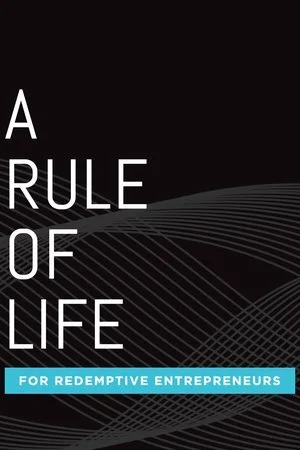
Rule of Life by Praxis Labs

We continue to count down the Top 100 Books for Faith Driven Entrepreneurs with…

Rule of Life

by Praxis Labs

Before beginning any venture, leaders must ask certain questions: What are my motives for leadership and entrepreneurship? How do I understand my identity, vision, and mission? What is the source of my creativity and what shapes my imagination? How do I internalize the pursuit of power, prestige, and wealth?

To this end, our good friends at Praxis Labs offers A Rule of Life for Redemptive Entrepreneurs as a set of shared practices for the Praxis community, and for anyone interested in faithfully pursuing a vocation as an entrepreneur, innovator, or creator.

We thought so highly of this content that we invited Andy Crouch to talk about this book and why it matters on his podcast with FDE.

Click on the book cover to check out the Reviews and Purchase at Amazon


How great companies deliver both purpose and profit

by Alex Edmans

Capitalism is in crisis. The consensus among politicians, citizens and even executives themselves – on both sides of the political spectrum and throughout the world – is that business just isn’t working for ordinary people.

The 2007 financial crisis cost nine million Americans their jobs and 10 million their homes. The economy has recovered since then, but the gains have largely gone to bosses and shareholders, while ordinary incomes have stagnated. In 2018, just 26 tycoons owned the same wealth as the 3.8 billion poorest citizens in the world.

Corporations affect not only people, but also the planet. The environmental costs created by business are estimated at $4.7 trillion per year. Notable examples are the Deepwater Horizon disaster, which spilled five million barrels of oil into the sea, and Volkswagen’s dodging of emissions tests, which caused an estimated 1,200 deaths in Europe alone.

Citizens, and the politicians who represent them, are fighting back. The precise reaction varies – occupy movements, Brexit, electing populist leaders, restricting trade and immigration, and revolting against CEO pay. But the sentiment’s the same. “They” are benefiting at the expense of “us”.

While radical calls to reform business drum up significant support, they risk throwing out the baby with the bathwater and ignore the positive role that businesses can play in society. Successful businesses design products that transform customers’ lives for the better, provide employees with a healthy and enriching workplace and preserve the environment for future generations. Merck’s drug Mectizan has substantially reduced river blindness worldwide; Vodafone’s mobile money service M-Pesa has lifted 200,000 Kenyans out of poverty; and Google’s maps, search engines and shared documents make millions of lives easier each day. Moreover, successful businesses generate profits. Profits aren’t evil value extraction, but serve a crucial role in society, providing returns to parents saving for their children’s education, pension schemes investing for their retirees and insurance companies funding future claims.

Read the full article here!

This article was originally published here by London Business School

Recent articles

——

[ Photo by Aleksandra Boguslawska on Unsplash ]