Success Was Just as Destabilizing as Failure, Until This Changed

Success Was Just as Destabilizing as Failure, Until This Changed

Success Was Just as Destabilizing as Failure, Until This Changed

How a Relationship with God Stabilizes Entrepreneurs Through the Highs and Lows

Steven is a serial tech entrepreneur in his 40s. Four kids. A venture studio that birthed a unicorn. A faith-motivated accelerator. A fintech co-founder who raised over $100M in venture capital.

By any external measure, he had made it. And yet, he felt off course.

“I thought we were successful, and we’re not,” he said. “You feel like you’re on a rocket to the moon and it turns out you’re not. You’re actually a failure.”

The pattern kept repeating. One exit wasn’t enough. The next comparison was always waiting. Success, it turned out, was just as destabilizing as failure — because Steven’s identity had quietly become inseparable from his venture’s outcomes.

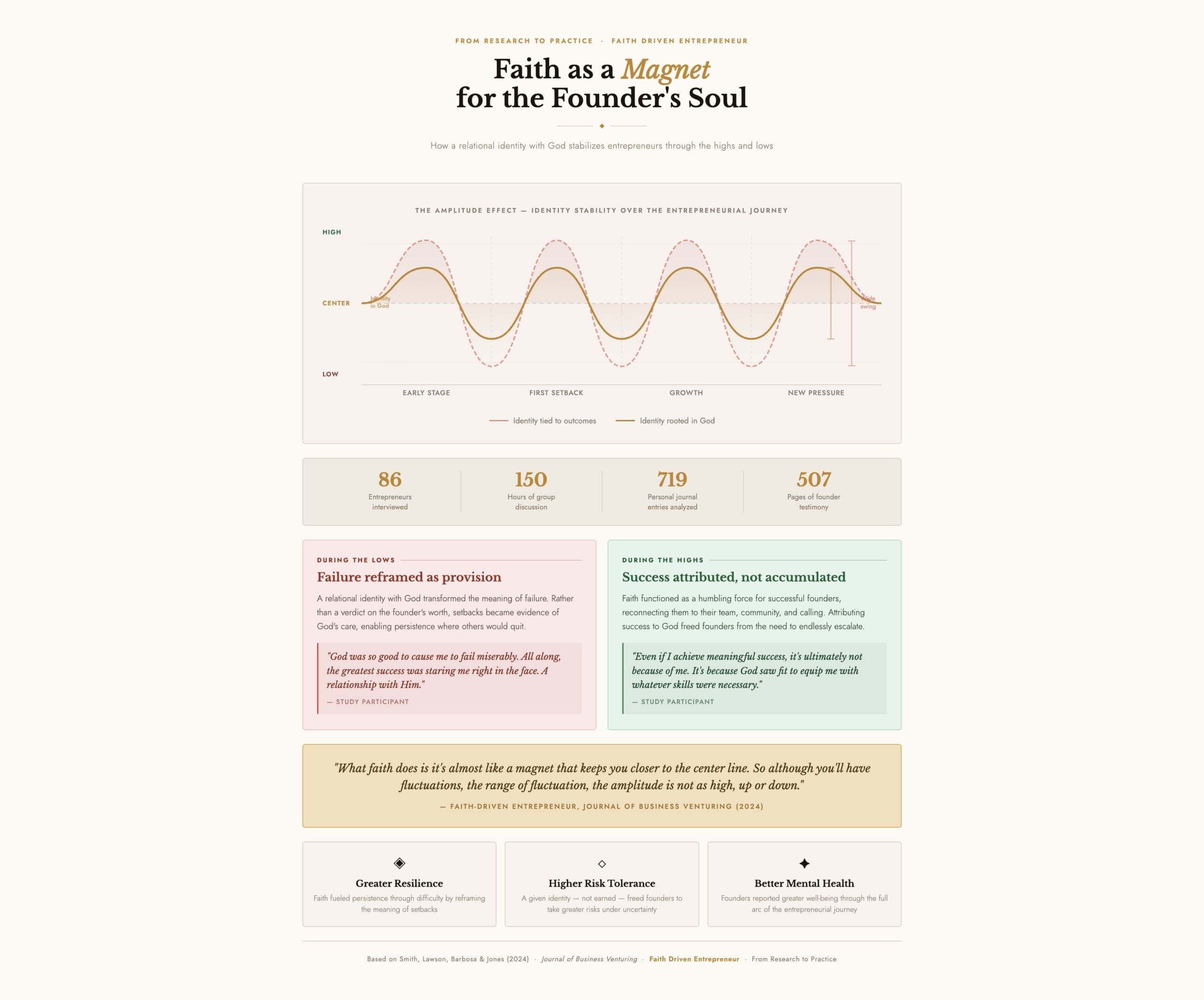
He’s not alone. New research published in the Journal of Business Venturing studied 86 entrepreneurs across 150 hours of group discussion and 719 personal journal entries. What the researchers found was this: a relational identity with God significantly stabilizes the founder’s journey — humbling entrepreneurs during the highs, affirming them during the lows, and anchoring identity to something that doesn’t move when the company does.

“The same journey, two different centers.”

The Problem No One Talks About

Entrepreneurs are unusually prone to becoming their ventures. The company succeeds, the founder feels worth. The company struggles, the founder feels worthless. This cycle isn’t a character flaw, it’s a structural feature of how deeply founders invest themselves in what they build.

Researchers Brett Smith, Amanda Lawson, Saulo Barbosa, and Jessica Jones set out to understand how the highs and lows of entrepreneurship affect a founder’s identity, and whether faith changes that equation. Their method was unusually thorough: 86 entrepreneur interviews, 150 hours of group discussion, and 719 personal journal entries totaling 507 pages.

What they found was a phenomenon they called “inter identity stability,” a faith-grounded center that reframes the meaning of both failure and success without denying the weight of either.

What Faith Does During the Lows

For entrepreneurs experiencing failure or stress, the research found that a relational identity with God reframed what the difficulty actually meant.

One entrepreneur described it this way: “God was so good to cause me to fail miserably. He knew my heart wouldn’t have been able to handle those things. I am so thankful. All along, the greatest success was staring me right in the face. A relationship with Him.”

This isn’t denial or spiritual bypassing. It’s a genuine reframe. Failure stopped being a verdict on the founder’s worth and became, instead, a provision from God. That shift changed what failure meant. And in changing the meaning, it changed how entrepreneurs responded to it.

Others drew on a received identity rather than an achieved one. One founder put it simply: “Just the thought of operating out of—you’ve already received it versus like you’re working to achieve this identity? That is a game changer.”

When identity is given rather than earned, setbacks can’t take it away.

What Faith Does During the Highs

The research found something equally striking on the other side of the curve. For entrepreneurs who did experience significant success, faith functioned as a humbling force that reconnected them to their team, their community, and their actual calling.

One founder said: “Even if I do achieve the levels of success necessary to accomplish something meaningful in the eyes of the world, it’s ultimately not because of me. It’s because God saw fit to equip me with whatever skills were necessary to achieve that end.”

This isn’t false modesty. It’s a theological reorientation of credit. When success belongs to God, the founder is freed from the need to endlessly escalate the next exit, the next valuation, the next comparison. The treadmill stops.

The research also found that a parent-child framework for understanding one’s relationship with God was particularly powerful. One entrepreneur described it this way: “I expect that God will guard, guide, discipline, and care for me in love with the intent that I grow in maturity and character, bearing a family resemblance to Him and the rest of His children.”

The Magnet Effect

One entrepreneur in the study captured the entire finding in a single image:

“What faith does is it’s almost like a magnet that keeps you closer to the center line. So although you’ll have fluctuations, the range of fluctuation, the amplitude is not as high, up or down.”

This is the core of what the researchers documented. Faith doesn’t eliminate the highs and lows of the founder’s journey. It compresses the amplitude. It keeps identity from swinging as far in either direction — from the paralysis of failure or the hubris of success.

The key takeaways from the research: a relational identity with God fueled resilience during difficulties, higher risk tolerance in times of uncertainty, and greater mental health and well-being through the full arc of the entrepreneurial journey.

How Steven Found His Center Line

Steven eventually found his center. He decided to mark the shift permanently.

“There was a shift in my understanding of my identity from ‘If it’s going to be, it’s up to me’ to what my tattoo says: ‘Not by my power and not to my glory.'”

“I couldn’t have been successful without God. He is my identity and He is a core part of my story as an entrepreneur. This is God’s story.”

Practical Steps

    Think differently about your identity:

    • Comparison is a root of entrepreneurial pain. When founders begin comparing themselves to their past performance, their projected future, or other entrepreneurs, identity becomes fragile. The risk is highest during significant highs and lows, when the emotional stakes amplify whatever story you’re telling yourself about your worth.
    • An active relationship with God is foundational to a healthy identity. The research is clear: those who see themselves in relationship with God navigate both success and failure with far greater stability than those whose identity is tied to outcomes.

    • Your identity in Christ changes the meaning of the journey itself. A parent-child framework, God as Father and you as child, allows entrepreneurs to trust, to communicate, and to receive direction. That given identity transforms both the goals and the meaning of every high and low along the way.

     Act differently in your venture:

    • Make space for faith in conversations about founder well-being. The evidence from this research shows that faith is overwhelmingly a positive influence on founders’ mental health. It deserves a seat at any serious conversation about founder resilience, not just a footnote.
    • Surround yourself with mentors who will speak into your God-given identity. Community matters. Relationships with people who know who you are outside of your company can anchor you when the company becomes the only thing you see.

    • Practice regular self-reflection on your core identity and motivations. As we speed towards scale, it’s easy to drift. Regularly ask: where am I deriving my sense of worth right now? The answer will tell you whether you need to be humbled, affirmed, or simply reminded of what has always been true.

    “When I Realized It Was Zero Percent Mine and 100% God’s, Everything Changed.”

    “When I Realized It Was Zero Percent Mine and 100% God’s, Everything Changed.”

    What Christian Impact Investors Teach Us About Identity, Calling, and Surrender

    Most investors measure risk in basis points. These investors measure it in obedience.

    A 2022 study published in the Journal of Business Ethics examined how Christian impact investors navigate one of the most demanding challenges in their work: holding financial, social, and spiritual priorities at the same time. What the researchers found wasn’t a sophisticated portfolio framework. It was something closer to a theology of surrender.

    And it has as much to say to entrepreneurs as it does to investors.

    The Question Nobody Asks Out Loud

    “People assume if you accept a lower return,” one faith-driven investor said, “then you’re a soft investor, or a stupid investor. Because why would you do that? Don’t you realize you can get an 18% return over here?”

    It’s a fair question. It’s also the wrong one.

    Researchers Brett Smith, Lawson Jones, Ashley Holcomb, and Minnich conducted in-depth interviews with Christian impact investors across firms, stages, and investment philosophies. They analyzed the transcripts using identity work theory, a framework from academic research that tracks how people prioritize competing identities when those identities come into conflict.

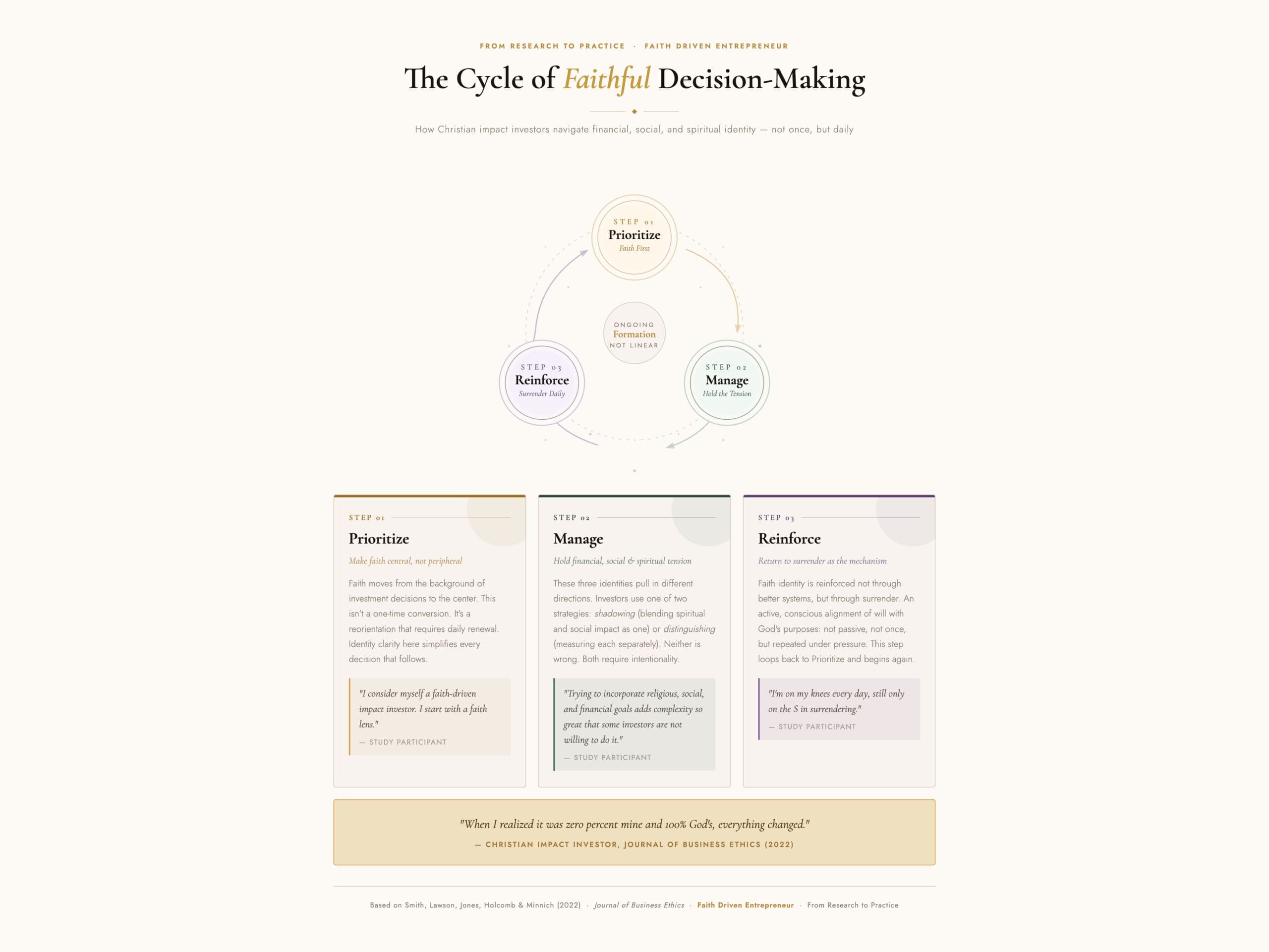
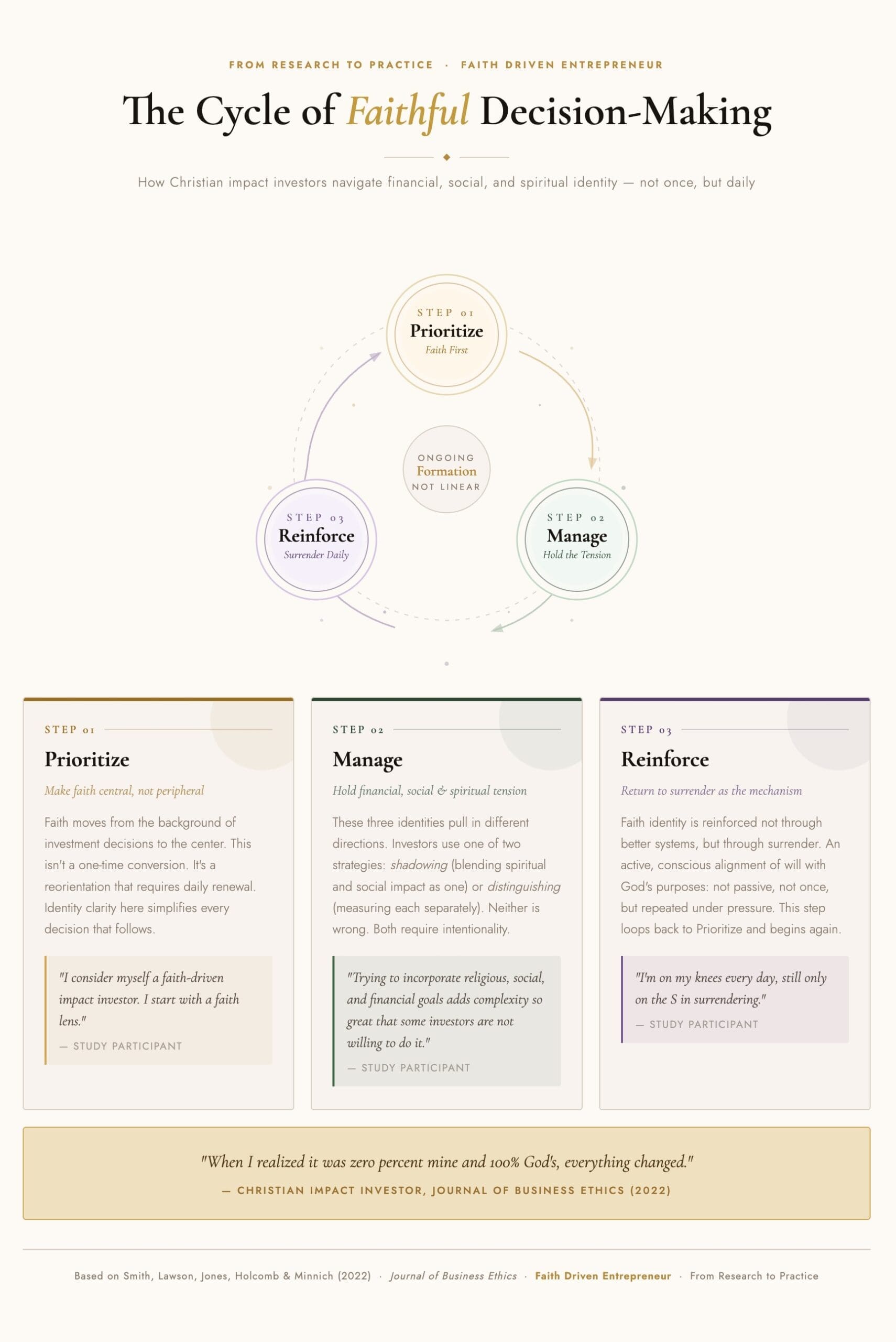
    What they found was a three-part model of faithful decision-making that doesn’t show up in any MBA curriculum.

    Step One: Make Your Faith Identity Central

    Many of the investors in the study described a clear turning point when faith moved from the background of their work to the center of it.

    “I consider myself a faith-driven impact investor,” one said. “I start with a faith lens.” Another described it this way: “I was a Christian for a long time, but it’s only in the last few years that this identity became central to all that I do.”

    But the researchers were careful to note something important: this isn’t a permanent arrival. It’s an ongoing practice. As one investor admitted, “This identity isn’t fixed. It fluctuates day to day.”

    That honesty matters. Putting faith at the center isn’t a one-time decision. It’s a daily act of reorientation.

    Step Two: Manage the Tension Between Competing Values

    Financial return. Social impact. Spiritual obedience. These three don’t always point in the same direction. The investors in the study had developed two distinct ways of handling it.

    Some chose to shadow, blending their spiritual and social identities into one. “I do not see spiritual impact as different from social impact,” one investor said. “They are the same thing.” Another put it plainly: “Lifting people out of poverty is a Kingdom outcome.” Shadowing reduces internal tension by merging motivations, but it increases complexity in measurement.”

    Others chose to distinguish, treating each identity as a separate, measurable category. One investor created a 1 to 5 scale for financial, social, and spiritual outcomes and required a score of at least 4 in all three areas for any investment to qualify. “It is critical to measure religious returns,” this investor argued. “Not only possible but necessary.”

    Neither approach is wrong. The research doesn’t endorse one over the other. What it does emphasize is the importance of choosing intentionally rather than letting the tension go unaddressed.

    Step Three: Reinforce Faith Through Surrender

    This is where the study’s most striking finding lands.

    The investors who had developed the most clarity didn’t reinforce their faith identity through better systems or smarter portfolio construction. They reinforced it through surrender.

    “When I realized it was zero percent mine and 100% God’s, everything changed.”

    “It wasn’t about building bigger barns for myself but building Kingdom impact with my wealth.”

    “Making the wrong investment isn’t the biggest risk. Disobedience is.”

    The researchers were clear that surrender, in this context, is not passivity. It is an active, conscious commitment to align one’s will with God’s purposes, even when better financial returns are available elsewhere. It is a choice made repeatedly, under pressure, often in rooms where that logic is considered naive.

    One investor described it with unusual honesty: “The thing that we need to sacrifice or surrender is really our will.”

    And another, reflecting on the posture the whole study seemed to circle back to, said simply: “I’m on my knees every day, still only on the S in surrendering.”

    What This Means Beyond Investing

    The research speaks directly to investors. But the framework it describes applies to anyone who has tried to build something meaningful while holding faith, financial pressure, and a desire for genuine impact at the same time.

    That’s most faith-driven entrepreneurs.

    The tension between these identities isn’t a problem to be solved. The research frames it as formation. What matters is not whether the tension exists but how you’ve decided to navigate it, and whether your faith is at the center when you do.

    Practical Steps

    Think differently about your work:

    • Let faith lead, not lag. When faith is genuinely central to your identity as a builder or investor, the purpose of your work shifts from personal achievement to Kingdom impact. That shift changes how you make decisions long before any specific decision arrives.
    • Expect tension and don’t fear it. Financial, social, and spiritual priorities will pull against each other. That friction isn’t a sign something is wrong. It’s often a sign something important is at stake. Pay attention to it.
    • Rethink what success requires. Surrender is not a concession. It is a strategic alignment of your will with God’s. The investors in this study weren’t naive about returns. They had simply decided that obedience was the higher metric.

    Act differently in your work:

        • Choose your model. Are you a shadower who sees social and spiritual impact as inseparable? Or a distinguisher who measures each separately? Neither is superior. But choosing intentionally, rather than letting the tension manage you, is the difference between clarity and drift.
        • Build metrics that reflect your actual values. Identify three to five indicators that capture not just financial return but spiritual and social flourishing. Then let those shape your decisions, not just your reporting.
        • Practice surrender as a habit, not a moment. The investors in this study didn’t surrender once and move on. They returned to it daily. Check your motives regularly. Ask honestly: am I pushing this because God is calling me, or because I want control? Then offer the answer back to God.

    One investor in the study captured something that doesn’t show up in return tables or impact reports:

    “We are programmed our entire lives to seek higher returns. You sit at the bar and say, ‘I made this investment and got these incredible financial results.’ No one says, ‘I fed people in Africa and got my money back.'”

    And yet, for those who have surrendered control, that second story is the one worth telling.

    Your Faith Could Cost You the Deal, Or Close It

    Your Faith Could Cost You the Deal, or Close It

    What New Research Tells Us About Faith in the Pitch Room

     You’ve been in that room. Pitch at the ready. Dreams laid out for all to see.

    Maybe you mentioned your faith and the energy shifted. Maybe you held back and wondered if you should have said something. Maybe you’re still unsure what the right call is.

    New research finally gives us a framework. And the answer isn’t “always share” or “never share.” It’s more nuanced and more useful than that.

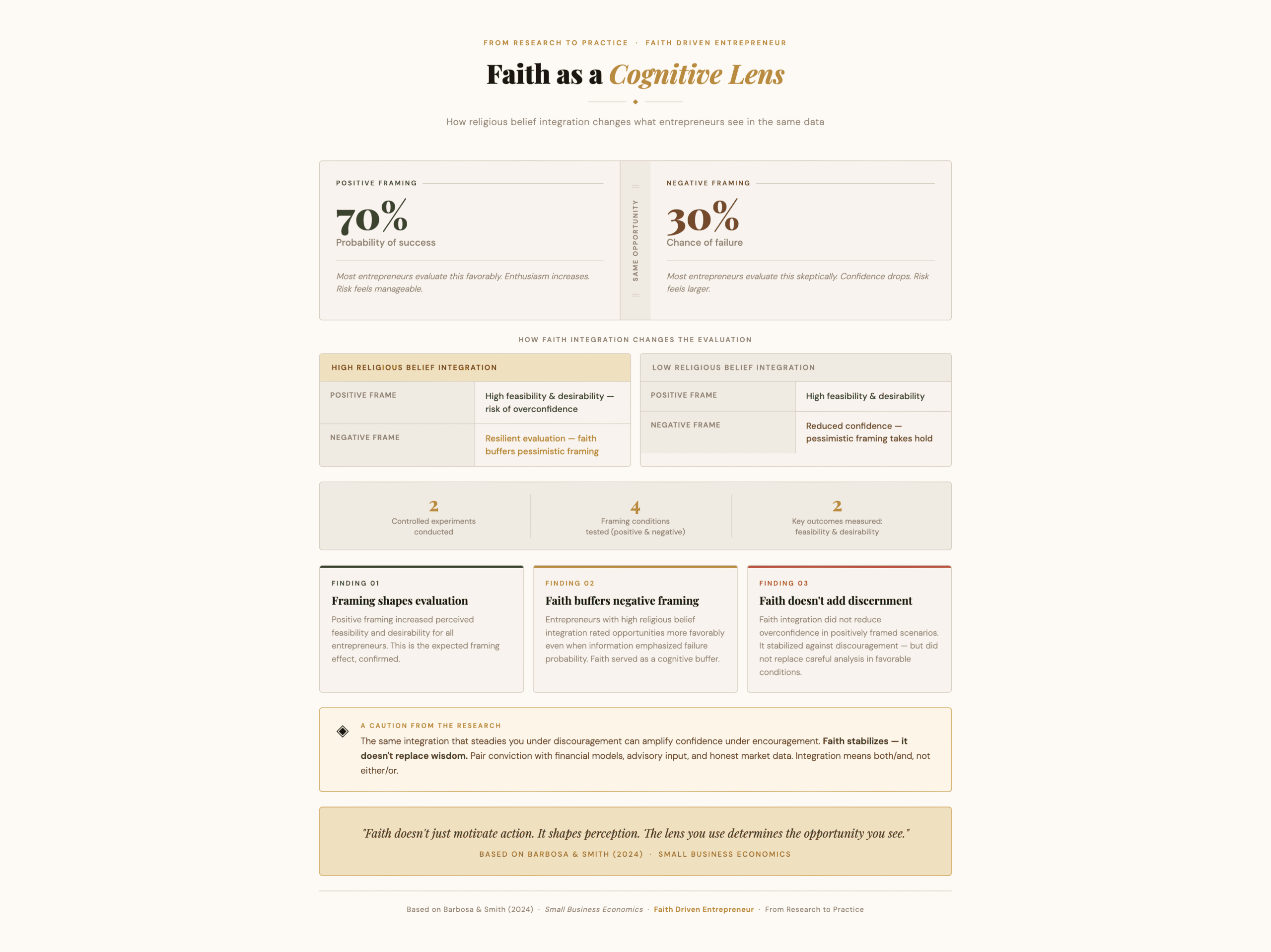
    A 2024 study published in Small Business Economics looked at exactly this question: does religious language in a startup pitch help or hurt investor confidence? Researchers Jessica Jones, Christian Hymer, Ashley Roccapriore, and Brett Smith ran controlled experiments with both faith-driven and secular angel investor groups. Participants evaluated near-identical pitches, some with faith-based mission statements and some without, and shared how those statements shaped their perception of the founder and the venture.

    What they found matters for every faith-driven entrepreneur raising capital.

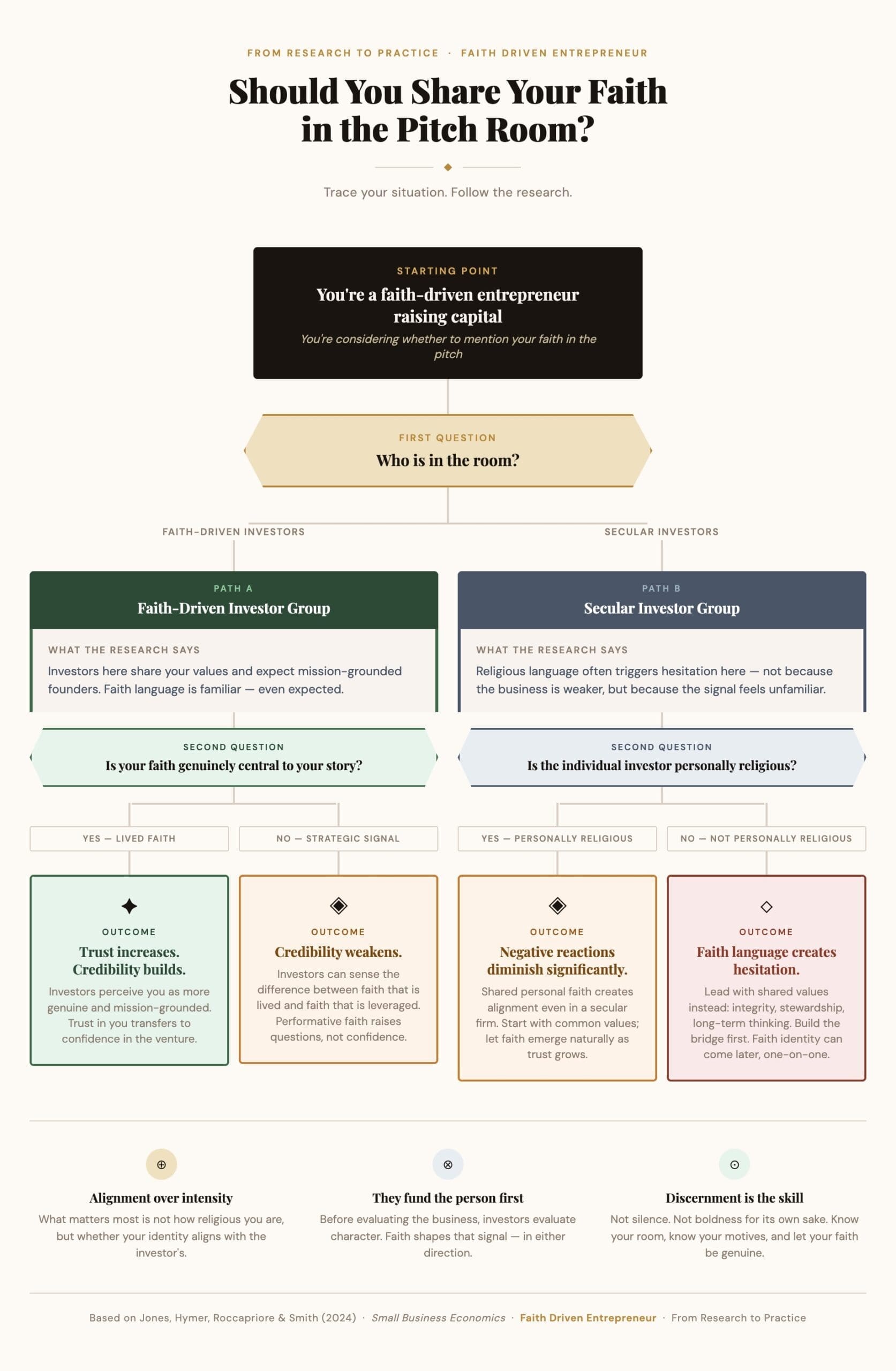
    Trace your situation through the research findings.

    Faith is a Double-Edged Sword in the Pitch Room

    The research confirmed what many of us have suspected: faith can help, and faith can hurt. It is not a universal advantage or a universal liability. It depends entirely on the room.

    The same sentence that builds trust with one investor can raise eyebrows with another. Faith functions as a signal, and people interpret that signal through the lens of their own identity, values, and expectations.

    That’s not a reason to hide who you are. It’s a reason to be wise about when and how you show up.

    What Happens in Faith-Driven Investor Rooms

    Here’s what the research found specifically: 

    When faith-driven investor groups heard religious language in a pitch, they didn’t automatically like the business more. But they did trust the founder more.

    The mechanism is authenticity. When a founder shares their faith openly in a room where that faith is shared, investors perceive them as more genuine, more sincere, and more mission-grounded. That trust in the person then translates into increased confidence in the venture.

    Faith didn’t sell the business. Faith revealed the person. And investors funded the person.

    What Happens in Secular Investment Rooms

    In secular environments, the dynamic reverses. Religious language often triggered hesitation, not because the business was weaker, but because the signal felt unfamiliar or out of place.

    The one exception: 

    When an individual investor inside a secular firm was personally religious, those negative reactions became much smaller or disappeared entirely.

    The implication is significant. It is not the setting that ultimately matters. It’s the alignment between your identity and theirs. A secular firm with one faith-driven partner is a different conversation than a room full of investors for whom faith is irrelevant to their work.

    What This Means For You

    Before the pitch, investors are not primarily evaluating your business. They’re evaluating you. Religious language works as a character signal, and investors use it to ask: Is this founder reliable? Grounded? Consistent? Mission-driven?

    The research makes clear: alignment matters more than intensity. A simple phrase rooted in genuine faith can inspire trust in one room and confusion in another, without changing your business model at all. What moves the needle is fit, not fervor.

    Authenticity is more persuasive than persuasion. Faith language works best when it naturally reflects who you are and not when it’s deployed as strategy. Investors can sense the difference between faith that is lived and faith that is leveraged. The former builds credibility. The latter raises questions.

    Practical Steps

    Think differently about your pitch.

    • Know your audience before you walk in the room. Faith language builds confidence with investors who share your values or who clearly prioritize mission and purpose. In secular or unfamiliar environments, it’s often wiser to start with shared values — integrity, stewardship, long-term thinking, ethical leadership — before naming your religious identity directly.

    • Check your motives, not just your message. Before you bring up faith in a pitch, ask yourself why you’re sharing it and what you hope it accomplishes. Discernment starts with honest self-awareness.

    • Don’t assume your faith will transfer to their decision. As a faith-driven entrepreneur, you’ve integrated faith and work. Your investors haven’t necessarily done the same. The research is clear: faith shapes how investors perceive you, not automatically how they evaluate your business.

    Act differently in the room

    • Tailor the pitch to the setting. Research who you’re pitching. Look for investor groups or individuals who care about values, purpose, or faith integration. This information is often available before you walk in. If it’s not clear, don’t assume mentioning your faith will help.

    • Let it be authentic, not performative. If faith is part of your leadership and your story, share it as part of your story and not as a credential you’re strategically deploying. The research is clear: sincere faith strengthens credibility; performative faith weakens it.

    • In mixed or secular rooms, build the bridge first. Start with the values that transcend religion: integrity, responsibility, long-term stewardship, care for people. As trust grows, your faith-grounded identity will become clear and land differently than if you’d led with it cold.

    Discernment is the skill. Not silence. Not boldness for its own sake.

    Know your room. Know your motives. Let your faith be genuine and trust that genuine things are recognized.

      Top 100 Books

      We live in a digital age to be sure. But there is still something timeless and captivating about the written word. That’s why we’ve compiled a list of the Top 100 Books for Faith Driven Entrepreneurs.

      Best of all, you don’t go through them on your own. Many have a video series that corresponds to the topics and best practices that are presented. Maybe you meet up with a friend over coffee or you join one of our Faith Driven Entrepreneur Groups to discuss what you read in more detail.

      President Harry Truman once said, “Not all readers are leaders, but all leaders are readers.” That’s why we think you should pick up a copy of any of these titles for yourself.


      And if you’re an entrepreneur, then you’re a leader. Whether you have one employee or 100, you need learn from the brightest minds and doers in the field. The books in this list were written specifically for entrepreneurs, business leaders, creatives, innovators, and employees in every sector.

      These books cover topics ranging from inspiration to practical how-tos. You’ll gain insights into why your work matters. You’ll be encouraged by accounts of success, failure, and everything in between. We hope this list enlightens you, challenges you, and helps you along your entrepreneurial journey.

      These our our top recommendations for books geared toward the Faith Driven Entrepreneur.

      Know of any we missed? Let us know what books deserve a spot on this list.


      #1 The Bible

      We believe that God speaks to us through His word and that all of Scripture is useful for instruction on how to live, work, and serve in any capacity. Scripture, when taken in aggregate, provides us with a great handbook on every question of life and entrepreneurship.

      If you need a book to start with, this is the one. It’s easy to overlook, but it’s vital if we want to steward our life and our business for God’s glory.

      If you’re not sure where to start, check out our resources to help you stay connected to God’s Word.

      #2 Rule of Life

      by Praxis Labs

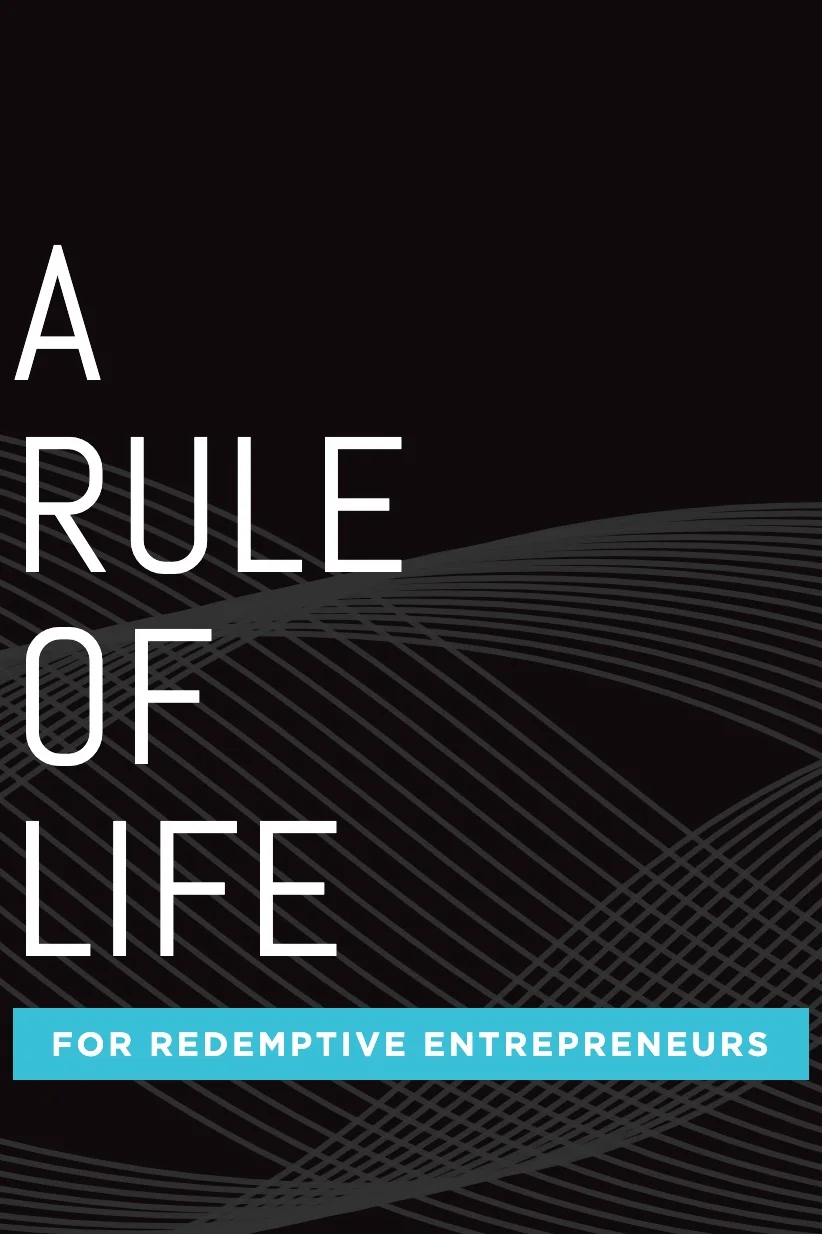
      Before beginning any venture, leaders must ask certain questions: What are my motives for leadership and entrepreneurship? How do I understand my identity, vision, and mission? What is the source of my creativity and what shapes my imagination? How do I internalize the pursuit of power, prestige, and wealth?

      To this end, our good friends at Praxis Labs offers A Rule of Life for Redemptive Entrepreneurs as a set of shared practices for the Praxis community, and for anyone interested in faithfully pursuing a vocation as an entrepreneur, innovator, or creator.

      We thought so highly of this content that we invited Andy Crouch to talk about this book and why it matters on his podcast with FDE.

      #3 Every Good Endeavor

      by Tim Keller

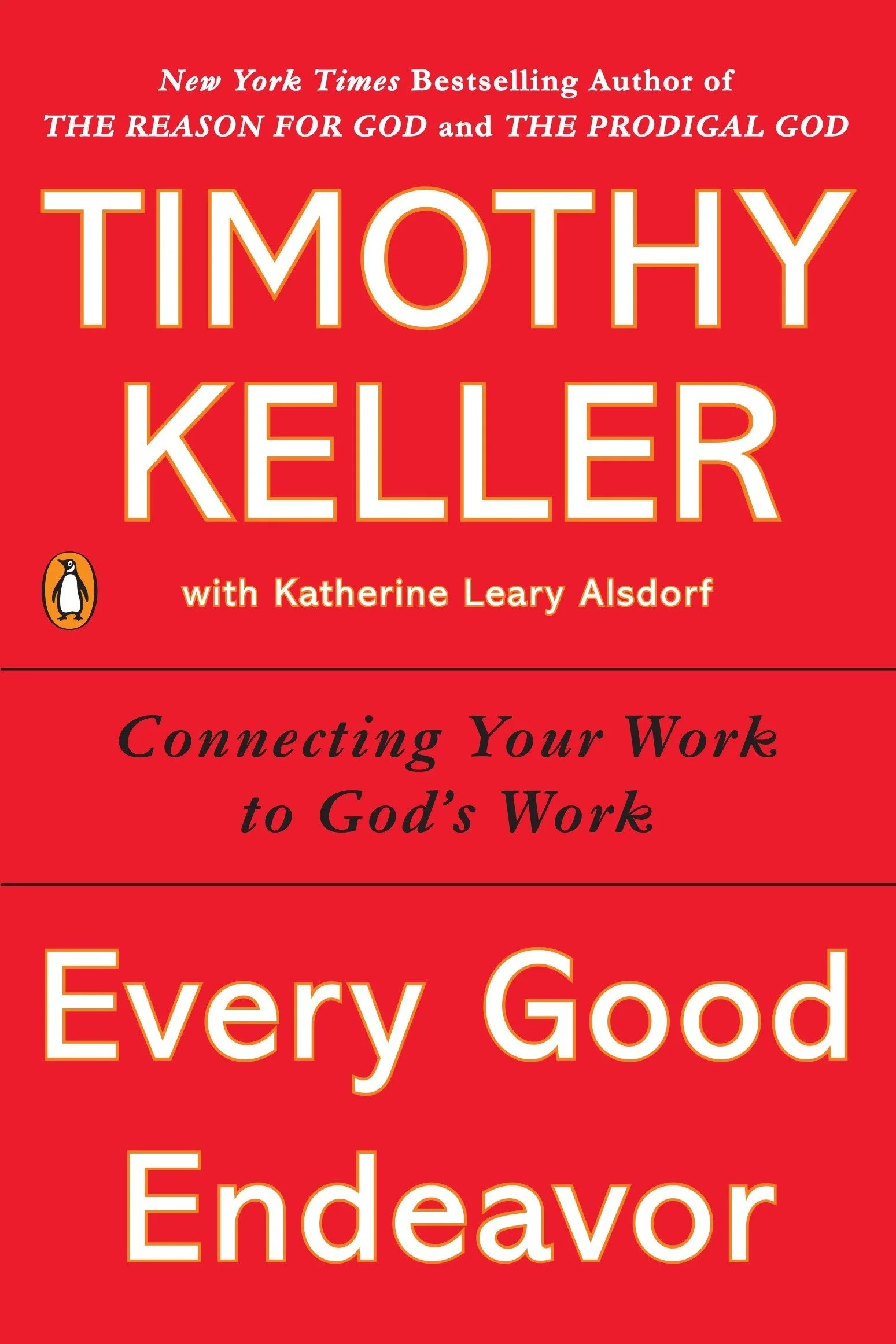
      With deep conviction and often surprising advice, Keller shows readers that biblical wisdom is immensely relevant to our questions about work today. In fact, the Christian view of work—that we work to serve others, not ourselves—can provide the foundation of a thriving professional and balanced personal life. Keller shows how excellence, integrity, discipline, creativity, and passion in the workplace can help others and even be considered acts of worship—not just of self-interest.

      If you’ve been around our podcast, you know that we have the utmost respect for Tim and his wisdom in this conversation. You can hear Tim Keller talk about faith, work, and identity in his podcast with FDE.

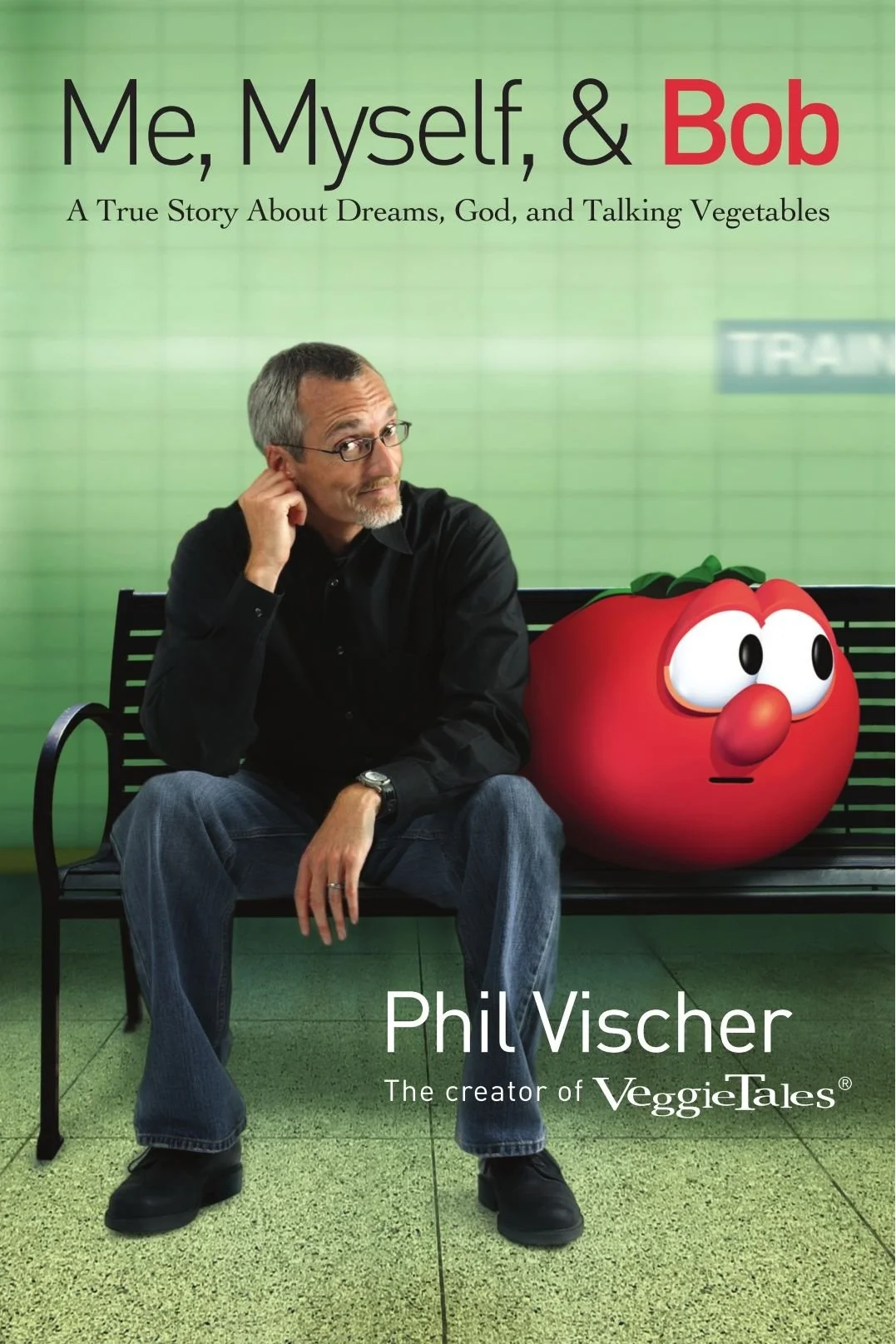
      #4 Me, Myself, and Bob: A True Story About Dreams, God, and Talking Vegetables

      by Phil Vischer

      This is a story of dreaming big and working hard, of spectacular success and breathtaking failure, of shouted questions, and, at long last, whispered answers. With trademark wit and heart, Phil Vischer shares how God can use the death of a dream to point us toward true success.

      Phil has delivered what has come to be known as one of our most popular podcasts. Hear Phil Vischer share the emotional side of his entrepreneurial journey on his podcast with FDE.

      #5 work Matters: Connecting Sunday Worship to Monday Work

      by Tom Nelson

      Work. For some this word represents drudgery and the mundane. For others work is an idol to be served. In either case, a biblical understanding of work as godly activity and a means of spiritual formation is lost.

      Striking a balance between theological depth and practical counsel, Work Matters engages the theological basis of God’s plan for everyday work. Tom Nelson explains how the fall has impacted vocation, how God’s redemption touches every sphere of our lives including our work, and how what we do now is connected to what we will do forever. As Nelson connects Sunday worship to Monday morning, he gives readers practical tools for understanding their own gifts, so that they may better live in accord with God’s design for work.

      You can hear more about this book and these ideas our good friend Tom Nelson on his podcast episode with us. Listen to The Scoreboard of the Monday Church here or a different episode about Media, Culture and Opportunities here.

      #6 Called to Create

      by Jordan Raynor

      In this energizing book, serial entrepreneur and bestselling author Jordan Raynor helps artists, entrepreneurs, writers, and other creatives reimagine our work as service to God and others.

      Raynor shares compelling stories from an eclectic group of 40+ Christian entrepreneurs, including the founders of TOMS Shoes, Charity: Water, Chick-fil-A, In-N-Out Burger, Guinness, HTC, and Sevenly, as well as nontraditional entrepreneurs such as C. S. Lewis, Johann Sebastian Bach, and J. R. R. Tolkien. Raynor’s “show” rather than “tell,” story-driven style makes you feel as if you are sitting at the feet of some of the godliest and most successful entrepreneurs of all time.

      Perfectly poised to reach today’s growing creative class, this unique work restores God’s position as the first entrepreneur, helping readers see the eternal value in the work they do today.

      #7 Mission Drift: The Unspoken Crisis Facing Leaders, Charities, and Churches

      by Peter Greer and Chris Horst

      Slowly, silently, and with little fanfare, organizations routinely drift from their purpose, and many never return to their original intent. Harvard and the YMCA are among those that no longer embrace the Christian principles on which they were founded. But they didn’t drift off course overnight. Drift often happens in small and subtle ways. Left unchecked, it eventually becomes significant.

      Why do so many organizations–including churches–wander from their mission, while others remain Mission True? Can drift be prevented? In Mission Drift, HOPE International executives Peter Greer and Chris Horst tackle these questions. They show how to determine whether your organization is in danger of drift, and they share the results of their research into Mission True and Mission Untrue organizations. You’ll discover what you can do to prevent drift or get back on track and how to protect what matters most.

      We invited our good friend Peter Greer on our podcast to share more about this topic. Listen to his podcast with FDE here.

      #8 The Tech-Wise Family

      by Andy Crouch

      Making conscientious choices about technology in our families is more than just using internet filters and determining screen time limits for our children. It’s about developing wisdom, character, and courage in the way we use digital media rather than accepting technology’s promises of ease, instant gratification, and the world’s knowledge at our fingertips. And it’s definitely not just about the kids.

      Drawing on in-depth original research from the Barna Group, Andy Crouch shows readers that the choices we make about technology have consequences we may never have considered. He takes readers beyond the typical questions of what, where, and when and instead challenges them to answer provocative questions like, Who do we want to be as a family? and How does our use of a particular technology move us closer or farther away from that goal? Anyone who has felt their family relationships suffer or their time slip away amid technology’s distractions will find in this book a path forward to reclaiming their real life in a world of devices.

      As entrepreneurs, we’re all somewhat terrified by what technology might be doing to us and our families. If you’re interested in this topic and how it relates to you, listen to Andy Crouch talk more about it on his podcast with FDE.

      #9 EntreLeadership

      by Dave Ramsey

      EntreLeadership is Dave Ramsey’s championship playbook with step-by-step guidance to take your business where you want it to go.

      Dave has grown his company to a winning national brand with more than 800 team members who have impacted millions of lives. EntreLeadership is how he did it, mistakes and all. This is 20 years of real-world experience with all the sweat, tears and prayers. This is how his company has been named one of the Best Places to Work in Nashville seven times. It’s proven. It’s practical. And it’s how you can do it too.

      Whether you lead a team of two or 200, you can grow your business to where you want it to be. Reaching your dream is no longer a question of “What if we could?” You can. EntreLeadership is how.

      #10 The Redemptive NonProfit

      by Praxis Labs

      In the century since its invention, the nonprofit organization structure has powered immense social good, by enabling countless entrepreneurial leaders to address problems not adequately served by the market. But when it comes to delivering that social good today, many nonprofits fall short of the durable impact they hope to deliver. Our friends at Praxis proposes that there is a higher horizon of opportunity for the redemptive nonprofit—one that seeks the renewal of the larger society as well as all the stakeholders involved in the work.

      They hope to inspire a new generation of leaders to go beyond the baseline of ethics and excellence that should characterize any organization (whether or not it receives a tax exemption)—to building nonprofits that embody the radical hope of the Christian gospel and its power to transform persons, communities, and the course of history.

      In the coming weeks, we’ll have Jena Nardella on our podcast, so stay tune to hear more from her!

      #11 The Ideal Team Player

      by Patrick Lencioni

      In The Ideal Team Player, Lencioni tells the story of Jeff Shanley, a leader desperate to save his uncle’s company by restoring its cultural commitment to teamwork. Jeff must crack the code on the virtues that real team players possess, and then build a culture of hiring and development around those virtues.

      Beyond the fable, Lencioni presents a practical framework and actionable tools for identifying, hiring, and developing ideal team players.  Whether you’re a leader trying to create a culture around teamwork, a staffing professional looking to hire real team players, or a team player wanting to improve yourself, this book will prove to be as useful as it is compelling.

      In all our interviews with entrepreneurs this is the top book people point to when it comes to building a team and beginning to set culture. See why in this video series.

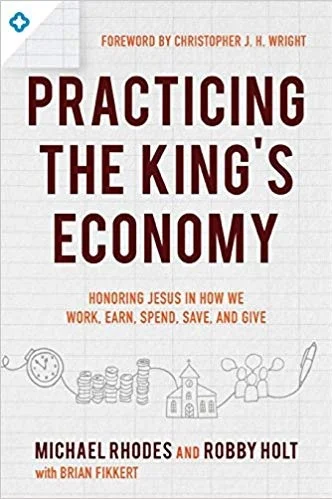
      #12 Practicing the Kings Economy

      by Michael Rhodes and Robby Holt

      The church in the West is rediscovering the fact that God cares deeply for the poor. More and more, churches and individual Christians are looking for ways to practice economic discipleship, but it’s hard to make progress when we are blind to our own entanglement in our culture’s idolatrous economic beliefs and practices.

      Practicing the King’s Economy cuts through much confusion and invites Christians to take their place within the biblical story of the “King Jesus Economy.” Through eye-opening true stories of economic discipleship in action, and with a solid exploration of six key biblical themes, the authors offer practical ways for God’s people to earn, invest, spend, compensate, save, share, and give in ways that embody God’s love and provision for the world.

      Our partners at Made To Flourish have written about how the ideas presented in this book, specifically that of gleaning, are challenging and stretching concepts.

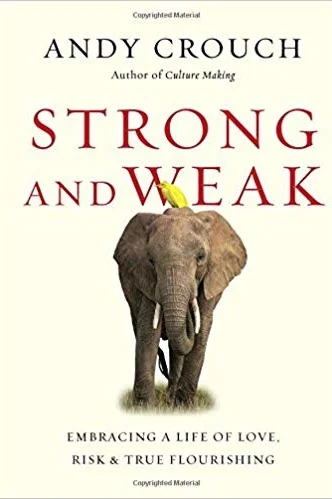
      #13 Strong and Weak

      by Andy Crouch

      Flourishing people are strong and weak. Two common temptations lure us away from abundant living—withdrawing into safety or grasping for power. True flourishing, says Andy Crouch, travels down an unexpected path—being both strong and weak.

      We see this unlikely mixture in the best leaders—people who use their authority for the benefit of others, while also showing extraordinary willingness to face and embrace suffering. We see it in Jesus, who wielded tremendous power yet also exposed himself to hunger, ridicule, torture and death. Rather than being opposites, strength and weakness are actually meant to be combined in every human life and community. Only when they come together do we find the flourishing for which we were made.

      With the characteristic insight, memorable stories and hopeful realism he is known for, Andy Crouch shows us how to walk this path so that the image of God can shine through us. Not just for our own good, but for the sake of others.

      As entrepreneurs and business leaders, how do we avoid abusing our power? This is one of many topics Andy Crouch addressed on his podcast with FDE.

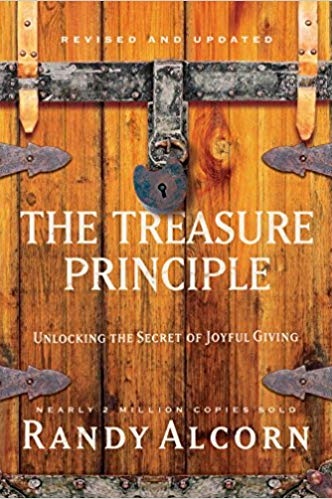
      #14 Treasure Principle

      by Randy Alcorn

      Jesus spent more time talking about money and possessions than about heaven and hell combined. But too often we’ve overlooked or misunderstood his most profound teaching on this topic, from his words in Matthew 6. Jesus offers us life-changing investment advice. He actually wants us to store up treasures for ourselves—just not here on earth. Instead, he urges us to store our treasure in heaven, where they will await us, and last forever. We can’t take it with us—but we can send it on ahead!

      With this compact classic, you can read about and understand God’s view on stewardship during a short plan flight. In The Treasure Principle, you’ll unearth a radical teaching of Jesus—a secret wrapped up in giving. Once you discover this secret, life will never look the same. And you won’t want it to be.

      Why does this matter? Because entrepreneurs need to recognize the value of surrendering it all to God. You can also check out this video series from RightNow Media to accompany the book.

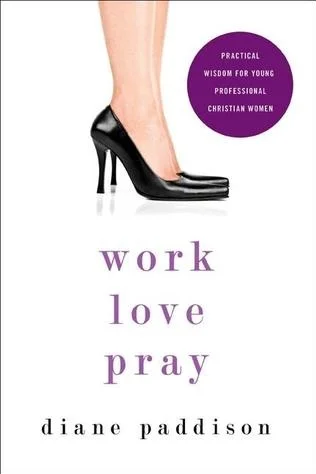
      #15 Work Pray Love

      by Diane Paddison

      The number of Christian women in today’s professional workforce is increasing, and they are hungry for practical mentoring. They yearn to learn from someone who has climbed the ladder of success without sacrificing family or faith—something author Diane Paddison has done with excellence and grace.

      This is a working book for working women.

      Full of practical, proven guidance that is both professionally viable and biblically sound, each chapter includes sidebars featuring pertinent facts from current research, resources relevant to the chapter’s topic, action-oriented ‘to do’ lists, and other interactive material.

      Work, Love, Pray is a valuable resource for professional Christian women, but it’s also a must-read for the husbands, sisters, daughters, and friends who share their lives.

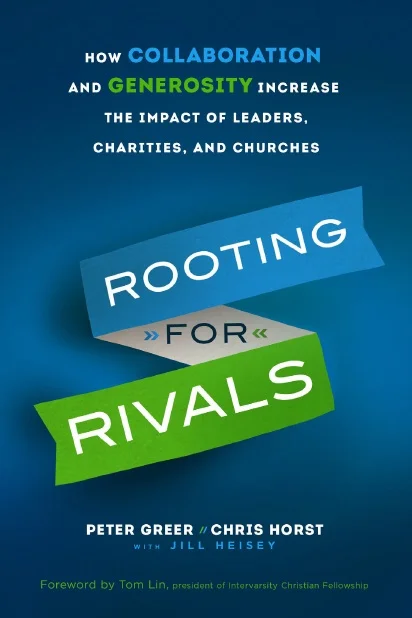
      #16 Rooting for Rivals

      by Peter Greer and Chris Horst

      Christian organizations have come to be known mostly for what they’re against. And all too often, that includes being against each other. But amid growing distrust of religious institutions, Christ-centered nonprofits have a unique opportunity to link arms and collectively pursue a calling higher than any one organization’s agenda.

      Rooting for Rivals reveals how your ministry can multiply its impact by cooperating rather than competing with others, modeling Christlike love and generosity in the process. Peter Greer and Chris Horst explore case studies illustrating the power of collaborative ministry. Writing with vulnerability, they also share their own failures and successes in moving toward a kingdom mindset.

      In Rooting for Rivals you’ll discover the key to revitalizing your ministry and making an enduring difference in the world.

      You can also hear Peter Greer talk about this book on his podcast with FDE.

      #17 Visions of Vocation

      by Steven Garber

      Is it possible to know the world and still love the world?

      Of all the questions we ask about our calling, this is the most difficult. From marriages to international relations, the more we know, the harder it is to love. We become cynics or stoics, protecting our hearts from the implications of what we know. But what if the vision of vocation can be recovered―allowing us to step into the wounds of the world and for loves sake take up our responsibility for the way the world turns out?

      Garber offers a book for everyone everywhere―for students, for parents, for those in the arts, in the academy, in public service, in the trades and in commerce―for all who want to discover the virtue of vocation.

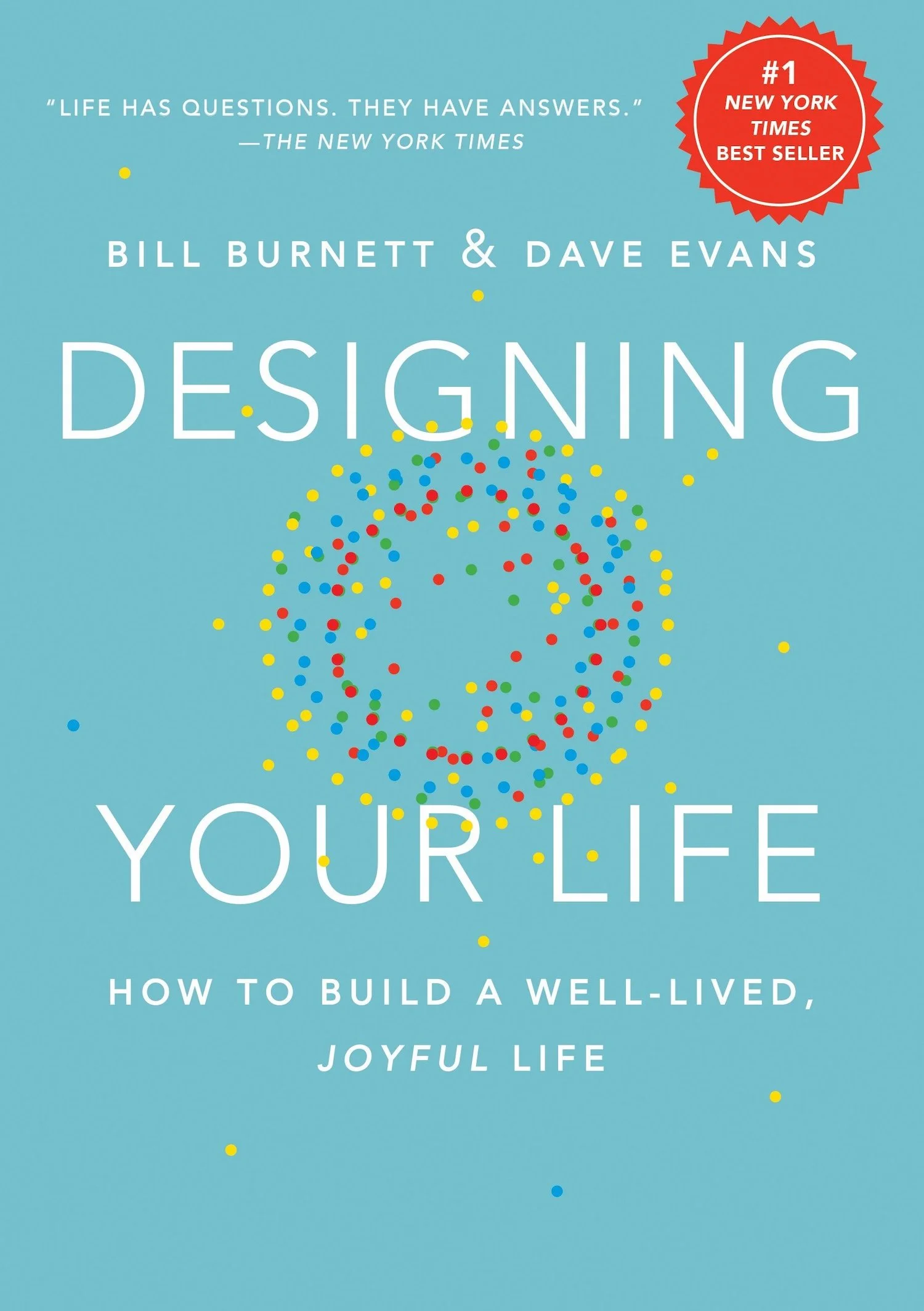
      #18 Designing Your Life: How to Build a Well-Lived, Joyful Life

      by Bill Burnett and Dave Evans

      Designers create worlds and solve problems using design thinking. Look around your office or home–at the tablet or smartphone you may be holding or the chair you are sitting in. Everything in our lives was designed by someone. And every design starts with a problem that a designer or team of designers seeks to solve.

      In this book, Bill Burnett and Dave Evans show us how design thinking can help us create a life that is both meaningful and fulfilling, regardless of who or where we are, what we do or have done for a living, or how young or old we are. The same design thinking responsible for amazing technology, products, and spaces can be used to design and build your career and your life, a life of fulfillment and joy, constantly creative and productive, one that always holds the possibility of surprise.

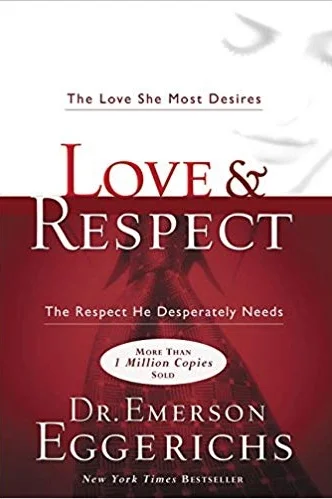
      #19 Love and Respect

      by Emerson Eggerichs

      New York Times bestseller Love & Respect has sold over 1.6 million copies! Love & Respect reveals why spouses react negatively to each other, and how they can deal with such conflict quickly, easily and biblically.

      Touted by leaders as a “classic” among marriage books, this book also reveals insightful wisdom about what it looks like to have respect in the workplace.

      A Faith Driven Entrepreneur understands the importance of family and having a healthy balance between work and life. That’s why we think this book matters for you. Also, check out this accompanying video series by RightNow Media.

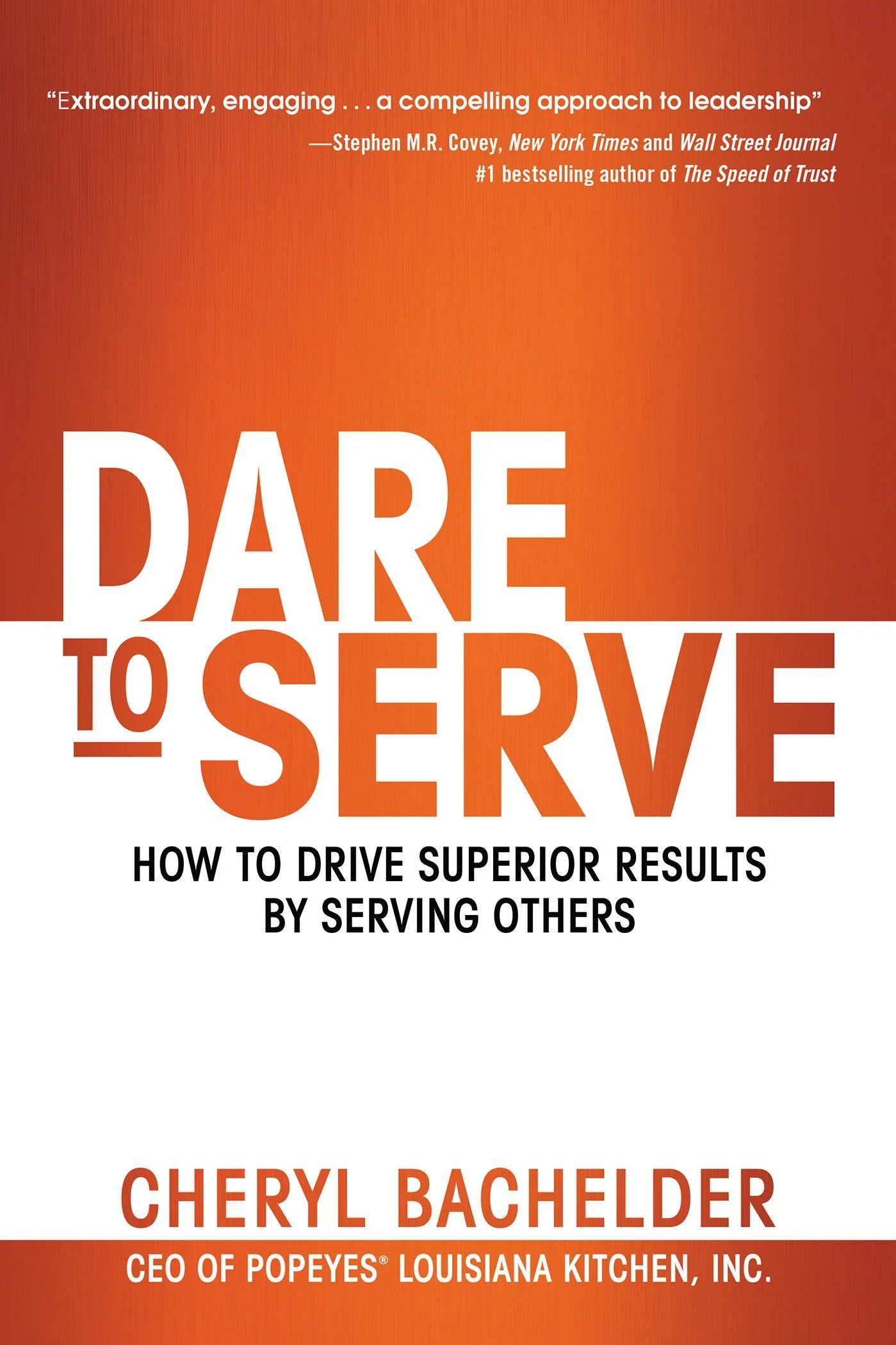
      #20 Dare to Serve

      by Cheryl Bachelder

      Cheryl Bachelder joined an ailing restaurant chain and turned it into the darling of the industry—by daring to serve the people in her organization well. In Dare to Serve, former Popeyes CEO Cheryl Bachelder shows that leading by serving is a rigorous and tough-minded approach that yields the best results.

      When she was named CEO of Popeyes in 2007, the stock price had slipped from $34 in 2002 to $13. The brand was stagnant, the team was discouraged, and the franchisees were just plain angry. Nine years later, restaurant sales were up 45 percent, restaurant profits had doubled, and the stock price was over $61. Servant leadership is sometimes derided as soft or ineffective, but this book confirms that challenging people to reach a daring destination, while treating them with dignity, creates the conditions for superior performance.

      Watch Cheryl Bachelder’s story in our Top 100 Videos for Faith Driven Entrepreneurs.

      #21 Zero to One

      by Peter Thiel

      The great secret of our time is that there are still uncharted frontiers to explore and new inventions to create. In Zero to One, legendary entrepreneur and investor Peter Thiel shows how we can find singular ways to create those new things.

      Thiel begins with the contrarian premise that we live in an age of technological stagnation, even if we’re too distracted by shiny mobile devices to notice. Information technology has improved rapidly, but there is no reason why progress should be limited to computers or Silicon Valley. Progress can be achieved in any industry or area of business. It comes from the most important skill that every leader must master: learning to think for yourself.

      Zero to One presents at once an optimistic view of the future of progress in America and a new way of thinking about innovation: it starts by learning to ask the questions that lead you to find value in unexpected places.

      #22 Start

      by Jon Acuff

      There are only two paths in life: average and awesome. The average path is easy because all you have to do is nothing. The awesome path is more challenging, because things like fear only bother you when you do work that matters. The good news is Start gives readers practical, honest, actionable insights to be more awesome, more often.

      It’s time to punch fear in the face, escape average, and do work that matters.

      It’s time to Start.

      #23 The 5 Dysfunctions of a Team: A Leadership Fable

      by Patrick Lencioni

      Kathryn Petersen, Decision Tech’s CEO, faces the ultimate leadership crisis: Uniting a team in such disarray that it threatens to bring down the entire company. Will she succeed? Will she be fired? Will the company fail? Lencioni’s utterly gripping tale serves as a timeless reminder that leadership requires as much courage as it does insight.

      Throughout the story, Lencioni reveals the five dysfunctions which go to the very heart of why teams even the best ones-often struggle. He outlines a powerful model and actionable steps that can be used to overcome these common hurdles and build a cohesive, effective team. Just as with his other books, Lencioni has written a compelling fable with a powerful yet deceptively simple message for all those who strive to be exceptional team leaders.

      Check out the video series from RightNow Media that accompanies the book.

      #24 Building a Storybrand

      by Donald Miller

      Donald Miller’s StoryBrand process is a proven solution to the struggle business leaders face when talking about their businesses. This revolutionary method for connecting with customers provides listeners with the ultimate competitive advantage, revealing the secret for helping their customers understand the compelling benefits of using their products, ideas, or services. Building a StoryBrand does this by teaching listeners the seven universal story points all humans respond to, the real reason customers make purchases, how to simplify a brand message so people understand it, and how to create the most effective messaging for websites, brochures, and social media.

      Whether you are the marketing director of a multibillion-dollar company, the owner of a small business, a politician running for office, or the lead singer of a rock band, Building a StoryBrand will forever transform the way you talk about who you are, what you do, and the unique value you bring to your customers.

      #25 Your Work Matters to God

      by Doug Sherman and William Hendricks

      One of the definining books that has impacted a lot of people involved in the faith and work conversation, Your Work Matters to God is one of the forefathers of the faith-driven entrepreneur movement.

      Your Work Matters to God demonstrates just how important secular work is to God. Whether you are a man or woman, once you realize how many different ways there are to influence your coworkers for Christ without preaching a word, you’ll be challenged to develop a lifestyle so striking and true, the people you work with will be eager to let you talk about what makes you different.


      New Releases

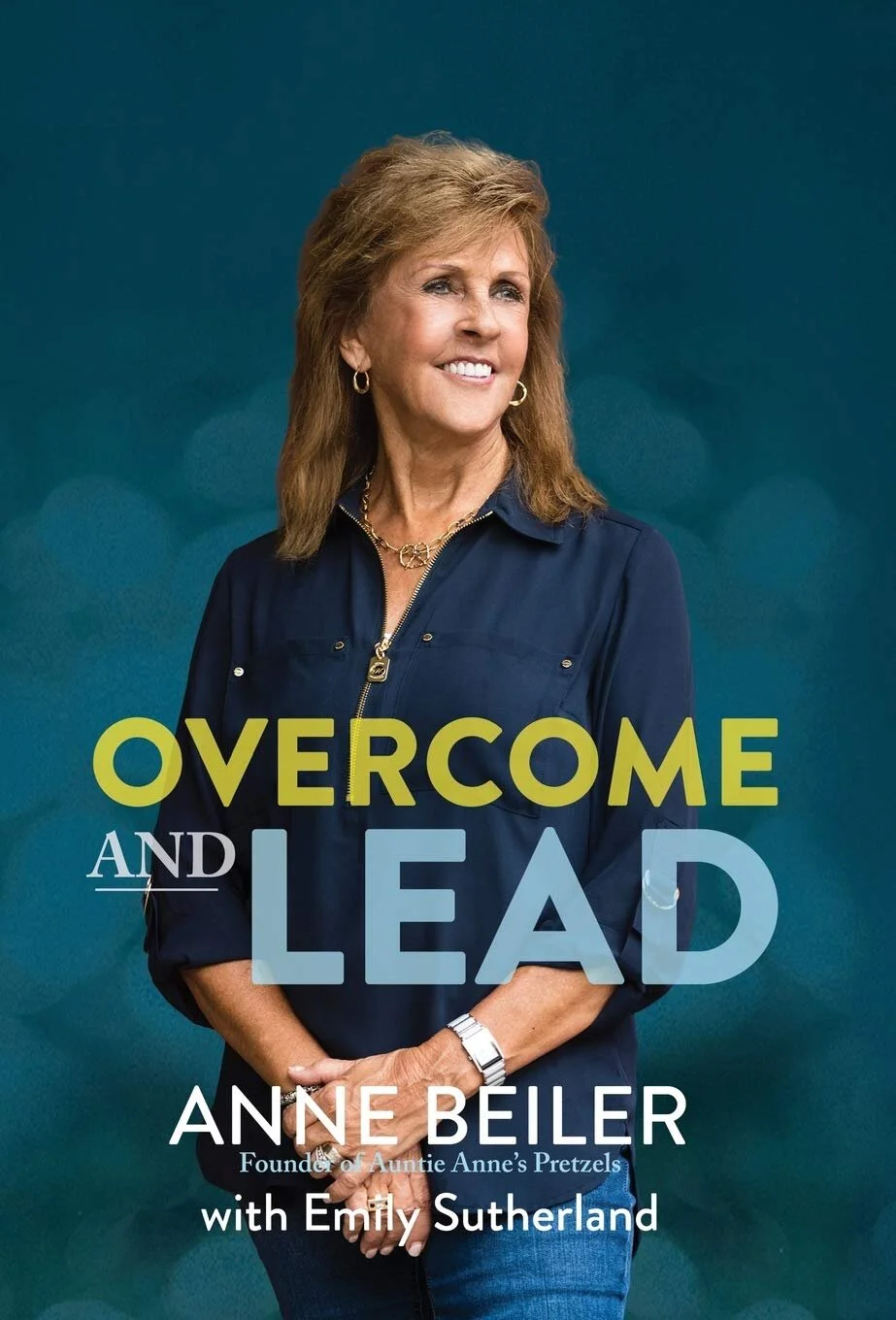
      Overcome and Lead

      by Anne Beiler and Emily Sutherland

      With no capital, no formal education, and no business plan, Anne launched Auntie Anne’s Soft Pretzels after a series of tragic life events left her broken, traumatized, and in a deep depression. As Anne and her team grew the company, she also grew herself personally and professionally. Join Anne as she takes you on a journey from feeling overwhelmed and inadequate to being an empowered and confident leader.


      Top 100 Books (26-50)

      #26 Work as Worship

      by Mark Russell

      The time has come for us to see a purpose for business that goes beyond money and that has a vision for this economy that goes even beyond this earth. Built around twelve themes: calling, leadership, character, success, money, stewardship, balance, disciplines, relationships, pluralism, ethics and giving, Work as Worship opens our collective eyes to the spiritual nature and mission of our daily work. Written by respected business leaders from well-known brands (Hobby Lobby, Interstate Batteries, PepsiCo, TOMS Shoes, etc.), Work as Worship creates a space for ongoing community and conversation on these important issues.

      #27 When Helping Hurts

      by Steve Corbett and Brian Fikkert

      With more than 225,000 copies sold, When Helping Hurts is a paradigm-forming contemporary classic on the subject of poverty alleviation and ministry to those in need. Emphasizing the poverty of both heart and society, this book exposes the need that every person has and how it can be filled. The reader is brought to understand that poverty is much more than simply a lack of financial or material resources and that it takes much more than donations and handouts to solve the problem of poverty.

      While this book exposes past and current development efforts that churches have engaged in which unintentionally undermine the people they’re trying to help, its central point is to provide proven strategies that challenge Christians to help the poor empower themselves. Focusing on both North American and Majority World contexts, When Helping Hurts catalyzes the idea that sustainable change for people living in poverty comes not from the outside-in, but from the inside-out.

      #28 Outliers

      by Malcolm Gladwell

      Malcolm Gladwell takes us on an intellectual journey through the world of “outliers”—the best and the brightest, the most famous and the most successful. He asks the question: what makes high-achievers different?

      His answer is that we pay too much attention to what successful people are like, and too little attention to where they are from: that is, their culture, their family, their generation, and the idiosyncratic experiences of their upbringing. Along the way he explains the secrets of software billionaires, what it takes to be a great soccer player, why Asians are good at math, and what made the Beatles the greatest rock band.

      Brilliant and entertaining, Outliers is a landmark work that will simultaneously delight and illuminate.

      #29 Garden City: Work, Rest, and the Art of Being Human

      by John Mark Comer

      You’ve heard people say “Who you are matters more than what you do”. Does the Bible really teach that?

      In Garden City, popular pastor and speaker John Mark Comer gives a fresh take on our calling and our purpose, with a surprisingly counter-culture take. Through his creative and conversational style, Comer takes a good look at Genesis and the story of a man, a woman, and a garden. He unpacks God’s creation and his original intent for how we are meant to spend our time. Here, you’ll find answers to questions like “Does God care where I work?”  “What about what I do with my free time or how much rest I get?” “Does he have a clear direction for me?”

      Practical and theologically rich, Garden City speaks to twenty and thirty-somethings who are figuring out next steps and direction in their lives. Garden City is the Purpose Driven Life for the next generation—the book that helps us answer why we are here and what should we do about it.

      #30 Gospel Patrons: People Whose Generosity Changed the World

      by John Rinehart

      Behind great movements of God stand a few generous men and women called Gospel Patrons. This book tells three stories from history about business leaders who were behind the scenes fueling amazing works of God.

      Gospel Patrons is an invitation to believe that God is not done writing history and he’s prepared a part for you to play. It’s a call to engage. It’s a challenge to give your life to what matters most.

      The Biblical message of generosity can transform any Christ follower’s life, of course, including an entrepreneur’s. Gospel Patrons is a great overview of how successful business people, especially entrepreneurs, have been the patrons behind some of the most impactful Gospel movements in history.

      #31 Give and Take

      by Adam Grant

      For generations, we have focused on the individual drivers of success: passion, hard work, talent, and luck. But today, success is increasingly dependent on how we interact with others. It turns out that at work, most people operate as either takers, matchers, or givers. Whereas takers strive to get as much as possible from others and matchers aim to trade evenly, givers are the rare breed of people who contribute to others without expecting anything in return.

      Using his own pioneering research as Wharton’s youngest tenured professor, Grant shows that these styles have a surprising impact on success. Although some givers get exploited and burn out, the rest achieve extraordinary results across a wide range of industries. Combining cutting-edge evidence with captivating stories, this landmark book shows how one of America’s best networkers developed his connections, why the creative genius behind one of the most popular shows in television history toiled for years in anonymity, how a basketball executive responsible for multiple draft busts transformed his franchise into a winner, and how we could have anticipated Enron’s demise four years before the company collapsed–without ever looking at a single number.

      #32 Purple Cow

      by Seth Godin

      In Purple Cow, first published in 2003 and revised and expanded in 2009, Godin launched a movement to make truly remarkable products that are worth marketing in the first place.

      Through stories about companies like Starbucks, JetBlue, Krispy Kreme, and Apple, coupled with his signature provocative style, he inspires readers to rethink what their marketing is really saying about their product. In a world that grows noisier by the day, Godin’s challenge has never been more relevant to writers, marketers, advertisers, entrepreneurs, makers, product managers, and anyone else who has something to share with the world.

      #33 Deep Work

      by Cal Newport

      Deep work is the ability to focus without distraction on a cognitively demanding task. It’s a skill that allows you to quickly master complicated information and produce better results in less time. Deep work will make you better at what you do and provide the sense of true fulfillment that comes from craftsmanship. In short, deep work is like a super power in our increasingly competitive twenty-first century economy. And yet, most people have lost the ability to go deep-spending their days instead in a frantic blur of e-mail and social media, not even realizing there’s a better way.

      A mix of cultural criticism and actionable advice, Deep Work takes the reader on a journey through memorable stories-from Carl Jung building a stone tower in the woods to focus his mind, to a social media pioneer buying a round-trip business class ticket to Tokyo to write a book free from distraction in the air-and no-nonsense advice, such as the claim that most serious professionals should quit social media and that you should practice being bored. DEEP WORK is an indispensable guide to anyone seeking focused success in a distracted world.

      #34 Ninja Selling

      by Larry Kendall

      In Ninja Selling, author Larry Kendall transforms the way readers think about selling. He points out the problems with traditional selling methods and instead offers a science-based selling system that gives predictable results regardless of personality type. Ninja Selling teaches readers how to shift their approach from chasing clients to attracting clients. Readers will learn how to stop selling and start solving by asking the right questions and listening to their clients.

      Ninja Selling is an invaluable step-by-step guide that shows readers how to be more effective in their sales careers and increase their income-per-hour, so that they can lead full lives. Ninja Selling is both a sales platform and a path to personal mastery and life purpose. Followers of the Ninja Selling system say it not only improved their business and their client relationships; it also improved the quality of their lives.

      #35 To Sell is Human

      by Daniel Pink

      According to the U.S. Bureau of Labor Statistics, one in nine Americans works in sales. Every day more than fifteen million people earn their keep by persuading someone else to make a purchase. But dig deeper and a startling truth emerges: Yes, one in nine Americans works in sales. But so do the other eight.

      Whether we’re employees pitching colleagues on a new idea, entrepreneurs enticing funders to invest, or parents and teachers cajoling children to study, we spend our days trying to move others. Like it or not, we’re all in sales now.

      To Sell Is Human offers a fresh look at the art and science of selling. As he did in Drive and A Whole New Mind, Daniel H. Pink draws on a rich trove of social science for his counterintuitive insights. He reveals the new ABCs of moving others (it’s no longer “Always Be Closing”), explains why extraverts don’t make the best salespeople, and shows how giving people an “off-ramp” for their actions can matter more than actually changing their minds.

      #36 Culture Making

      by Andy Crouch

      It is not enough to condemn culture. Nor is it sufficient merely to critique culture or to copy culture. Most of the time, we just consume culture. But the only way to change culture is to create culture.

      Andy Crouch unleashes a stirring manifesto calling Christians to be culture makers. For too long, Christians have had an insufficient view of culture and have waged misguided “culture wars.” But we must reclaim the cultural mandate to be the creative cultivators that God designed us to be. Culture is what we make of the world, both in creating cultural artifacts as well as in making sense of the world around us. By making chairs and omelets, languages and laws, we participate in the good work of culture making.

      A model of his premise, this landmark book is sure to be a rallying cry for a new generation of culturally creative Christians. Discover your calling and join the culture makers.

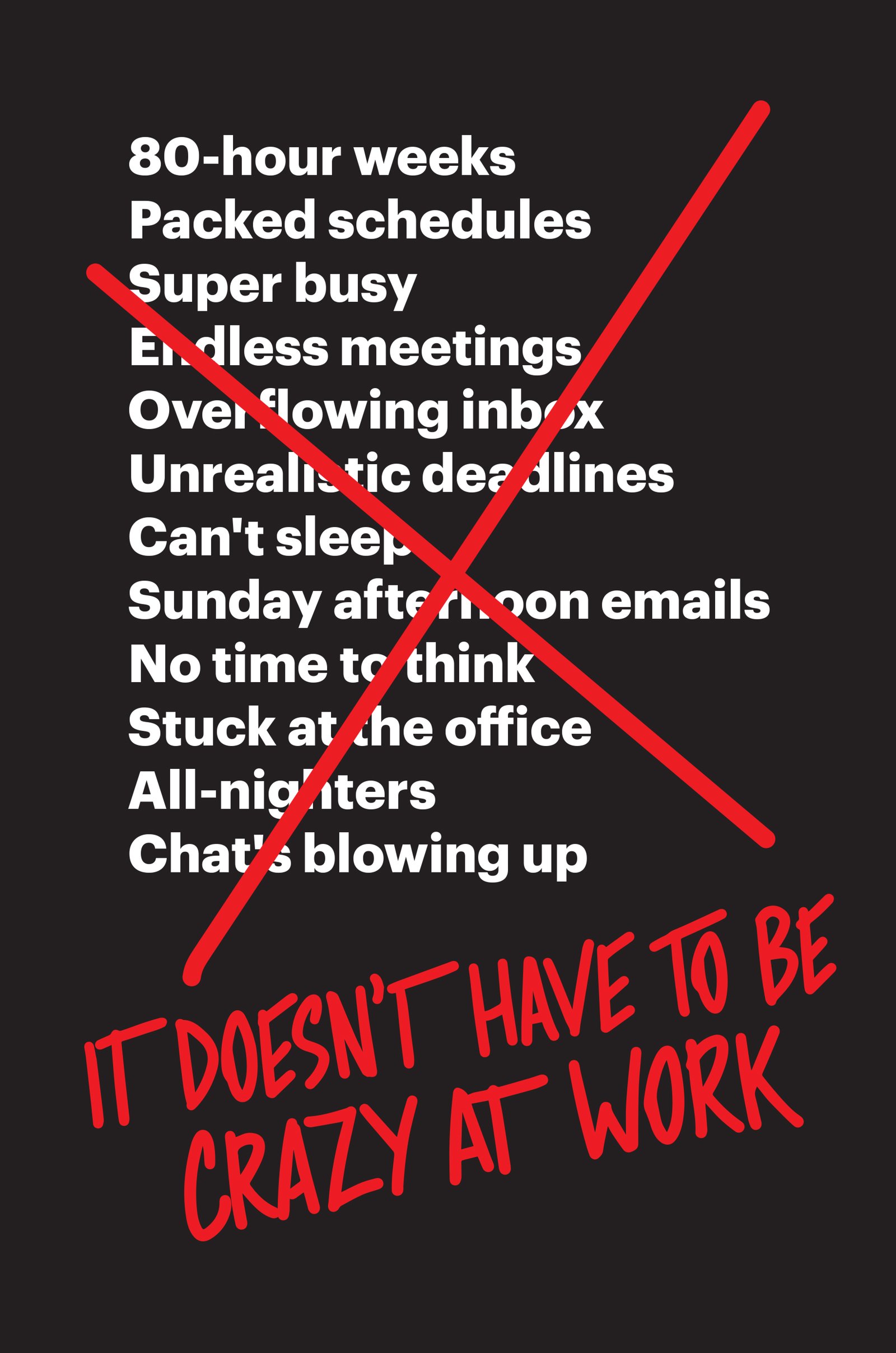
      #37 It Doesn’t Have to be Crazy at Work

      by Jason Fried and David Heinemeier Hansson

      Long hours, an excessive workload, and a lack of sleep have become a badge of honor for modern professionals. But it should be a mark of stupidity, the authors argue. Sadly, this isn’t just a problem for large organizations—individuals, contractors, and solopreneurs are burning themselves out the same way. The answer to better productivity isn’t more hours—it’s less waste and fewer things that induce distraction and persistent stress.

      It’s time to stop celebrating Crazy, and start celebrating Calm, Fried and Hansson assert.

      Fried and Hansson have the proof to back up their argument. “Calm” has been the cornerstone of their company’s culture since Basecamp began twenty years ago. Destined to become the management guide for the next generation, It Doesn’t Have to Be Crazy at Work is a practical and inspiring distillation of their insights and experiences. It isn’t a book telling you what to do. It’s a book showing you what they’ve done—and how any manager or executive no matter the industry or size of the company, can do it too.

      #38 Alternative to Futility

      by Elton Trueblood

      Modern man, now come to a full consciousness of his spiritual sickness, is ready for the first time to accept a thoroughgoing remedy, Dr. Trueblood is convinced. Here the author presents his prescription for restoring the total health of civilization.

      Dr. Trueblood’s answer is a ‘redemptive fellowship”—the only “alternative to futility” which holds promise of adequate fulfillment in our age. This book develops the idea of such a fellowship—a creative society in miniature—a “beloved community” which may have small beginnings but can grow like the mustard seed. Further, he supplies abundant suggestions as to how these redemptive fellowships may be nourished in the community and in national life.

      #39 The Gospel at WorK: How Working for King Jesus Gives Purpose and Meaning to our Jobs

      by Sebastian Traeger and Greg Gilbert

      Many Christians fall victim to one of two main problems when it comes to work: either they are idle in their work, or they have made an idol of it. Both of these mindsets are deadly misunderstandings of how God intends for us to think about our employment.

      In The Gospel at Work, Sebastian Traeger and Greg Gilbert unpack the powerful ways in which the gospel can transform how we do what we do, releasing us from the cultural pressures of both an all-consuming devotion and a punch-in, punch-out mentality—in order to find the freedom of a work ethic rooted in serving Christ.

      Solidly grounded in the gospel, The Gospel at Work confronts both our idleness at work and our idolatry of work with a challenge of its own—to remember that whom we work for is infinitely more important than what we do.

      #40 Originals

      by Adam Grant

      Using surprising studies and stories spanning business, politics, sports, and entertainment, Grant explores how to recognize a good idea, speak up without getting silenced, build a coalition of allies, choose the right time to act, and manage fear and doubt; how parents and teachers can nurture originality in children; and how leaders can build cultures that welcome dissent.

      Learn from an entrepreneur who pitches his start-ups by highlighting the reasons not to invest, a woman at Apple who challenged Steve Jobs from three levels below, an analyst who overturned the rule of secrecy at the CIA, a billionaire financial wizard who fires employees for failing to criticize him, and a TV executive who didn’t even work in comedy but saved Seinfeld from the cutting-room floor. The payoff is a set of groundbreaking insights about rejecting conformity and improving the status quo.

      #41 Quitter

      by Jon Acuff

      From figuring out what your dream is to quitting in a way that exponentially increases your chance of success, Quitter is full of inspiring stories and actionable advice.

      This book is based on 12 years of cubicle living and Jon Acuff’s true story of cultivating a dream job that changed his life and the world in the process.

      It’s time to close the gap between your day job and your dream job. It’s time to be a quitter.

      #42 Start with Why

      by Simon Sinek

      Sinek starts with a fundamental question: Why are some people and organizations more innovative, more influential, and more profitable than others? Why do some command greater loyalty from customers and employees alike? Even among the successful, why are so few able to repeat their success over and over?

      People like Martin Luther King Jr., Steve Jobs, and the Wright Brothers had little in common, but they all started with WHY. They realized that people won’t truly buy into a product, service, movement, or idea until they understand the WHY behind it.

      Start with Why shows that the leaders who’ve had the greatest influence in the world all think, act, and communicate the same way—and it’s the opposite of what everyone else does. Sinek calls this powerful idea The Golden Circle, and it provides a framework upon which organizations can be built, movements can be led, and people can be inspired. And it all starts with WHY.

      #43 The Lean Startup

      by Eric Ries

      The Lean Startup approach fosters companies that are both more capital efficient and that leverage human creativity more effectively. Inspired by lessons from lean manufacturing, it relies on “validated learning,” rapid scientific experimentation, as well as a number of counter-intuitive practices that shorten product development cycles, measure actual progress without resorting to vanity metrics, and learn what customers really want. It enables a company to shift directions with agility, altering plans inch by inch, minute by minute.

      Rather than wasting time creating elaborate business plans, The Lean Startup offers entrepreneurs—in companies of all sizes—a way to test their vision continuously, to adapt and adjust before it’s too late. Ries provides a scientific approach to creating and managing successful startups in a age when companies need to innovate more than ever.

      #44 The Juggling Act

      by Pat Gelsinger

      Lunch is reserved for meetings, technology makes us available anytime, anywhere-and somewhere along the way 9-to-5 morphed into 24/7, and technology makes us available anytime, anywhere. Our demanding schedules crowd out what matters most: family, friends, even our faith. Although it may feel like you’re living under the Big Top, take heart. You don’t have to be a circus professional to keep all the plates spinning.

      Pat Gelsinger understands this challenge. As a prominent executive in the Silicon Valley, Pat struggled to juggle* a thriving career with his family. Pat’s pursuit of balance led him to dynamic truths that revolutionized his approach to life.

      #45 Managing as if Faith Mattered

      by Helen Alford and Michael Naughton

      Managing As If Faith Mattered studies the very best of what the Catholic social tradition has to offer in response to the pressing issues and problems of our times. Challenging the often-held double standard of private and public moralities, authors Helen Alford and Michael Naughton bridge the fault line between work and faith by engaging current management issues with that tradition.

      They consider the practical realities of managers within their economic and human resource environments, and discuss such concrete management issues as job design, just wages, corporate ownership structures, marketing communication, and product development. Undergraduate and graduate students and faculty in management, business, theology, and ethics will find it an excellent text, and real-life managers will benefit from the practical wisdom it contains.

      #46 A High Impact Life

      by Pete Ochs

      Pete Ochs defines what it means to live a high impact life and provides today’s leaders with the resources they need to define their purpose, embrace their passion, and maximize their platform for success in business and beyond. Do you have what it takes to lead a high impact life?

      Ochs reached material success early in his career, but wasn’t satisfied with just a large bank account. He wanted to create human flourishing and build economic, social, and spiritual wealth for the common good. Follow Ochs’ journey inside a business operating inside a maximum-security prison, and understand how his philosophy is not only economically profitable, but socially and spiritually transforming lives.

      #47 Kingdom Calling

      by Amy Sherman

      Amy Sherman, director of the Center on Faith in Communities and scholar of vocational stewardship, uses the tsaddiqim—the vision of Proverbs 11:10, in which the people who see everything they have as gifts from God to be stewarded for his purposes― as a springboard to explore how, through our faith-formed calling, we announce the kingdom of God to our everyday world. But cultural trends toward privatism and materialism threaten to dis-integrate our faith and our work. And the church, in ways large and small, has itself capitulated to those trends, while simultaneously elevating the “special calling” of professional ministry and neglecting the vocational formation of laypeople. In the process, we have, in ways large and small, subverted our kingdom mandate.

      God is on the move, and he calls each of us, from our various halls of power and privilege, to follow him. Here is your chance, keeping this kingdom calling in view, to steward your faith and work toward righteousness. In so doing, you will bless the world, and as you flourish, the world will celebrate.

      #48 God at Work

      by David Miller

      In God at Work, David W. Miller looks at how this Faith at Work movement developed and considers its potential value for business and society. Done well, the integration of faith and work has positive implications at the personal level, as well as for corporate ethics and the broader economic sphere. At the same time, increasing expressions of religion and spiritual practices at work also present the threat of divisiveness and discrimination.

      Offering compelling new evidence of the depth and breadth of spirituality at work, Miller concludes that faith at work is a bona fide social movement and here to stay. He establishes the importance of this movement, identifies the possibilities and problems, and points toward future research questions. God at Work is essential reading for business scholars and leaders, theologians and clergy, and anyone interested in the integration of faith and work.

      #49 The Integrated Life

      by Ken Eldred

      Ken Eldred reveals how to find a deep integration between our work and faith such that all areas of our lives further God’s kingdom, glorify him, and fulfill our life mission. As we integrate our lives, he explains, we can experience the abundant life that Jesus offers us.

      Eldred explains that we have a threefold ministry in our work life: pointing those around us to God (a ministry at work), serving and creating via the work itself (a ministry of work), and redeeming the practices, policies, and structures of institutions (a ministry to work). That’s a pretty lofty charge for those of us in the marketplace!

      This book offers a powerful picture of the integrated life in which our faith impacts every sphere, including our work in the marketplace. Drawing on his own experience and the example of others, Eldred lays out practical applications that lead to abundant living through a far deeper connection between work and faith.

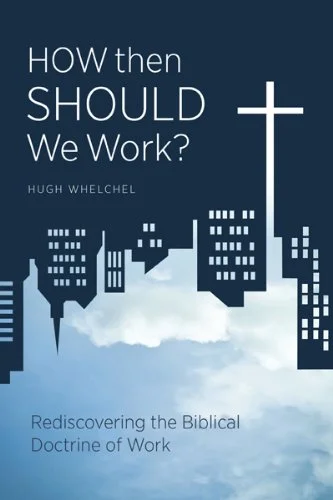
      #50 How Then Should We Work?

      by Hugh Whelchel

      “If you had asked me to describe the work I was doing that was important to God, I would have told you about my work in the lay leadership of my church, the adult Sunday school class that I taught, and the work I did with Christian non-profit groups. I secretly envied pastors, missionaries, and others who got to work ‘full time’ for God. I saw little to no connection between what I did as a businessman and God’s Kingdom …”

      Have you ever felt like what you do the majority of the week at work may not have any value to God? Many Christians struggle to find any meaning in their work. Many are taught it’s just a place to share your faith or earn a paycheck to donate to missions. Businessman Hugh Whelchel was just that guy but knew there had to be more. His thorough biblical investigation reveals the eternal significance of work within the grand biblical story of God’s mission throughout history.


      Top 100 Books (76-100)

      #76 Church for Monday: Equipping Believers for Mission at Work

      by Svetlana Papazov

      Church for Monday book encourages believers to act in an entrepreneurial manner and partner with God in his working the world. It demonstrates through many examples, how the church is uniquely designed to model Creator God, the Ultimate Entrepreneur. It makes the case that a church equipping for Monday is a missional church that fosters the creative streak placed in every one of us, practices corporate public faith,innovatively contextualizes the gospel for the postmodern world, and seeks holistic spirituality by uniting worship on Sunday to mission on Monday.

      This type of church, called Church for Monday, have grown in the awareness that as the gap between practicing Christians and the unchurched has dangerously widened, the 8-to-5 window (the work day), has become a mission field as important as the 10/40 window (a geographical are a with high concentrations of unreached people for Christ), because at work is where the majority of the unchurched spend the majority of their waking hours.

      This book asks: “What type of church prepares for that type of world?” and offers the local church a practical re-tooling to equip believers for the workweek on Monday, regain relevance in the lives of the lapsed and non-Christians in its community, and re-establish the Church’s witness in the public arena.

      #77 Joy and success at work

      by Mark McClain

      “I can’t wait to get to work!” When was the last time you felt that way? Have you ever?
      Mark McClain has and still does. He and his leadership teams have focused on creating companies that make the quality of their employees’ work experiences of equal importance to the quality of the solutions those employees create. With Joy and Success at Work, McClain has produced a manual that shares how he and his teams have done it―and how you and your team can, too.
      Speaking directly to the lack of fulfillment that too often accompanies work―with generous portions of humor and irreverence―Mark McClain deconstructs the modern business environment, then puts it back together.
      Shot through with pithy tales from his own experiences, Joy and Success at Work is Mark’s honest take on what team building can be, and done right, what it produces: Great places to work that support people’s broader lives, rather than sucking the life out of them.

      #78 Emotional Intelligence 2.0

      by Travis Bradberry & Jean Greaves

      In today’s fast-paced world of competitive workplaces and turbulent economic conditions, each of us is searching for effective tools that can help us to manage, adapt, and strike out ahead of the pack.

      By now, emotional intelligence (EQ) needs little introduction—it’s no secret that EQ is critical to your success. But knowing what EQ is and knowing how to use it to improve your life are two very different things.

      Emotional Intelligence 2.0 delivers a step-by-step program for increasing your EQ via four, core EQ skills that enable you to achieve your fullest potential:

      1. Self-Awareness

      2. Self-Management

      3. Social Awareness

      4. Relationship Management

      #79 Every Job a Parable: What Walmart Greeters, Nurses and Astronauts Tell Us About God

      by John Van Sloten

      A Walmart greeter, a nurse, and an astronaut walk into a church…

      They each bring with them their own exhaustions and exasperations, their own uncertainty about whether and how their work matters to God. Good news: All work matters to God, because all work reflects some aspect of the character of God. God created the world so that it runs best when it mirrors Him, and we ourselves find the most fulfillment when we recognize God behind our labor.

      John Van Sloten offers a fascinating and innovative reflection on vocation: Our work is a parable of God; as we work, we are icons of grace.

      #80 Fabric of Faithfulness

      by Steve Garber

      All kinds of important choices are made during the college years. Young men and women explore what they really believe about the nature of the world and the purpose of life. They choose their work. They build friendships and often choose to marry. They develop goals and adopt habits that may last a lifetime. Yet late modernity is not a welcome environment for emotional, intellectual and spiritual formation. Society is increasingly fragmented. And the educational system itself, fragmented and specialized, may disintegrate more than it integrates.

      How do parents, professors, campus ministers, youth pastors and others help students, during one of the most eventful and intense periods of life, learn to connect what they believe about the world with how they live in it? Steven Garber vigorously engages just that question in this revised edition that includes a new chapter on what he has learned about lifelong formation in the years since the book first appeared. Drawing on the history of ideas, ethics, sociology and popular culture, he offers must-reading on the critical lifework of making sense of life.

      #81 The Fabric of This World

      by Lee Hardy

      An in-depth historical, philosophical, theological–and practical–exploration of work from an evangelical perspective. Hardy discusses several historical views of work from the ancient Greeks onward, highlighting the Christian concept of vocation as articulated by Luther and Calvin; these expositions lead to practical applications regarding the personal issue of career choice and the important (but often neglected) social issue of job design.

      #82 Fruitfulness on the Frontline

      by Mark Greene

      Daily life may never be quite the same. In this horizon-expanding, spirit-lifting, heart-warming book Mark Greene serves up a liberating view of how God can and does work in and through us in our daily lives. Whether you’re a student or retired, at the gym or at work, at the school gate or in the supermarket, here is a fresh and original framework for fruitfulness which will open up a host of possibilities to make a difference for Christ among the people you naturally meet in the places you find yourself day by day. Brimming with true stories, the combination of fresh Biblical insight, humor, and practical steps will not only spark your imagination; it will enrich your sense of wonder at the greatness and grace of the God who not only gave his life for us, but invites us to join him in his glorious, transforming work. And who helps us as we do.

      #83 The Heavenly Good of Earthly Work

      by Darrell Cosden

      Does a person’s day to day work have any ultimate value from the perspective of Eternity? Should our work be seen as a discipline through which we connect spiritually with God and others? Is ordinary work the primary way that people can participate in God’s mission to make all things new? What is the heavenly good of earthly work? In this book Darrell Cosden takes us on a spiritual and theological journey of discovery exploring these questions. Creatively, constructively, and sometimes provocatively, he shows us that the heavenly good of earthly work really makes the gospel good news for ordinary people by offering the possibility of a genuinely purpose-full Christian life.

      #84 It’s About Excellence

      by David W. Gill

      It’s About Excellence: Building Ethically Healthy Organizations   For too many businesses and their leaders today, business ethics is just about staying out of jail. “Litigation, indictment, and penal system avoidance” is not just the first but the only reason they think ethics is important. It’s about “damage control.” It’s not by accident that these damage control ethics programs are generally under the guidance of legal and compliance departments.   Of course companies need a damage control, crisis management, trouble-shooting component in their ethics and management toolbox. But if that’s all there is, something of critical business value is missing.

      It’s About Excellence tells the larger story. Ethics is about identifying and pursuing excellence and business achievement. It’s about getting clear on an inspiring corporate mission and vision, building a value-embedded culture, and pursuing principle-guided practices. Ethics is not a patch-and-repair add-on here; it’s something woven through the whole organization, created and owned by the whole workforce.

      #85 Whatever You Do: Six Foundations for an Integrated Life

      by Luke Bobo

      We all long for our lives to have meaning and purpose, yet we live in a segmented way — our faith is separate from our work, home is separate from church, and more. As whole persons, this is not the way God designed us to live. Instead, our lives should exhibit coherence in all areas as we seek to flourish in our personal lives, within our communities, and churches.

      Whatever You Do explores how we can pursue a more integrated faith and life through six important theological areas that provide a scaffolding to help us live meaningful lives, which is a fundamental human longing. As humans, we long for truth and understanding of the world around us. Scripture provides us with a foundation for how to “live, move, and have our being,” as Paul writes in Acts, which leads to our own flourishing, the good of our neighbors, and the glory of God.

      While the six theological foundations are not exhaustive, they cover a wide range of biblical themes that are essential for a Christian worldview. These foundations include the Bible’s Big Story, God’s Mission, Personal Wholeness, The Goodness of Work, Economic Wisdom, and the Local Church. These six authors examine how the themes of Scripture influence and shape every area of our lives, including our work.

      #86 What’s Best Next: How the Gospel Transforms the Way You Get Things Done

      by Matt Perman

      Productivity isn’t just about getting more things done. It’s about getting the right things done–the things that count, make a difference, and move the world forward. In our current era of massive overload, this is harder than ever before. So how do you get more of the right things done without confusing mere activity for actual productivity?

      When we take God’s purposes into account, a revolutionary insight emerges. Surprisingly, we see that the way to be productive is to put others first–to make the welfare of other people our motive and criteria in determining what to do (what’s best next). As both the Scriptures and the best business thinkers show, generosity is the key to unlocking our productivity. It is also the key to finding meaning and fulfillment in our work.

      What’s Best Next offers a practical approach for improving your productivity in all areas of life. It will help you better understand:

      • Why good works are not just rare and special things like going to Africa, but anything you do in faith even tying your shoes.

      • How to create a mission statement for your life that actually works.

      • How to delegate to people in a way that actually empowers them.

      • How to overcome time killers like procrastination, interruptions, and multitasking by turning them around and making them work for you.

      • How to process workflow efficiently and get your email inbox to zero every day.

      • How your work and life can transform the world socially, economically, and spiritually, and connect to God’s global purposes.

      By anchoring your understanding of productivity in God’s purposes and plan, What’s Best Next will give you a practical approach for increasing your effectiveness in everything you do. This expanded edition includes a new chapter on productivity in a fallen world and a new appendix on being more productive with work that requires creative thinking.

      #87 Joy at Work

      by Dennis W. Bakke

      In Joy at Work, Bakke tells how he helped create a company where every decision made at the top was lamented as a lost chance to delegate responsibility–and where all employees were encouraged to take the “game-winning shot,” even when it wasn’t a slam-dunk. Perhaps Bakke’s most radical stand was his struggle to break the stranglehold of “creating shareholder value” on the corporate mind-set and replace it with more timeless values: integrity, fairness, social responsibility, and a sense of fun.

      #88 Leadership as Art

      by Max Depree

      Leadership Is an Art has long been a must-read not only within the business community but also in professions ranging from academia to medical practices, to the political arena. First published in 1989, the book has sold more than 800,000 copies in hardcover and paperback. This revised edition brings Max De Pree’s timeless words and practical philosophy to a new generation of readers.

      De Pree looks at leadership as a kind of stewardship, stressing the importance of building relationships, initiating ideas, and creating a lasting value system within an organization. Rather than focusing on the “hows” of corporate life, he explains the “whys.” He shows that the first responsibility of a leader is to define reality and the last is to say thank you. Along the way, the artful leader must:

      • Stimulate effectiveness by enabling others to reach both their personal potential and their institutional potential

      • Take a role in developing, expressing, and defending civility and values

      • Nurture new leaders and ensure the continuation of the corporate culture

      Leadership Is an Art offers a proven design for achieving success by developing the generous spirit within all of us. Now more than ever, it provides the insights and guidelines leaders in every field need.

      #89 Leadership as a Lifestyle

      by John Hawkins

      Shows how personal spirituality and spirituality in the workplace can be both substantive and practical. Hawkins draws from his years of entrepreneurial experience and organizational leadership to provide instruction that is both credible and insightful to people who want to rethink and redirect their leadership in their marriages, families and careers.

      #90 The Leadership Challenge: How to Make Extraordinary Things Happen in Organizations

      by James Kouzes and Barry Posner

      The Leadership Challenge is the gold-standard manual for effective leadership, grounded in research and written by the premier authorities in the field. With deep insight into the complex interpersonal dynamics of the workplace, this book positions leadership both as a skill to be learned, and as a relationship that must be nurtured to reach its full potential. This new sixth edition has been revised to address current challenges, and includes more international examples and a laser focus on business issues; you’ll learn how extraordinary leaders accomplish extraordinary things, and how to develop your leadership skills and style to deliver quality results every time. Engaging stories delve into the fundamental roles that great leaders fulfill, and simple frameworks provide a primer for those who seek continuous improvement; by internalizing key insights and putting concepts into action, you’ll become a more effective, more impactful leader.
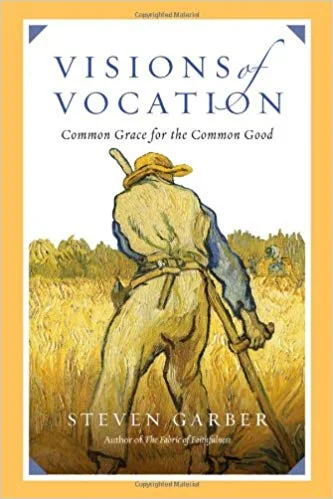
      #91 Person Called You

      by Bill Pollard

      Bill Hendricks goes beyond personality types to explore and explain the fullness of human giftedness and the concept of personhood. Using the “Discover Your Design” test, The Person Called You provides a specific, comprehensive, and accurate understanding of the phenomenon of human giftedness from a Biblical perspective. It moves past the limited scope of other gift discovery tests to look at each person’s unique God-given designs and motivations. This book helps the reader understand their deep uniqueness as a human being and purpose in life from a variety of angles –work, marriage, parenting, education, and one’s relationship with God.

      The Person Called You is for anyone who knows they aren’t quite where they ought to be – and not quite where they will flourish best – and wants to who they were created to be. It’s a presentation of hope – hope that there actually are answers to some of life’s most perplexing questions.

      #92 Workplace Grace

      by Bill Peel and Walt Larimore

      You can take your faith to work in appropriate, engaging ways. Workplace Grace offers a simple, non-threatening approach to evangelism. Whether your work takes you to a construction site, a cramped cubical or the corner office, every Christian plays a significant role in the Great Commission. Between Sundays, you can be a pipeline for God’s grace in the most strategic mission field in the world: your workplace. Workplace Grace is for Christians who are not gifted evangelists, yet they want to make a spiritual difference at work and see their coworkers and friends come to faith in Jesus Christ. After adopting Workplace Grace strategies, Christians who once felt awkward sharing their faith now say, “A load of guilt has been taken off my shoulders.” “I never knew sharing my faith could be so simple.” “I can do this!”

      #93 The Speed of Trust: The One Thing That Changes Everything

      by Stephen M.R. Covey

      Stephen M. R. Covey, widely known as one of the world’s leading authorities on trust, asserts that it is “the most overlooked, misunderstood, underutilized asset to enable performance. Its impact, for good or bad, is dramatic and pervasive. It’s something you can’t escape.” Thankfully, it’s is also the thing that can dramatically improve your personal and professional success.

      Why trust? The simple, often overlooked fact is this: work gets done with and through people. The Speed of Trust offers an unprecedented and eminently practical look at exactly how trust functions in every transaction and every relationship—from the most personal to the broadest, most indirect interaction. It specifically demonstrates how to establish trust intentionally so that you and your organization can forego the time-killing, bureaucratic check-and-balance processes that is so often deployed in lieu of actual trust.

      This 2018 updated edition includes an insightful afterword by the author which explores ten key reasons why trust is more relevant now than ever before—including how trust is the new currency of our world today.

      #94 Spirituality Inc

      by Lake Lambert

      For many Americans spirituality and business seem to be polar opposites: one is concerned with lofty questions of ultimate significance, the other with mundane matters of the daily grind. Yet over the last two decades the two have become increasingly linked, and as the barriers between them are broken down, many see this as a revolutionary shift in American business culture.

      Lake Lambert III provides a comprehensive examination of the workplace spirituality movement, and explores how it is both shaping and being shaped by American business culture. Situating the phenomenon in an historical context, Lambert surveys the role of spirituality in business from medieval guilds to industrial “company towns” right up to current trends in the ever-changing contemporary business environment. Using case studies from specific businesses, such as Chick-fil-A and Hobby Lobby, he analyzes the enhanced benefits and support that workplace spirituality offers to employees, while exposing the conflicts it engenders, including diversity, religious freedom, and discrimination issues.

      The American workplace today is experiencing dramatic upheaval and change. Spirituality, Inc. offers important insights into the role of religion in this transformation. With employees seeking new ways to strike a proper life-work balance and find meaning in their everyday lives, spirituality in the workplace is a trend that will become increasingly important in the American business landscape. Spirituality, Inc. provides a critical overview of this phenomenon that does not ignore the movement’s many positive contributions to the workplace, yet does not overlook the potential for abuse.

      #95 Work: The Meaning of Your Life

      by Lester DeKoster

      Our daily work – whatever our job is – gets the largest single block of our lives. But time on the job is for too many of us time at the rat race – with the rats winning. Is this “it”? I used to think so, but one day two things dawned on me together: 1) if life is to have a meaning, I would have to find it, not hope to create it for myself; and, 2) living must get its meaning, first of all, on the job because that’s the drain down which the best hours of every week dribble away. I write this little booklet so you can share, if you want to, in the discovery that it is daily work, whatever your job, that gives meaning to life, not because you will now decide to put meaning there but because God has already done so. Come see.

      #96 Taking Your Soul to Work: Overcoming the Nine Deadly Sins of the Workplace

      by R. Paul Stevens and Alvin Ung

      Instead of regarding work as a diversion from the spiritual life, R. Paul Stevens and Alvin Ung are convinced that it is an arena and an incentive for spiritual growth. However, they acknowledge that this is not without its challenges.

      Work in Progress examines life in the workplace through an innovative exploration of both the seven deadly sins and the ninefold fruit of the Spirit. This approach provides a framework to reveal how the Spirit has given Christians powerful gifts to overcome struggles the face in the challenges of daily work in a globalized world. The authors interact both with one another and with the wisdom of great spiritual writers of history in order to draw out real-life dilemmas and to suggest practical tips for becoming vibrant disciples in the workplace.

      In addition to filling a critical need for a resource on spiritual growth at work, Work in Progress has an intercultural approach ― the authors are from Canada and Malaysia ― that is particularly dynamic and engaging.

      #97 Team of Teams: New Rules of Engagement for a Complex World

      by General Stanley McChrystal

      In this book, McChrystal shows not only how the military made that transition, but also how similar shifts are possible in all organizations, from large companies to startups to charities to governments. In a turbulent world, the best organizations think and act like a team of teams, embracing small groups that combine the freedom to experiment with a relentless drive to share what they’ve learned.

      Drawing on a wealth of evidence from his military career, the private sector, and sources as diverse as hospital emergency rooms and NASA’s space program, McChrystal frames the existential challenge facing today’s organizations, and presents a compelling, effective solution.

      #98 Traction: Get a Grip on Your Business

      by Gino Wickman

      Do you have a grip on your business, or does your business have a grip on you?

      All entrepreneurs and business leaders face similar frustrations—personnel conflict, profit woes, and inadequate growth. Decisions never seem to get made, or, once made, fail to be properly implemented. But there is a solution. It’s not complicated or theoretical.The Entrepreneurial Operating System® is a practical method for achieving the business success you have always envisioned. More than 2,000 companies have discovered what EOS can do.

      In Traction, you’ll learn the secrets of strengthening the six key components of your business. You’ll discover simple yet powerful ways to run your company that will give you and your leadership team more focus, more growth, and more enjoyment. Successful companies are applying Traction every day to run profitable, frustration-free businesses—and you can too.

      For an illustrative, real-world lesson on how to apply Traction to your business, check out its companion book, Get A Grip.

      #99 Vision to Results: Leadership in Action

      by Jim Fischetti

      As a leader, your job is to make your people and your organization better. It’s safe to say you have no intention of leading a stagnant organization, yet organizational decay can creep in and go unnoticed unless you’re actively working to combat it. What begins with a few missed goals and declining productivity can evolve into a widespread malaise that robs your people of their passion and causes them to create uninspired work. For every organization in this situation, the real culprit is a lack of vision. If leaders want their people to achieve results that will drive the organization forward, each employee must understand why they’re doing what they’re doing. In Vision to Results, Jim Fischetti teaches you how to create an actionable vision for your organization that brings everyone’s role into sharp focus, as well as implement a continuous accountability system that addresses problems before they arise, keeping your organization healthy for years to come.
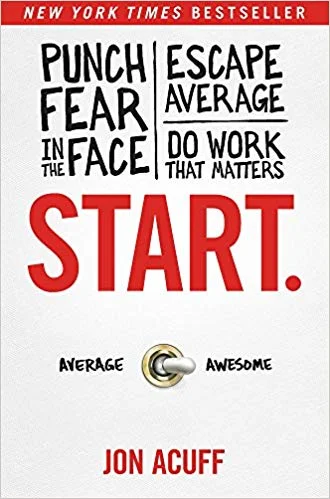
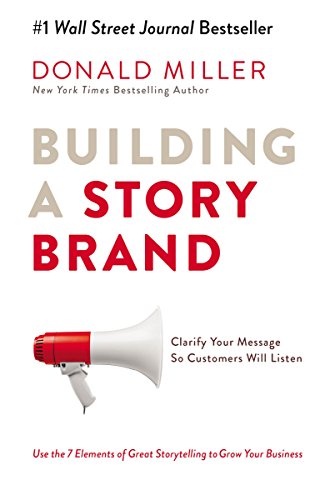
      #100 Working: People Talk About What They Do All Day and How They Feel About What They Do

      by Studs Terkel

      Perhaps Studs Terkel’s best-known book, Working is a compelling, fascinating look at jobs and the people who do them. Consisting of over one hundred interviews conducted with everyone from gravediggers to studio heads, this book provides a timeless snapshot of people’s feelings about their working lives, as well as a relevant and lasting look at how work fits into American life.


      OTHERS WE RECOMMEND

      The list continues to grow as we get great recommendations from the Faith Driven Entrepreneur Family. Here’s a few others that have come in since we put together the list.