





Results Matter – Deficient by Design
This video was originally published here by The C12 Group
— by The C12 Group
What if God is glorified by taking us to Red Sea Moments on purpose? How do you respond as a leader when you find yourself up against the wall?
Related articles
Featured























The Gratitude Game
At the end of every podcast, we like to ask our guests to share what God has been teaching them in this season of life. This week’s guest is Scott Harrison of Charity: Water.
Psalm 7:17
I will give thanks to the Lord because of his righteousness;
I will sing the praises of the name of the Lord Most High.
The practice of gratitude is so important, which is actually not super intuitive for me. I’m an enneagram eight, you know, I’m always looking for a fight and nothing is ever good enough. It’s funny, during the book tour, people would say, look at charity water, you’ve raised like half a billion dollars and you’ve grown faster than anyone. Did you ever think that you guys would be so successful?
I’m like, this is such a small fraction of what I believe we should have and would have achieved by now. I’m totally dissatisfied with 11 million people. It’s frickin clean water. You know, I’ve got friends that built and sold video games for twice as much money as I’ve raised to save human life in half the time, you know, so I think there’s just this sense of discontent that is kind of who I am and it’s just how I look at things.
So I’ve been trying in this season to just really be grateful. I mean, I’ve got my family, I’ve got my kids. You know, we wake up every morning and we try to play the gratitude game and list out 30 or 50 things that we’re grateful for, our health, our family, you know, the ability just to be a couple hours outside of New York City with our loved ones in their 80s and know that we can probably protect them a little bit better
Even, the other day we were walking through the woods and I was thanking God for the thorns. And my kids are like, why thorns? And I’m like, well, I have a machete in my hand. And it’s fun to cut them down as we’re like cutting a path through the backyard.
So I think I’m just trying to just be so grateful in the midst of really bad news, both for our organization and our impact and giving. Obviously, I’ve got many friends in New York City who are sick with COVID 19 and are really struggling and have double pneumonia. I think everybody listening can attest it has been a very, very long and bad news cycle.
And I’ll tell you, you know, if you sit around with a spouse or your kids or you just go out on your own, the minute you finish naming 50 things you’re grateful for, it really just changes you. I mean, you can last on that for a while before you go back into the grumbling or irritability that many of us are experiencing cooped up with our kids, ready to do homeschool.
Rooting for Rivals by Peter Greer and Chris Horst
We continue to count down the Top 100 Books for Faith Driven Entrepreneurs with…
Rooting for Rivals
by Peter Greer and Chris Horst
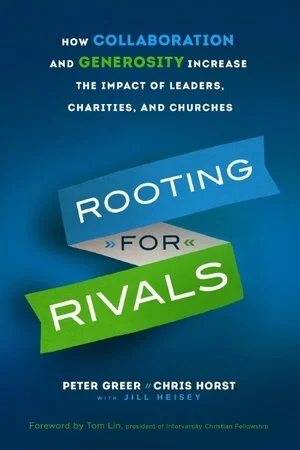
Christian organizations have come to be known mostly for what they’re against. And all too often, that includes being against each other. But amid growing distrust of religious institutions, Christ-centered nonprofits have a unique opportunity to link arms and collectively pursue a calling higher than any one organization’s agenda.
Rooting for Rivals reveals how your ministry can multiply its impact by cooperating rather than competing with others, modeling Christlike love and generosity in the process. Peter Greer and Chris Horst explore case studies illustrating the power of collaborative ministry. Writing with vulnerability, they also share their own failures and successes in moving toward a kingdom mindset.
In Rooting for Rivals you’ll discover the key to revitalizing your ministry and making an enduring difference in the world.
You can also hear Peter Greer talk about this book on his podcast with FDE.
Click on the book cover to check out the Reviews and Purchase at Amazon
Katie Adkins
Founder | Adkins Talent Solutions
Katie Melick Adkins founded Adkins Talent Solutions in 2019 after over 10 years of business experience helping leaders uncover and maximize their underlying potential. Prior to Adkins Talent Solutions, Katie worked at Salesforce running Leadership Programs. Her career and volunteer experiences provide her with relevant insight in the different worlds of marketing, advertising, start-ups, high-tech, corporations, and non-profits.
Katie has formal training from Emory Executive Coaching, Co-Active Training Institute, Human Capital Institute (HCI), and other development sessions. She is Myers Briggs (MBTI) certified as well as experienced with StrengthsFinder and other assessments.
Katie was born with a passion to inspire and empower others to better understand and value their unique talents! She began mentoring others in grade school, grew up coaching a swim team, and even created businesses with family and friends.

CONTRIBUTIONS TO FAITH DRIVEN ENTREPRENEUR
Featured


Being “crisis ready”
This article was originally published here by the Boating Industry
— by Bill Yeargin
The past 100 years has seen one crisis after another; WWI, the Spanish Flu, the stock market crash, the Great Depression, WWII, Korean War, flu’s of the 50’s and 60’s, Vietnam War, Oil Embargo, inflation, sky high interest rates, the ‘87 stock market crash, the Gulf War, 9/11, the Great Recession and now COVID-19. You’d think we would recognize that crisis is a regular occurrence; but, we don’t.
Despite a clear track record of crisis on a consistent basis, we often get captured by the thought that when things are good, they will stay that way.
Last year I read a book, called “This Time It’s Different,” that did a good job of explaining how we get captured by thinking our current situation is different than similar situations in the past and ignore lessons we should have learned.
As Mark Twain is reputed to have said, “History does not repeat itself, but it rhymes.”
Since it is difficult to project what the next crisis might be or when it will occur, some of the best things we can do are:
• Expect that there will be a crisis even (maybe, especially) when you don’t see it coming and remain flexible.
• Create a crisis business model that is flexible and can be adjusted quickly if needed. I am wired to be an optimist, so this is not negative, it is smart.
• Have a downturn plan ready. While you cannot predict the crisis, you can have a plan for how you will function when a crisis happens. This is not necessarily a detailed plan, but a model that helps you adjust your business for the unpleasant surprises that are inevitable. This needs to be a workable model with targets that are achievable.
• Once the crisis starts, assume a “fighter pilot” mentality. My CIA agent friend Michele tells me that CIA agents are taught that they have three options in a crisis (fight, flight, or freeze). She says the CIA teaches them the importance of “getting off the spot;” which means that of the three options, the worst choice is to freeze.
• Use the crisis as an opportunity to “reset.” I have been repeating this with our team over and over since COVID-19 began. As much as we don’t want to deal with this pandemic, it is a rare opportunity to make substantive change. No one wants a crisis, but teams need to see them as an opportunity.
Forming your team’s thinking is more important than giving them a to-do list. Get your team to take on a fighter pilot mentality and embrace crisis as an opportunity; they will take care of the details.
The last couple of months we have all had a crash course in crisis management, and, this particular crisis has been one with no playbook. We have all been writing the pandemic playbook on the fly. But despite the uniqueness of a global pandemic, the crisis principles are still the same; there are things we can do to prepare and respond well when the unexpected happens.
Related articles
Featured


















——
[ Photo by The New York Public Library on Unsplash ]
How to Grow in Godliness
At the end of every podcast, we like to ask our guests to share what God has been teaching them in this season of life. This week’s guest is Pete Kelly , the CEO of Apartment Life—a growing nationwide ministry helping people see their neighbors as their greatest amenity, while also improving financial return for real estate owners.
2 Peter 1:3-8
His divine power has given us everything we need for a godly life through our knowledge of him who called us by his own glory and goodness. Through these he has given us his very great and precious promises, so that through them you may participate in the divine nature, having escaped the corruption in the world caused by evil desires. For this very reason, make every effort to add to your faith goodness; and to goodness, knowledge; and to knowledge, self-control; and to self-control, perseverance; and to perseverance, godliness; and to godliness, mutual affection; and to mutual affection, love. For if you possess these qualities in increasing measure, they will keep you from being ineffective and unproductive in your knowledge of our Lord Jesus Christ.
Just a couple days ago I emailed our senior leadership team a passage from 2 Peter 1:3-8 that just really stood out to me as being so essential for what we do. But in that passage, the apostle Peter says God’s divine power has given us everything we need for life and godliness through our knowledge of him, who called us by his own glory and goodness.
And then he goes on to say, for this very reason, make every effort to add to your faith. And he really lists several attributes that we need to add to our faith. So he says for this very reason, make every effort to add to your faith. Goodness. And the Greek word for goodness, which means excellence. Sometimes it’s translated as moral excellence. But in general, it’s just excellence.
And so one of the first attributes of our Apartment Life coordinators is they need to be able to serve with excellence, because if you’re not serving the client with excellence, you’re not going to be able to keep that mission field open. To assess for this very reason, make every effort to add to your faith, goodness and after goodness, knowledge.
So, in Peter’s context, that idea of knowledge had to do with knowing God, which absolutely our coordinators need to know God and they need to know his word. But in addition to that, they need to know their clients. They need to know what their client’s preferences are. They need to know how to run an effective Apartment Life program. So they not only need to grow in faith, they need to grow and goodness or excellence, they need to grow in knowledge and then after knowledge, self-control.
One of the things we like to tell our teams is it takes a lot of self-discipline and control to be an apartment life coordinator, because managers aren’t always grateful. Residents can be quirky. Sometimes you don’t want to do a welcome or renewal visit after work. So it takes a lot of self-control. And Peter goes on to say self-control and perseverance. So there’s a stick to it type of attitude.
And then after perseverance, godliness. You need to have a character that reflects who God is to your residents and to godliness, brotherly kindness and a brotherly kindness love. So, first, you need to like people. And then as you like them, you’ll grow to love them. And it’s hard to love your neighbor with God’s unconditional love if you don’t even like them to begin with.
That passage out of 2 Peter is just a great descriptor of what it means to be a great Apartment Life team or coordinator.
Trusting God in Trials
Trusting God in Trials
Sometimes the journey of faith is more important than the actual on-going success of a business.
Read More →
Trusting God in Trials