4 Qualities of a Christ-Centered Business (and what a Christ-Centered business is not)

by Darren Shearer

Should businesses be “Christ-centered”? Or, is that calling reserved for your local church?

Most Christian business professionals are employed within “Babylonian” organizational cultures. Unlike Daniel, Shadrach, Meshech, and Abednego, these Christians in “Babylonian” businesses won’t be thrown into a lion’s den or a fiery furnace. However, the corporate cultures in which they perform their jobs usually discourage any public expressions of their Christian faith. Yet, they can still make an impact for Christ from within these organizations.

For those of us that live in a free society and are called and gifted to be entrepreneurs and business leaders, how much more do we have opportunities to shape the culture of our businesses. We can dedicate our businesses to God and submit them to his purposes and strategies.

Before I talk about what a “Christ-Centered Business” is, I need to share what it is not.

It’s not about only hiring Christians.

Refusing to hire anyone except Christians is illegal (at least, in the United States). Not only is it illegal, such a practice would prevent a business from fulfilling a key part of its redemptive purpose: being salt and light among unbelievers in the workplace. Jesus spent a significant portion of his time with unbelievers. If we’re not working with unbelievers, our business probably isn’t being Christ-Centered.

It’s not about being “churchy.”

Being a Christ-Centered Business is not about packing your employees into the conference room, playing worship music, and bringing in your pastor to preach to them. It’s not about transplanting local church service models into a business setting.

It’s not necessarily about being financially prosperous.

If we define prosperity only in terms of money and influence, it’s not enough to say, “Christ-Centered businesses prosper more than businesses led by non-Christians.” Many businesses led by non-Christians are on the Fortune 500Inc. 500, and other lists of the most successful companies in the world. Jesus explains this phenomenon by saying that God “causes His sun to rise on the evil and the good, and sends rain on the righteous and the unrighteous” (Matt. 5:45b).

It’s about more than applying timeless principles.

The Bible is full of practical business wisdom that has proven effective in the marketplace since the beginning of economics. Christians and non-Christians alike can apply the Bible’s timeless business principles and experience the benefits. Therefore, it’s possible to take business principles from the Bible and leave God out of your business. God is a person, not merely a set of timeless principles.

If there is more to being a Christ-Centered business than hiring Christians only, churchiness, financial prosperity, and the application of timeless wisdom, what are the qualities by which they can be recognized? Here, I will offer share four of those indispensable qualities.

Quality #1 – Eternal Return on Investment (EROI) is the Bottom Line

The bottom line for a Christ-Centered business is not merely financial, social, environmental, or anything else that is temporary. The bottom line for a Christ-Centered is eternal. The Bible says…

“…each man’s work will become evident; for the day will show it because it is to be revealed with fire, and the fire itself will test the quality of each man’s work. If any man’s work which he has built on it remains, he will receive a reward. If any man’s work is burned up, he will suffer loss; but he himself will be saved, yet so as through fire” (1 Cor. 3:13-15)

If it doesn’t last in eternity, it’s not the bottom line.

Quality #2 – Makes disciples of Jesus

I believe the ultimate purpose of a Christ-centered business is the same as for a Christian individual: “to make disciples of all nations” (Matt. 28:19).

Making disciples of Jesus in a business setting may sound more complicated than it is. The Apostle Paul simplified and defined disciple-making with this invitation: “Imitate me as I imitate Christ” (1 Cor. 11:1).

Do the business practices of your company reflect the character of Jesus Christ? In other words, does your company treat your employees, customers, clients, and other stakeholders as Jesus would? Have you invited others to follow your example? If so, you are making disciples, followers, of Jesus. It’s that simple.

Quality #3 – Led and empowered by the Spirit of God

If a company is in business to fulfill the mission of God, it only makes sense that the company would be led by God Himself. He leads us through the presence and voice of the Holy Spirit in our lives.

When leading the children of Israel toward the Promised Land, Moses said to God, “’If your Presence does not go with us, do not send us up from here” (Exodus 33:15). He didn’t want to move anywhere unless he was following God.

When I first started out as an entrepreneur, I hired a web developer without first praying about whether he was the right choice. To make a long story short, I ended up losing $5,000 on account of this person and had nothing to show for it. Asking God first would have prevented the loss of six months, $5,000, and my peace of mind during that frustrating season of my life.

Quality #4 – Chooses to be accountable to godly advisors

The Bible says, “Where there is no guidance the people fall, but in abundance of counselors there is victory” (Prov. 11:14).

There are many thought leaders in and around my industry that I respect for the advice that they share. The problem is that many of them do not know God. A diet of business advice and guidance fed primarily by non-Christian thinkers will condition a person to believe that God is not relevant to his/her business. As Larry Burkett said in his classic, Business by the Book, “The difficulty isn’t the advice they give; it’s the advice they don’t give, specifically, the lack of spiritual insight.”[i]

Over the past several years, I have benefitted from the business wisdom of Christian thought leaders such as Dave Ramsey, Dan Miller, Michael Hyatt, John Maxwell, and others. At the same time, I must admit that a large percentage of the business books I have read and business podcasts I have listened to were presented by non-Christian thought leaders.

In your company, make sure that you are giving priority to the voice of counsel from those who share your Christian values.

[i] Larry Burkett, Business by the Book (Nashville: Thomas Nelson, 1998), 89.

What are some other qualities of “Christ-Centered businesses”? 

Editor’s Note:  we’re grateful to have Darren, The director of the Theology of Business Institute as contributor at FDE.  

Becoming Formidable

Editor’s Note: On the list of articles that I have found to be timely and on-aim, this one (originally published on Medium) from our friend Jeff LaBarge is at or near the top of the list. In an environment that embraces and even celebrates hardship, Jeff does a great job of unpacking faith as the source code that can make a founder ‘Formidable.’ For so many entrepreneurs in Silicon Valley and around the world, our identity becomes inextricably entangled with our work. As the business ebbs and flows, so goes our heart –> towards discouragement or towards pride. I found Jeff’s perspective on his own journey as an entrepreneur, as well as his counsel on the role that prayer has in his daily journey, to be bold and insightful — Luke Roush

How To Become Formidable — An Unpopular But Effective Way

by Jeff Labarge

Silicon Valley celebrates founders with super-human ability to focus, work hard, and survive the extreme pressure startups. We retell their heroic stories and celebrate their successes. However, there is a glaring absence of information regarding how to develop the character traits required to overcome the intense stress and hardships of starting a company.

For example, Ashlee Vance described Elon Musk this way:

He saw a man who arrived in the United States with nothing, who had lost a child, who was being pilloried in the press by reporters and his ex-wife and who verged on having his life’s work destroyed. “He has the ability to work harder and endure more stress than anyone I’ve ever met,” Gracias said. “What he went through in 2008 would have broken anyone else. He didn’t just survive. He kept working and stayed focused.” That ability to stay focused in the midst of a crisis stands as one of Musk’s main advantages over other executives and competitors. “Most people who are under that sort of pressure fray,” Gracias said. “Their decisions go bad. Elon gets hyper rational. He’s still able to make very clear, long-term decisions. The harder it gets, the better he gets. Anyone who saw what he went through firsthand came away with more respect for the guy. I’ve just never seen anything like his ability to take pain.”

The above narrative is inspiring, but fails to answer the critical follow-up question. How do entrepreneurs obtain/develop this characteristic? What do you do if you weren’t born with Musk’s super-human ability to deal with stress? Musk himself, worries about this for his kids:

It bothers Musk a bit that his kids won’t suffer like he did. He feels that the suffering helped to make him who he is and gave him extra reserves of strength and will. “They might have a little adversity at school, but these days schools are so protective,” he said. “If you call someone a name, you get sent home. When I was going to school, if they punched you and there was no blood, it was like, ‘Whatever. Shake it off.’ Even if there was a little blood, but not a lot, it was fine. What do I do? Create artificial adversity? How do you do that?

PG begins to answer this question in his essay, “How To Convince Investors.” He asserts that the most important characteristic for founders is “being formidable” which he defines as “justifiably confident.” The rest of his essay gives some very helpful advice about how to “seem formidable”. PG’s advice is a step function better than the previous conventional wisdom. However, “seeming formidable” and being formidable are different. “Seeming formidable” is probably enough to get you some initial investment capital, but you need to be formidable to build an enduring company. Being formidable requires resilience over a long period of time. Being formidable requires that you can endure the challenges of a startup as you execute against your “justifiable confidence.”

Without a reliable way to become formidable, the current status quo will continue: lots of entrepreneurs will dedicate years of their lives to a startup, VCs will fund founders who are formidable for whatever reason, and the unfunded startups will crater in a very painful way for everyone involved. Depression, anxiety, and suicide will continue to be rampant in our community. If we want more successful startup founders, we need to find way for founders to become formidable. We need new tools to endure the challenges of being a founder.

I believe the solution is readily apparent, but so controversial it is ignored. Historically, the spiritual disciplines of Christianity have enabled extreme resilience to suffering. Christianity enabled previous generations to endure torture, religious persecution, plagues, and trench warfare. Christians have endured suffering that makes the stress of founding a company pale in comparison. However, Silicon Valley culture has rejected Christianity in favor of contemporary Western culture which focuses instead on individual freedom and happiness. Unfortunately, contemporary Western culture does not provide the tools needed to endure suffering. Tim Keller[1] describes this well:

Sociologists and anthropologists have analyzed and compared the various ways that cultures train its members for grief, pain, and loss. And when this comparison is done, it is often noted that our own contemporary secular, Western culture is one of the weakest and worst in history at doing so. — Walking With God Through Pain and Suffering

I believe that faith is the secret to becoming formidable, and it is hidden in plain sight. The following describes my experience using the traditional Christian disciplines to become substantially more formidable than I would have been naturally.

Getting Practical

YC is a wonderful experience, but also extremely stressful. You have to design, build, and deliver a product in just a few months or your company will die. During that time of extreme stress, I relied on God to get me through the anxiety and depression, and trusted that if God wanted my company to succeed, He could make it happen. And if my company wasn’t going to succeed, my life still had purpose. I often wondered how my batch-mates, who were going through the same experience presumably without any faith, were able to endure. Maybe they were born formidable, but for me, my faith was the key thing that got me through. Below are some practical disciplines that really helped me:

Your Company Is Not Your Identity

Understand that your company is not your identity. Many entrepreneurs let their startup become their identity. Their self-worth is tied to the success of the startup. This is extremely dangerous because a lot of startups fail through no fault of the founder, and suddenly the person’s identity has been taken from them. The shame and disorientation of this experience is immense. For me, it is helpful to continually keep the perspective that my identity is in God. I do everything I can to make my company succeed, but it is not my God, and it does not determine my eternity. Counterintuitively, this freedom from worrying about outcome made me able to work harder and make better decisions because I wan’t frozen in fear of failure.

Memorize Philippians 4:4–7

Philippians 4:4–7 is one of the clearest declarations that we are supposed to rejoice in the Lord and not be anxious. Amazingly, these words were written from inside a Roman prison, but God still was able to give Paul great joy and confidence in his faith.

Rejoice in the Lord always. I will say it again: Rejoice! Let your gentleness be evident to all. The Lord is near. Do not be anxious about anything, but in every situation, by prayer and petition, with thanksgiving, present your requests to God. And the peace of God, which transcends all understanding, will guard your hearts and your minds in Christ Jesus. — Phillippians 4:4–7

Memorize this verse, and say it to yourself multiple times a day. Reaffirming God’s promises to take away anxiety and his invitation to present our requests to him, are immensely comforting and empowering.

Also, use these words as a reality check. Being an entrepreneur is not supposed to be miserable. We are supposed to rejoice in the Lord always, even in difficult times. If you are struggling with this, spend time dwelling on the next few versus:

Whatever is true, whatever is noble, whatever is right, whatever is pure, whatever is lovely, whatever is admirable — if anything is excellent or praiseworthy — think about such things. Whatever you have learned or received or heard from me, or seen in me — put it into practice. And the God of peace will be with you. — Philippians 4:8–9

The simple discipline of dwelling on the good things can make you more formidable.

Put Others Above Yourself

Working for selfish motives like fame, reputation, and short-term profit is not sustainable. Worrying about these selfish things compounds the anxiety of a startup and undermines founder trust. Instead, we should do what Philippians 2:3 says, “Do nothing out of selfish ambition or vain conceit. Rather, in humility value others above yourselves”. Working to serve others, and put others above yourself, gives you a purpose and frees you from so much anxiety.

This also happens to be an incredibly effective way to avoid founder disputes. YC partners teach that founder breakups are the primary reason that companies fail during the YC batch. If all founders are working for the good of the other rather than for selfish motives, unresolvable founder disputes are much less likely.

Seek God first, receive happiness

Counterintuitively, if you seek God, and put others above yourself, you will get happiness as a byproduct. Tim Keller puts this well:

Happiness is a by-product of wanting something more than happiness — to be rightly related to God and our neighbor. If you seek God as the nonnegotiable good of your life, you will get happiness thrown in. If, however, you aim mainly at personal happiness, you will get neither — Walking With God Through Pain and Suffering

The problem with modern culture is that it is optimized for “happiness for self”, which is fleeting if pursued directly. If you seek God first, the confidence and satisfaction of faith will produce joy as a byproduct.

Worry less about optimizing personal finances

Another source of crippling anxiety is worrying about optimizing personal finances during the early days of a startup. This includes worrying about below-market salaries and over-optimizing equity ownership. Jesus makes it clear that Christians should not be stressed about these things:

So do not worry, saying, ‘What shall we eat?’ or ‘What shall we drink?’ or ‘What shall we wear?’ For the pagans run after all these things, and your heavenly Father knows that you need them. But seek first his kingdom and his righteousness, and all these things will be given to you as well — Matthew 6:31–33

Finances are very important, and Christian businessmen need to make money by definition. However, this scripture gives us comfort that we shouldn’t have crippling anxiety around personal finances because God is in control.

Pray Each Morning

YC famously advises startups that the only things founders should do is build product, talk to users, exercise, and sleep. For people of faith, I think prayer should be added to that list. Prayer is exercise and rejuvenation for the soul. It is just as important to the soul as physical exercise is to the body. It is a place to draw strength and refocus on what is important. The value of this time investment can’t be overstated.

Conclusion

My faith is what has allowed me to thrive under the stressful process of founding a startup. Before I found faith, trivial things like final exams would cause me an immense amount of stress. Without an eternal perspective, it is easy to become paralyzed by fear of failure. Without eternal purpose, it is easy to be worn down by the endless grind. The spiritual practices above help me maintain the eternal perspective. In the context of an almighty God, who promises to be with us for eternity, it is much easier to deal with the stress and anxiety of being a founder. It is a daily renewing source of formidability.

I hope sharing these habits enables more founders to thrive under the intensity of startups without the destructive effects of stress. The community is riddled with depression, suicide, and stress that puts on 10 years. This is not necessary. It’s ruining lives and families and company cultures. And it’s lowering the quality of our work. Formidability through faith makes being an entrepreneur more joyful.

I also hope that formidability through faith enables more people to at least try to start great companies. There are many potentially great founders who hear Elon Musk’s quote that starting a company is like “eating glass and staring into the abyss of death” and rationally choose an alternative path. If we can make the entrepreneurial experience less painful, more great companies will be built, and fewer entrepreneurs will suffer[2].

Thanks to Jeff Huber, Chris Tsai, Ben Chelf, Stacey LaBarge, and Greg Squires for reading drafts of this.

[1] Tim Keller is a NY based pastor. His book Every Good Endeavor would probably be interesting to anyone who enjoyed this post

[2] For the avoidance of doubt, there is no promise in the Bible of wealth or business success. In fact the opposite is true; the Bible promises hardship. However, God also promises a “light yolk”(Matt 11:30) and “rejoicing” in hardship (Philippians 4:4) for those who seek him above all. Christianity can help founders with the challenges of a startup, but it is not a “prosperity gospel”


Podcast Episode 9 – Treat Your Employees So Well They Never Want to Leave

by Johnny Shiu

This week’s episode

In a competitive marketplace, a company’s benefits package is an announcement of its values and mission.  We don’t really have look any further than the Golden Rule: do unto others as you would have them do to you.  In scripture we are told “Love your neighbor as yourself.” (Matt. 12:31) Jesus here compared loving one’s neighbor as loving the “self.”  Clearly, God knows that we love ourselves. The charge here is to love others with that same love.

Generally speaking, the best benefit that a company can provide to any employee is rewarding them with meaningful work.  (Eph. 4:28) When work is missional the employee and employer both benefit synergistically.

In order to compete, an employer can love on its employee by providing “at-market” benefits or even “above-market” benefits.  Benefits such as medical coverage, dental, vision, 401K, bonuses, stock options, and other incentives are fairly standard.

Providing an employee with at market or above market benefits serves several purposes: 1) it is an opportunity to show how much a company cares for its employees; 2) it can validate the company’s core values (or not); 3) it can promote employee retention; and 4) it can create happiness at the workplace.

As Richard Branson famously reminds us “Train your employees so well that they can leave; but treat them so well that they won’t want to.”

An employer would do well to be mindful of the demographics of its employee base. A younger population may find above market pay and regular bonuses superior to say extra Pringles on the shelves.  By contract, an employee base comprised of parents would surely appreciate full family medical coverage, and a flexible work schedule or  “work anywhere” model.

Other non-traditional benefits such as “Mindfulness” training to line managers, an Adoption Honorarium, Identity Theft protection for the employee and his/her entire immediate family, and Student Loan assistance are opportunities to attract, and co-opt employees.

In this episode we look at a few more novel benefits as well.  For instance, a vacation embargo against contacting vacationing  employees so that time off can be appropriately focused on family.  Similarly, the employee would not earn brownie points for “checking in” while on the sandy beaches of Wailea, Maui.

Occasionally, a company – with great intentions – may provide benefits that actually undermine family time.  Rusty examines an early story from the annals of IBM where Tom Watson famously implemented cafeterias….but just for lunch. Benefits such as providing breakfast and dinner on campus may send the wrong signal to the employee base. It may convey a message “we want you to work early and stay late.”

In sum, the suite of benefits that a company provides to its employees should align with the company’s values.  How the leaders of a company practice the promoted benefits will speak much louder than what is written in the employee handbook.  When a company is authentic about how a particular benefit is practiced in real life, it provides the employee with a sense of peace in exercising that benefit.  Such an environment will likely have the unintended consequence of breeding happier employees, employees who want to work, and employees who are proud to flash their company badge.

Hope International – A US Entrepreneur making a huge Global Impact for the Kingdom

by Henry Kaestner

I will never forget the time when I first came to know about Hope International.  God had started to bless Bandwidth with more success, and I knew that I wanted to get more serious about giving.  I became fascinated with the concept of microfinance.  God had placed a passion in me for marketplace transformation and I knew that entrepreneurship could create great opportunity for poverty alleviation in the US, but especially overseas.   Mohammed Yunus’ Book, “Banker to the Poor” had just come out and I couldn’t get enough.  I read everything I could find on MFI and eventually came across a podcast from Kiva that shared the stories of their member partners and what they did with MFI and where they did it. 

After listening to several episodes, I was half way in to another segment when everything changed.  The speaker, Peter Greer from Hope International, said that he actually didn’t think that it was enough to alleviate financial poverty, but that his organization was also about alleviating spiritual poverty through the Good News of God’s gift of His son.  I almost wrecked the car.  Seriously.  I remember exactly what stretch of Rt 751 I was on in Durham, North Carolina.  I couldn’t believe that Peter was being so bold about his faith on such a secular podcast.  I was very, very impressed.

I cold called Peter later that day.  I don’t know how our conversation went exactly, but it amounted to me admitting that I was his new “fan-boy” and what could I do to help.  He invited me to his office in Lancaster PA as much as to offer me an opportunity to learn more I suppose as a way to test how serious I was.  Lancaster is beautiful, but not exactly easy to get to.   I went.  I met Peter and then also his Chairman and the Founder of Hope.   I made two decade long friends that day and I got to serve alongside Peter and Jeff part time for the next three years making many trips back up to their office to spend time with their staff and also got a chance to visit their partnerships in the DR and South Asia.

 A young HK (badly in need of a hair cut) with Hope CEO Peter Greer (l) and Jeff Rutt, Hope Chairman and Founder (r)

A young HK (badly in need of a hair cut) with Hope CEO Peter Greer (l) and Jeff Rutt, Hope Chairman and Founder (r)

I’ll likely highlight Hope’s work supporting entrepreneurs among the world’s working poor over the coming years.  There is no better way to get started than by sharing the story of how Hope International got started.  There is SO much here.   I hope that you’ll come away from this story encouraged and inspired, and that you’ll learn (as I did) how trial and error resulted in something great over time.  One home builder in central Pennsylvania wanting to love his neighbor overseas took a risk and after some great trial and error has, with the grace of God, landed on something that has been an extraordinary blessing to hundreds of thousands of families.

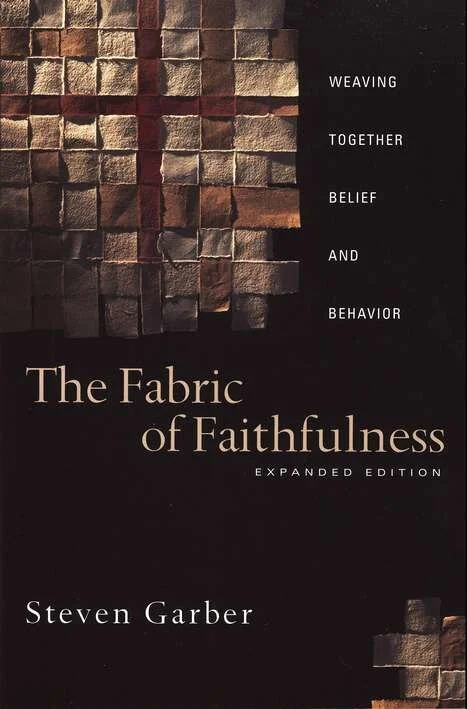
Fabric of Faithfulness by Steve Garber

We continue to count down the Top 100 Books for Faith Driven Entrepreneurs with…

Fabric of Faithfulness

by Steve Garber

All kinds of important choices are made during the college years. Young men and women explore what they really believe about the nature of the world and the purpose of life. They choose their work. They build friendships and often choose to marry. They develop goals and adopt habits that may last a lifetime. Yet late modernity is not a welcome environment for emotional, intellectual and spiritual formation. Society is increasingly fragmented. And the educational system itself, fragmented and specialized, may disintegrate more than it integrates.

How do parents, professors, campus ministers, youth pastors and others help students, during one of the most eventful and intense periods of life, learn to connect what they believe about the world with how they live in it? Steven Garber vigorously engages just that question in this revised edition that includes a new chapter on what he has learned about lifelong formation in the years since the book first appeared. Drawing on the history of ideas, ethics, sociology and popular culture, he offers must-reading on the critical lifework of making sense of life.

Click on the book cover to check out the Reviews and Purchase at Amazon