We Can Have Hope

At the end of every podcast, we like to ask our guests to share what God has been teaching them in this season of life. This week’s guest is Gabe Lyons, founder of Q Media has spent a decade wading into the data and bringing out the conversations that we need to have as Christ Followers and to make sure we understand the waters we’re wading into each day when we go into the marketplace. 

Yeah, well, you know, it’s funny, the book that I happened to be in right now is Revelation. And in studying Revelation, which is a difficult book to study, I’m doing it with a group of men. And it’s been really, really helpful realizing how much God cares about us enduring and overcoming and how much that theme is there that he’s with us. 

But even in the face of fear or concern or a future that we don’t understand, we can have hope. That’s because he is trustworthy and he’s going before us. And righteousness and goodness does overcome evil. And we can just fully count on that. And so that’s been a great encouragement to me. 

It’s also encouraged me towards repentance. And it says in Revelation 17 that this spirit is basically over. It’s like a city that’s over the whole world, that all the kings are just kind of operating underneath. Right. And it’s this idea that there’s a system that competes with the kingdom and that system is about greed. It’s about deceit. It’s about sensuality. It’s about all these different attributes that actually lead us down these paths of idolatry that lead to our ruin.

And so I’ve just been convicted about ways in which my own life has any of those elements woven into them because I bought into an American idealized vision of Christianity or American dream or ideas that aren’t true. And so it’s just been a good reckoning for me to walk through and try to sift out what are these areas, especially out of the season where all of our lives have been somewhat upended. We’ve had to stop and pause long enough to reflect on what’s been good about my life and what do I want to change and to really go through that process with my wife and our family and say, what do we want to sift out of our life? What is God trying to sift out as we move into a new season of preparation for what he’s trying to do in the world? 

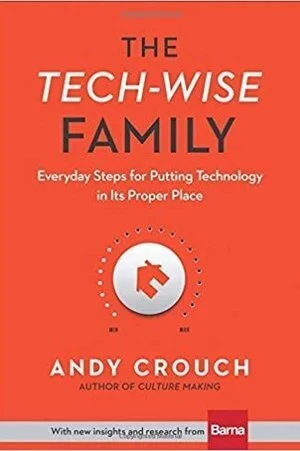
The Tech Wise Family by Andy Crouch

We continue to count down the Top 100 Books for Faith Driven Entrepreneurs with…

The Tech Wise Family

by Andy Crouch

Making conscientious choices about technology in our families is more than just using internet filters and determining screen time limits for our children. It’s about developing wisdom, character, and courage in the way we use digital media rather than accepting technology’s promises of ease, instant gratification, and the world’s knowledge at our fingertips. And it’s definitely not just about the kids.

Drawing on in-depth original research from the Barna Group, Andy Crouch shows readers that the choices we make about technology have consequences we may never have considered. He takes readers beyond the typical questions of what, where, and when and instead challenges them to answer provocative questions like, Who do we want to be as a family? and How does our use of a particular technology move us closer or farther away from that goal? Anyone who has felt their family relationships suffer or their time slip away amid technology’s distractions will find in this book a path forward to reclaiming their real life in a world of devices.

As entrepreneurs, we’re all somewhat terrified by what technology might be doing to us and our families. If you’re interested in this topic and how it relates to you, listen to Andy Crouch talk more about it on his podcast with FDE.

Click on the book cover to check out the Reviews and Purchase at Amazon


Jason Trice

Co-President & CEO | Jasco Products Company

Jasco designs, develops and markets more than 3,000 consumer technology products under the GE, Disney, Pixar, Marvel, DC Comics, Nickelodeon, Enbrighten, Eco-Survivor, Projectables and Uber brands.

Jason began his career at Jasco as a Product Manager in 2002 and received numerous Innovation awards. He also worked as Business Development Director and then Executive Vice President of Sales, managing all Jasco’s sales efforts throughout North and South America. Currently, as Co-CEO he oversees Jasco’s sales, operations and finance teams.

Prior to his career at Jasco, Jason won multiple national championships as a debater, coach and ultimately the Directorof the Michigan State University Debate Team.

Mr. Trice holds a BA in Political Science and MS in Communication from Michigan State University. He previously served on the Board of Mid-America Christian University and is an active community member and trustee of the Jasco Giving Hope Foundation.

The Oklahoma City native has been married to his wife, Emily, for 16 years, has two children, and enjoys playing tennis in his spare time.

LINKS

Linkedin

CONTRIBUTIONS TO FAITH DRIVEN ENTREPRENEUR

Leah Davidson

Co-Founder | Canduit

Adopted from China at the age of nine months, Leah is a social entrepreneur currently residing in the San Francisco Bay Area. She is a Wharton alum and the co-founder of Canduit (www.canduit.co), an ed-tech platform that helps first-generation and minority college students access virtual project-based engagements sponsored by top companies interested in diversity and inclusion.

Passionate about technological innovation and intercultural understanding, Leah has co-founded a few social ventures focused on accessibility and disability, environmental sustainability, and education that have raised $5M. Personally inspired by her Christian faith, she loves creating opportunities for people to learn, collaborate, and connect and has previously represented Canada as an ambassador for the UN and Y20 delegate, traveling to almost 50 countries for work, research, and volunteering. 

Leah serves on the University of Waterloo Youth Advisory Council and the Canadian Council for Youth Prosperity and has worked for companies like Uber, Mastercard, and Johnson & Johnson in strategy and operations and social impact roles. In the Bay Area, she is involved with the Faith and Work Movement and Foster the Bay.

LINKS

Linkedin

CONTRIBUTIONS TO FAITH DRIVEN ENTREPRENEUR

Dr. K. Shelette Stewart

Speaker | Author | Consultant

Dr. K. Shelette Stewart has over 20 years of leadership experience as a business practitioner and academician with leading organizations including Harvard Business School, The Coca-Cola Company, and BellSouth / AT&T in strategic business planning, business development, and marketing. She is a Fulbright Foreign Scholarship Program Specialist and holds a Doctorate in Business Administration.

A graduate of Harvard University, Dr. Stewart is the founder and principal of Stewart Consulting, LLC, a strategic planning firm, launched in 2007, serving companies, non-profits, and higher education institutions with consulting and programming so that they pivot and thrive during unprecedented times.

Dr. Stewart is also the author of the award-winning book, Revelations in Business: Connecting Your Business Plan with God’s Purpose and Plan for Your Life© which has been formally endorsed by several industry leaders including Dan Cathy, Chairman and CEO of Chick-fil-A.

A highly sought-after international speaker, Dr. Stewart has served as the keynote speaker for many leading organizations including: Harvard Business School, Texas Instruments, The Coca-Cola Company, Women’s Foodservice Forum, and Yunnan University in China. She served as the 2020 Commencement Speaker for Judson University and has also appeared as a guest on Trinity Broadcasting Network (TBN), Daystar Television Network – Marcus; Joni Lamb Show, and a host of other TV and podcast programs.

Dr. Stewart’s board memberships include the LEAD Program, New Hope and Compassion for China (NHC), the Warren Holyfield Boys; Girls Club, and Morehouse School of Medicine – School of Public Health Visiting Committee. She is the recipient of The YWCA of Greater Atlanta; The Coca-Cola Company Salute to Women of Achievement Award and is available for consulting and speaking engagements nationally and globally. To learn more, please visit: shelettestewart.com.

CONTRIBUTIONS TO FAITH DRIVEN ENTREPRENEUR

Entrepreneurship in the Kingdom of God

This article was originally published here by The Denver Institute

— by Drew Yancey

Perhaps some of you have a similar story, but the most difficult circumstance of my life thus far — spiritually, emotionally, and in fact financially — has come through the failure of a start-up in which I was an investor.

I will spare you a detailed account of the saga (or rather, I will spare myself from reliving it yet again), but suffice it to say it did not go well. In fact, despite the relative financial strength of the business model, the well-capitalized investors, and the seemingly qualified operations team, it failed miserably.

Left in the wake were hundreds of thousands of dollars in unpaid liabilities, strained friendships, and life-long personal wounds that can eventually heal, but will always retain a scar.

For an introspective person like myself, this experience of failure has led to an endless amount of self-evaluation and regret. I would like to think that, as someone who strives to be a follower of Jesus, I have a relatively healthy perspective on life. This has been deeply challenged by both my experience with this specific failure and my general dabbling in the world of entrepreneurship — a world that especially prioritizes linear-thinking and immediate results.

As I reflect on the saga, it is hard to not believe that God had perfectly engineered the situation to enact the most harm. No doubt, in looking back on the situation, I can see many instances where as an investor I should have spotted some alarming red flags along the way. But just as easily I can point to evidence that God seemed to be indicating to move forward with the investment. The business even had “Eden” in its name – that had to count for something!

Several years ago, I probably would have drudged forward through this difficulty — grasping onto the thin hope often preached in the start-up world — that “failure leads to opportunity.” Or even the spiritualized version, that God will work all of this together for my “good.” This translates to, this failure will eventually be the key to my multimillion-dollar breakthrough as confirmed in Romans 8:31.

Such hope doesn’t attract me much anymore. The simple reason is that I don’t think life — the earthly form and certainly the spiritual — normally operates that way. Yes, as a follower of Jesus, I cling to the hope of a better future, a redeemed world to come, but I also believe that the way this narrative plays out in the Kingdom of God is often very different than the linear-thinking, immediate-results sort of world that drives our modern culture of entrepreneurship.

When Jesus spoke about the Kingdom of God he, in effect, challenged his original hearers to fundamentally rework their worldviews. The same is true for you and me today. I would like to suggest that in three key areas, the life and teachings of Jesus present a means for those of us engaged in entrepreneurship to restore its promise in a culture of excess.

(1) Time

The modern culture of entrepreneurship — like much of Western society — prizes the immediate. What is real is determined by what is now. The primary goal of virtually every start-up is to scale as quickly as possible.

In such a world, it is difficult to think of ourselves beyond what we are able to achieve in the material present, which often means that we can get caught in an endless cycle of discontentment. Jesus, of course, calls us to think of our lives beyond just the here and now and contemplate our afterlives. Humans are a created and contingent being whose story stretches as far back as the Garden and as far forward as eternity. This means we will never be able to measure the value of our lives by the ever-evaporating “here and now.”

(2) Character

Because of its obsession with the present, the modern culture of entrepreneurship places a premium on external results and immediate satisfaction, much to the neglect of internal processes and enduring commitments. This can amount to a Machiavellian-style, “ends justify the means” mentality, in which human worth and identity are tied not to the development of certain character qualities—which take time and steadfast commitment—but the obtainment of material achievements.

The question, “Where I am going?” becomes the central aim, obscuring the question, “What type of person am I becoming?” In his life and death, Jesus modeled something entirely different — the condition of the heart in relationship to our love for God and for others is of the upmost importance in the Kingdom of God, more so than any social status or power we might obtain in fleeting earthly kingdoms.

(3) Money

It might seem like we should begin with this area, but Jesus’ truly counter-cultural approach to money is more apparent in light of the first two. The modern ethos of entrepreneurship has the potential to develop a feverish obsession with money. We might say, in fact, that in Silicon Valley wealth is a god. Interestingly, I don’t suspect Jesus would entirely disagree with this. As created beings in the image of the one true God, humans will inevitably worship something. The question is, what will ultimately satisfy the human quest for meaning? If reality is nothing but the pursuit of material outcomes in the immediate now, the temptation will be to think that money is indeed the only thing that can satisfy. But if so, why do we never have enough of it?

The Kingdom of God is Jesus’ way of telling us that we are made to flourish in an exceedingly better narrative. One in which everything — including money — can be a means to a greater end, namely a fully reconciled world in which created beings find their joy and happiness in fellowship with their Creator.

Related articles

——

[ Photo by marc liu on Unsplash ]