A Structure for your Prayers

— by Roland Heersink

In the last two posts, we uncovered the reason for prayer and what to pray for. But how do you pray? And how can you do that every day without falling into a rut?

God wants a relationship with you, so it’s not just about solving problems! And, as you deepen your relationship with God through prayer, it becomes easier and easier to know His will for your life and your life and your entrepreneurship.

So how do you pray? In the spirit of practical guidance—and definitely not as the only way—I’ll offer the following structure, which has been used by many leaders and saints through the ages: A-C-T-S. This is, of course, not the only way to pray and no formula guaranteeing success, but it gives a good structure which you might use each and every day.

A: Adoration

Entering your prayer time resembles entering a holy place, so it makes sense to first assume a posture of reverence and humility. After all, you are the created one and God is your Creator. You are mortal, finite, and limited; God is immortal, infinite, and unlimited.

So it makes sense to humble yourself, to place your time and talents at God’s disposal—from both your personal and work life. Start by giving everything over to Him, in worship and thanksgiving.

For some help getting started, read and reread how David led his people in prayer—a small portion of which is given here:

“Praise be to you, Lord, the God of our father Israel, from everlasting to everlasting. … Now, our God, we give you thanks, and praise your glorious name.” — 1 Chronicles 29:10…13

If you need some inspiration, I find this video helpful.

C: Confession

Once you’ve completed a period of adoration for your great God, examine yourself and consider how you may have fallen short of God’s plan.

Confession is your way of saying sorry, a way of healing the brokenness that you’ve introduced into the relationship.

Not sure about that? Then look at what the Bible says about the importance of confessing your sins:

If we confess our sins, he is faithful and just and will forgive us … If we claim we have not sinned, we make him out to be a liar and his word is not in us. — 1 John 1:9-10

T: Thankfulness

After reflecting on how great God is, and how much God has given you—family, health, work, and so much more—it’s hard not to be thankful.

Even so, the Devil wants you to think that you are missing out, how it’s not fair, and how you deserve more. Flee from that! Focus instead on what God has already given; stay close to Him and do not follow the ways of the world.

Instead, list the blessings you already have, and then, when you run out, ask God to come into your heart and show you more.

Do not be anxious about anything, but in every situation, by prayer and petition, with thanksgiving, present your requests to God. — Philippians 4:6

S: Supplication

After preparing with the first three steps, it is time to pour out your heart and seek God’s help. Even if you don’t what to say, you may just groan before Him; He already knows your need and is glad to hear from you in whatever form it takes:

We do not know what we ought to pray for, but the Spirit himself intercedes for us through wordless groans. — Romans 8:26b

During this time, be still before God. Let your thoughts roll around in your head; don’t try to solve any problems, but just enjoy the ideas and peace that God will give.

Afterwards, thank God again and slowly return to your awakened and refreshed self. You may not have all the answers or have even heard anything, but as you repeatedly come back to God in a time of prayer, He will eventually show you His will, His way, and His plan for your life and leadership.

The above A-C-T-S structure has been found helpful by many Faith-Driven Entrepreneurs, and hopefully you find it helpful also. Next to this, the other go-to structure for praying is the example that Jesus himself gave us: The Lord’s Prayer.

“Our Father in heaven, hallowed be your name,

[adoration]

Your kingdom come, your will be done, on earth as it is in heaven.

Give us today our daily bread.

[supplication – give us what we need so that we might help build your Kingdom]

And forgive us our debts, as we also have forgiven our debtors.

[confession]

And lead us not into temptation, but deliver us from the evil one.”

[supplication – keep us pure so that we might be examples to others]

Again, there is no one formula for your prayers as a Faith-Driven Entrepreneur. God values all prayer, but, as Jesus and the Bible teach, do remember that prayer is so much more than just asking for help!

Prayer: the Faith-Driven Entrepreneur’s most powerful tool


We hope you found this set of 3 blog posts to be helpful. Each post has been abstracted from the book “Toolbox Devotions for the Faith-Driven Entrepreneur” by Roland Heersink and Dr. Szaszi Bene (Tyndale Seminary, Amsterdam). 

Related articles

What to Pray For & When to Pray

— by Roland Heersink

In the last post, we looked at the reason for your prayer—praying “so that” God is glorified. But let’s get practical—how do you do that, and what does that really mean when praying for your business?

Many times, it seems that we reserve our most fervent prayers for our biggest problems that are not easily solved by our human efforts. Just like the example of Hezekiah going up to the temple and laying out the message from his enemies before the Lord, we too may find ourselves coming to God when we’re already backed into a corner with our business, our staff, production, customers or other.

It’s like prayer is our final go-to problem-solving tool when we are stuck with our backs against the wall.

But that’s not how it should be. Prayer is foundational to building and maintaining a healthy relationship with God. It is how we draw close, how we know God’s will, sense His presence and proceed in our business decisions with confidence.

But that’s often not how it happens, is it? Too often, we’re busy making decisions, plotting strategy, hiring, firing and doing deals without involving God every step of the way. Even though the Bible tells us the opposite:

Rejoice always, pray continually, give thanks in all circumstances; for this is God’s will for you in Christ Jesus. — 1 Thessalonians 5:16-18

Rejoice in the Lord always. I will say it again: Rejoice! Let your gentleness be evident to all. The Lord is near. Do not be anxious about anything, but in every situation, by prayer and petition, with thanksgiving, present your requests to God. And the peace of God, which transcends all understanding, will guard your hearts and your minds in Christ Jesus. — Philippians 4:4-7

Instead of stressing about all the many issues around our business, we are told to rejoice, give thanks and pray always.

So, how does that work?

Proactive Prayer

Jesus gives us a good example of proactively praying for our business. Jesus very much came to earth as an entrepreneur as well—with the task of establishing an entirely new religion for all peoples of the world. A big assignment in a huge market with lots of competition. From our perspective today, it is perhaps the ultimate Faith-Driven Entrepreneur challenge!

But look at what Jesus does before he picks his leadership team to take on this challenge:

One of those days Jesus went out to a mountainside to pray, and spent the night praying to God. When morning came, he called his disciples to him and chose twelve of them, whom he also designated apostles…. — Luke 6:12-13

Here is Jesus, son of God, spending all night in prayer before choosing his leadership team!

What might happen if you committed your business decisions—big and small—to prayer as Jesus did? And, if Jesus, son of God, needed time away to strengthen his leadership, how much more so for you!

Imagine the results if you brought it all to God, instead of just approaching him during times of stress or urgent trouble? What about bringing the following to God in prayer so that His Kingdom is built:

  • Who to hire, fire or promote?

  • What product or service strategy to follow?

  • How to set pricing and discounts?

  • What markets to focus on?

  • How to present to the customer?

  • How to run your meeting?

The list of potential topics to bring to God in prayer is endless. Sure, some are big and some are small, but God wants to hear them all.

Prioritizing Prayer Throughout Your Day

As entrepreneurs, we too often rely on our training, skills, and experience to make our decisions and set strategy, don’t we? But, if we tried to pray about all these things, we’d be so busy praying that we’d be at it all day! So how does that work?

God wants to engage with you all day long. Adding small reminders to speak with Him does not distract from your leadership work—on the contrary, it strengthens it! Engaging with God throughout the day gives perspective, reduces stress and brings success in a way that bears even more fruit for the Kingdom of God—each and every day! Just try it.

Of course, relationship with God thrives on short engagements throughout the day. But periods of extended prayer are also needed. Times of communication with your Heavenly Father where you stop everything else and focus on pouring out your heart to Him. Praising Him, enjoying His presence, confessing your shortcomings, seeking His will, asking for His strength, and finding the “so that” to help build His Kingdom.

Pray always—especially when you think you already know!


We hope you found this set of 3 blog posts to be helpful. Each post has been abstracted from the book “Toolbox Devotions for the Faith-Driven Entrepreneur” by Roland Heersink and Dr. Szaszi Bene (Tyndale Seminary, Amsterdam).

Related articles

The Reason to Pray: So That… Prayers

— by Roland Heersink

As an entrepreneur and leader, people expect more from you. To make the difficult decisions, to set the right direction, and lead them to success.

Others are counting on you. Your education, experience, and track record have prepared you for this time. The very reasons people trust you to lead them also gives you confidence.

Even so, sometimes things get beyond what you can see, past what you know, and out of your comfort zone. But, in those times, you know you can still reach out to God for help.

That’s both right and wrong.

God wants to guide you in your entrepreneurship and even bless you through it. So, it’s right for you to come before Him in prayer, with any and every request. Although coming to God with requests for business help is right, doing only that misses the relationship-building that God so greatly desires.

And so your prayer needs to be more than just asking for help. But how do you know what to pray for?

Your company? Your team? Your customers?

Praying “So That…” Prayers

As a Faith-Driven Entrepreneur, you have a lot on your plate, and there is a lot that you might present to God in prayer.

Fortunately, the Bible gives some very clear guidance on what to pray for, often through the use of two simple words: “so that.”

For an example of this, let’s go back to the time of King Hezekiah in the Old Testament. As king, Hezekiah proved himself to be one of the better leaders of Israel:

Hezekiah trusted in the Lord, the God of Israel. There was no one like him among all the kings of Judah, either before him or after him. He held fast to the Lord and did not stop following him; he kept the commands the Lord had given Moses. And the Lord was with him; he was successful in whatever he undertook. — 2 Kings 18:5-7a

As a leader, Hezekiah put God first, and in return, God helped him prosper in pretty much everything he did. Contrary to others, Hezekiah remained faithful to God’s plan in his leadership, not seeking his own glory or pleasure. This is an important leadership characteristic, especially for you as a Faith-Driven Entrepreneur.

But then came the test.

Sennacherib, king of the Assyrians, had already captured the cities of nearby Samaria and the outlying cities of Judah, finally surrounding Hezekiah and his people in the capital city of Jerusalem: a major leadership crisis for Hezekiah, and in many ways, not unlike crises you may face when the competition close in around you.

As the enemy forces circled the city and sent threatening messages over the city walls, Hezekiah didn’t seek guidance from his advisors, strength from his troops, or reassurance from his people. Instead, check what he did—it is instructive for you as a Faith-Driven Entrepreneur as well:

Hezekiah received the letter from the messengers and read it. Then he went up to the temple of the Lord and spread it out before the Lord. And Hezekiah prayed to the Lord: “Lord, the God of Israel, enthroned between the cherubim, you alone are God over all the kingdoms of the earth. You have made heaven and earth…. Now, Lord our God, deliver us from his hand, so that all the kingdoms of the earth may know that you alone, Lord, are God.” — 2 Kings 19:14-15,19

As you re-read Hezekiah’s prayer, note the use of the words “so that” in the closing of his prayer. In so doing, he gives the underlying reason for his prayer—not just that he, the city, or the people for whom he was responsible would be saved but “so that all the kingdoms of the earth may know that you alone, Lord, are God.”

Now compare Hezekiah’s prayer to how you pray. When you present your requests to God for guidance, wisdom or help, what is the “so that” behind your request? For what reason might God answer your prayer?

Prayers with a “so that” focused back on your company and its success might not be what God has in mind, and may therefore go unanswered. But prayers focused on helping others and bringing glory to God fall into an altogether different category, don’t they?

Trying It Out

As you face your next leadership or organizational challenge, try attaching a “so that” clause as you pray over it. For example, you might ask God to answer your request so that:

  • Others may see God’s hand in your work

  • A door may be opened for your testimony

  • God may be made known or glorified

Like Hezekiah’s prayer, your prayer should seek to glorify God and make Him known to those you work with. Not sure how to do that? Then check this:

If any of you lacks wisdom, you should ask God, who gives generously to all without finding fault, and it will be given to you. — James 1:5

Like Hezekiah and the many others after him, you can also learn to use prayer as your weapon to help build God’s Kingdom … and your business!

I pray for this so that….


This is the first blog in a set of 3. Each post has been abstracted from the book “Toolbox Devotions for the Faith-Driven Entrepreneur” by Roland Heersink and Dr. Szaszi Bene (Tyndale Seminary, Amsterdam). 

Related articles

5 Keys to Success in Business: The Total Quality Life Approach

— by Chris Paliska

Hi, I’m Chris Paliska. In my early 20s, I landed my dream corporate promotion, the one I’d been grinding my whole career for. But the euphoria lasted all of 15 seconds. That fleeting moment led me to some uncomfortable truths: I was distant from God, emotionally unavailable to my family, physically unfit at 312 pounds, and mentally on the brink with stress and anxiety. I realized then that success in business meant nothing if I was failing in every other aspect of my life which lead me on my entrepreneurial journey to start Total Quality Lending. I want to share with you the five key areas that every Christian entrepreneur should focus on for what I call The Total Quality Life.

Remember as an entrepreneur, living a total quality life has to start with YOU to have an impact in your business. You are massively in control. You are in the driver’s seat based on your actions. Everybody follows the example of the leader.

1. Faith: Implementing Spiritual Growth

Personal Action Steps:

  • Daily Prayer and Reflection: Start each day by aligning yourself with God’s will.

  • Active Church Community: Don’t just go to church; be a part of the church. Join small groups or volunteer to serve.

Workplace Implementation:

  • Incorporate Faith into Company Values: Let faith guide your company’s mission and decisions. Lead with faith-based energy that is contagious for the environment you are influencing.

  • Community Service: Allow employees to take paid time off for charity work or organize team community projects.

2. Family: Cultivating Relationships

Personal Action Steps:

  • Scheduled Family Time: Block out time on your calendar solely for family activities.

  • Open Communication: Keep an open line with your family about your work schedule and commitments. Bring them in on the mission with you.

Workplace Implementation:

  • Family Integration in the workplace: Implement flexible qualities that allow a welcoming environment for families of all shapes and sizes. We have a kid’s room if employees need to bring their kids into the office. We harness and encourage families in similar stages of life to band together, sharing childcare, doing family events together, children’s sports teams, etc.

  • Our company core value & definition of Family: Our culture is based on this definition of family. What do YOU stand for? Who can you count on when times get tough? Who believes in you? Who holds you accountable? Who is going to push you to press on? Those are the things that define our work family.

  • Family Events: Host family-friendly company events to help integrate work and family life.

3. Fitness: Honoring God with Your Body

Personal Action Steps:

  • Regular Exercise: Plan a workout regimen and stick to it. For me, it’s hitting the gym every day at 5 a.m.

  • Nutritional Plan: Eat balanced meals that give your body the fuel it needs without sacrificing health.

Workplace Implementation:

  • Fitness Challenges: Start a fitness challenge and invite all employees to participate. (Example: Spartan Races, 75 Hard, etc.)

  • Healthy Office Snacks: Replace the vending machine snacks with healthier alternatives.

  • Challenge & Check in: If people tell you they want to improve challenge and check in with them to make sure their eating healthy and exercising

4. Wellness: Mind, Body, and Soul

Personal Action Steps:

  • Mindfulness Practices: Incorporate practices like meditation or breathwork into your daily routine.

  • Mental Breaks: It’s important to take time off to relax and reset.

Workplace Implementation:

  • Wellness Room: Create a space in the office where employees can take a mental break.

  • Productivity Breaks: Encourage small, regular breaks for employees to recharge.

5. Business: Faith-Driven Success

Personal Action Steps:

  • Ethical Business Practices: Make sure your business operations align with your Christian values.

  • Financial Goals: Set realistic financial objectives aligned with personal and spiritual growth.

Workplace Implementation:

  • Holistic Goal Setting: Require employees to set goals in faith, family, fitness, wellness, and business.

  • Financial Literacy & Growth: We are dedicated to the financial growth of our employees. We share knowledge and resources that have helped us, such as tax-saving tips and wealth-building opportunities. Employees are also held accountable for their financial goals, creating a culture that fosters both personal and professional growth.

This approach to integrating faith, family, fitness, wellness, and business into the fabric of your business leads to a unique company culture and business model.  The dedication to these five key areas doesn’t just make for a successful business but enriches the lives of those who are part of it. While the world often presents a zero-sum game between personal happiness and professional success, Chris’s journey demonstrates that when you nurture all aspects of life, not only do they co-exist, but they also complement and enhance each other.


It’s hard to live a full life alone. We need other people to some alongside us and support us. That’s partly why we’ve created Faith Driven Entrepreneur Groups. Meet local entrepreneurs and share your faith journey.

Related articles

Are You A “Rich Young Ruler”? How Priorities and Identity Reveal Heart

— by Paul Michalski

Jesus is saying that the greatest concern of life is to place our relationship with God first, and everything else second.” (Oswald Chambers)

Don’t stop reading just because you are not “rich” or not “young” or not a “ruler”–being a “Rich Young Ruler” is not about status or circumstances. It is about your heart, as reflected in your primary identity.

“Are you a rich young ruler?” is a question every faith-driven leader must honestly assess if they are to lead an organization with faithful integrity in alignment with Biblical beliefs, principles, and priorities (what I will call business a better way).

This commentary was prompted by one of the segments in the recent Faith Driven Entrepreneur global conference. It was a conversation between Pat Lencioni and Henry Kaestner in which Lencioni vulnerably admitted that he wasn’t sure whether he would step out in faith if doing so could result in the loss of his business. He was asking himself the rich young ruler question.

The Biblical Rich Young Ruler Story

If you’ve read the Bible, attended Bible studies, or listened to sermons, you have probably heard the story of the “rich young ruler.”  It is one of the “biggies.”

Rather than try to summarize it myself, I decided to ask BibleChat – a new AI-driven engine that will answer any questions about the Bible (give it a try). Here is its answer:

The rich young ruler is a character mentioned in the New Testament of the Bible, specifically in the books of Matthew, Mark, and Luke. He approached Jesus and asked what he must do to inherit eternal life. Jesus told him to keep the commandments, to which the young man claimed he had done since his youth. Jesus then challenged him to sell all his possessions, give to the poor, and follow Him. The young man went away saddened because he was very wealthy and could not bring himself to part with his possessions (Matthew 19:16-22, Mark 10:17-22, Luke 18:18-23). The story serves as a lesson about the importance of prioritizing God above material wealth.

Although I don’t really know what happened to this man (he is never mentioned again in the Bible), everybody seems to assume he did not give everything away (if he did, he was certainly not a “joyful giver”). BibleChat is more honest when asked if he gave away his wealth:

The narrative does not provide any follow-up or indication of a change in the young man’s actions. Therefore, we cannot definitively say whether he eventually gave away his wealth or not. The story serves as a lesson about the challenge of prioritizing God above material possessions and the potential obstacles that wealth can present in following Jesus.

In both responses, BibleChat nails the key to determining if you are a rich young ruler – do you truly “prioritize” God?

What Do You Prioritize?

The word “priority” has an interesting history, and it plays an integral part in this commentary.  In his book Essentialism: The Disciplined Pursuit of Less, Greg McKeown observes:

The word priority came into the English language in the 1400s. It was singular. It meant the very first or prior thing. It stayed singular for the next five hundred years.

Similarly, the Bible suggests a person can have only one “priority.”  In Matthew 6:24, we are told, “No one can serve two masters.”

Notwithstanding the historical root of the word and the Biblical warning, today, we often talk about having numerous priorities–plural priorities.  “Plural priorities” are a reality of how we use the word “priority” today, how we think about our lives, and how we think about leading an organization.

Priority problems underlie business in the way of the world (what I will call business as usual) and the brokenness caused by business as usual. They are also at the root of many of the trials, fears, mistakes, and missed opportunities we face in our personal lives.

Equal Priorities Problem

While a person (or an organization) can have “plural” priorities, they can’t have equal priorities. The nature of something having priority is that it is prior to every other “priority” other than any priority that ranks even higher.  At the end of the day, there can only be one primary priority that will win out–other “priorities” usually get reduced to being “means” or “strategies,” which means they will be sacrificed if they no longer serve the higher priority or if they jeopardize the higher priority.

Real Priority Problem

A person (or an organization) may say they have one priority, but they are actually pursuing a different priority–or they may think they are pursuing equal priorities but there is a “real” priority.

Disordered Priorities Problem

A person (or an organization) has disordered priorities when they set priorities that are not aligned with Biblical priorities.

For a faith-driven leader to assess the “Are you a rich young ruler?” question, the leader must make an honest assessment of their priorities and, most importantly, their ultimate priority.

Priority in the Bible

People often cite Matthew 6:24 (“no one can serve two masters”) when talking about Biblical priority, but that principle weaves its way through many Biblical stories.

  • God asks Abraham to choose – God or Abraham’s son Isaac.

  • Jesus asks the rich young ruler to choose – God or money.

  • In Luke 14:26 Jesus tells his followers they must choose – God or father/mother/wife/children/brothers/sisters/life (“If anyone comes to me and does not hate his own father and mother and wife and children and brothers and sisters, yes, and even his own life, he cannot be my disciple.”)

In commenting on Matthew, Oswald Chambers observes:

Jesus is saying that the greatest concern of life is to place our relationship with God first and everything else second.

I believe priority in the Bible is about heart.

  • God didn’t actually want Abraham to kill Isaac–God just wanted to know that Abraham prioritized God over his son and was willing to sacrifice him.

  • We don’t know what Jesus would have done if the rich young ruler had prioritized God and been willing to liquidate his assets.  He might have told him to give just a percentage away and keep stewarding the rest in a way that glorified God.

  • Jesus isn’t really telling us to hate our family or our life–he is saying that we must prioritize God by being willing to sacrifice our relationships and even our lives if God calls us in a direction that puts those at risk.

I also believe priority in the Bible is “all or nothing.”  There is no grey.  God did not give Abraham the option of just giving Isaac a little cut.  Jesus didn’t negotiate with the rich young ruler over a specified percentage or tell his disciples they might have to have a slight disagreement with family members.  God calls people of Biblical faith to make Him THE priority.

“Grey” can feel good because it is better than black.  It also feels good because it will get affirmed–even from the church and faith community.  Grey is still black — the way of the world.  Remember 1 John 2:15: “Do not love the world or the things in the world.” Grey may be better than black, but it is not the heart to which people of Biblical faith are called and commanded–not the priority required for faithful integrity.

In the words and commentary of Oswald Chambers: “The greatest enemy of the life of faith in God is not sin, but good choices which are not quite good enough.”

Understanding Your Heart

The rich young ruler followed all the rules, which in the Matthew account even included the great commandment to love his neighbor as himself.  Actions do not necessarily reveal the heart of a faithful leader (or organization) – their true priority.

Larry Crabb and Frederick Buechner have insightful observations:

Larry Crabb:  Biblical principles are reduced to basic principles of the world when they’re followed in order to gain the “better life'” we demand.

Frederick Buechner:  A man can be basically interested in nothing so much as feathering his own nest and still give generously to the Cancer Fund, be on the Board of Deacons, run for town office, and have a soft spot in his heart for children and animals.

I believe identity is a clue to a person’s heart–to what “god” is truly their priority.  There are really two gods from which to choose–the God of the Bible or the “gods” of this world.  Although “gods” of the world come in various forms—wealth, success, happiness, power, influence, fame, leisure–I believe they are all manifestations of the spirit of mammon (mammon is not money, and if you are unsure about the evil of mammon, look back at Andy Crouch’s chilling description of the demonic spirit of mammon from the 2022 Faith Driven Investor global conference).

For a faith-driven leader assessing their heart, I want to focus on two identity choices–a WHAT identity or a WHO identity.  Every faith-driven leader has both, but the question is which one is their primary identity and which one is a secondary identity.

Although a person can only have one primary identity, they can have many secondary identities.  For example, a person can be a Christian, a businessperson, a wife (or husband), a mother (or father), a daughter (or son), all at the same time.

But when push comes to shove, there is one identity they view, consciously or subconsciously, as the primary identity—the one they will protect, even if it means sacrificing success in their secondary ones.  Our self-worth and value are wrapped up in whatever we see as our primary identity. Any primary identity other than the Biblical priority of a child of God or a follower of Jesus is an RYR identity. Dr. Skip Moen beautifully describes the facets of that Biblical identity:

I am a child of God.  I am an adopted son.  I am a member of Abraham’s nation.  I am beloved by the Father.  I am a follower of His chosen Messiah.  I am part of the family.  I am a citizen of the Kingdom.  I am a resident alien tasked with repairing a broken world.

How Identity Shapes Behavior

With a WHO identity, the faith-driven leader’s primary identity is WHO they are in relation to God (e.g., a child of God or follower of Jesus).  With a WHAT identity, the faith-driven leader’s primary identity is WHAT they do in the world’s eyes (e.g., a businessperson, lawyer, barista, Uber driver, nurse, banker, consultant, teacher, mechanic).  Let’s compare how a WHO identity and a WHAT identity might impact a faith-driven leader’s behavior.

With a WHO Identity

She will see herself as “a Christian engaged in the business”, with faith being the primary identity and business being an activity in which that identity is lived out.

She may have to make sacrifices in her worldly business success to follow God’s principles and priorities.

  • WHAT she does will be determined by God’s leading rather than its potential for worldly success.

  • WHO she is where God places her will be more important than WHERE God places her.

  • She will wear WHAT SHE DOES lightly and will be able to change disguise at a moment’s notice.

  • She will need to trust God with her provision and circumstances.

  • Her identity will push her to go beyond “good” to pursue “Godly”.

  • She will be on the path to operating with “faithful integrity”.

This is a picture of a faithful leader.  They accept the “success” that comes with obedience to God’s call and commands.

With a WHAT Identity

They may see themselves as a “Christian businessperson”, with faith being merely a modifier describing how they carry out their primary identity as a businessperson. There are numerous problems that can flow from work being his primary identity and source of worth and value.

  • They may sacrifice the two great commandments (love your God and love your neighbor) or the pursuit of God’s Kingdom and His righteousness to achieve “success” in their primary identity as a businessperson (possibly rationalizing that they are still doing better than the people with no faith inspiration).

  • They will hold on very tightly to their worldly identity.

  • They will always need a worldly identity to latch on to.

  • They may be “good,” but they probably won’t be “Godly”.

  • They may operate with “integrity,” but it won’t be “faithful integrity”

  • There are numerous problems that can flow from work being their primary identity and source of worth and value.

  • An employer or investor has the power to take away “who they are”, if even for a short period of time.

  • If those to whom they answer (e.g., managers, investors) are driven by profit and power, they are vulnerable to extreme manipulation in their pursuit of worth and value through their job.

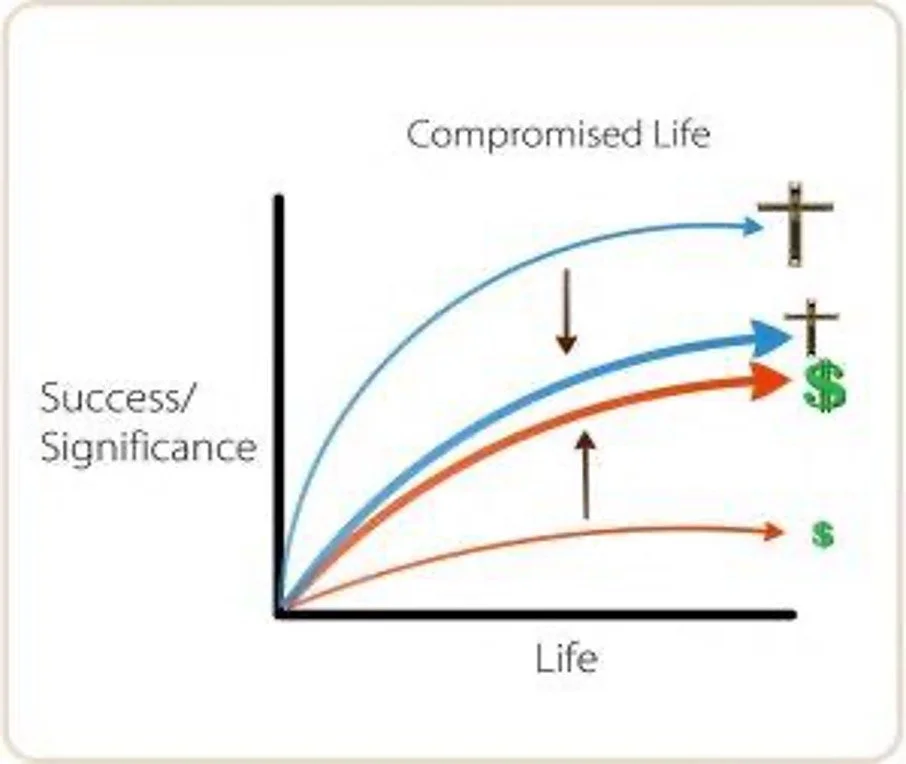
Most importantly, because a person can only have one primary identity, and they will sacrifice their secondary identities to ensure success in their primary identity, their identity is grounded in things like faith, family, and fitness will be compromised or even sacrificed to ensure success at work.

This is a picture of a faith-driven leader with a WHAT identity – a rich young ruler.  They will compromise their faith, ever so slightly, to ensure heightened worldly success, rationalizing that their faith remains much better than most of the broken world.

Maintaining a WHO Identity in a Broken World

I do not mean to suggest that maintaining a WHO identity and avoiding becoming a rich young ruler is easy.  We live in a fallen world in which most people (and organizations) operate according to the priorities and systems of the kingdom of the world.  A purely linear or hierarchical approach to implementing Biblical priorities misses the reality of our world.

A faith-driven leader may be a husband, wife, father, or mother in a world in which marriage is viewed as a contractual rather than a covenantal relationship, and divorce is seen as an easy and acceptable path to the “happier” life a person deserves.  A faith-driven leader of a business is also a “business leader” building a business in the world.  They face pressure from analysts, markets, investors, employees, and customers. Sustainability comes with financial metrics to track and hurdles to achieve.  The world of business measures success in terms of profit and growth.

I believe there are four keys to a faith-driven leader successfully ordering priorities, personally and professionally, to avoid the path of the rich young ruler:  Humility, Trust, Patience, and Prayer.

Humility.  Navigating the tension between the world’s priorities and God’s priorities requires Godly wisdom, and humility is a key to wisdom.  The link between humility and wisdom can be seen in Proverbs 11:2:

When pride comes, then comes disgrace, but with humility comes wisdom.

God is the source of all wisdom, and the Bible tells us that God will give wisdom to those who ask (James 1:5). The faith-driven leader who operates without the humility to recognize the need for God’s wisdom and the need to pray for guidance is destined to run aground on the rocks of the “priorities” dilemma.  An honest assessment of the “real” priority in the leader’s life (and an organization’s culture) absolutely requires humility and will yield wisdom.

Trust.  Of course, even the faith-driven leader who has the humility to recognize the need for God’s wisdom will only get the benefit of that wisdom by trusting God’s process, timing, and outcome:

  • Process: God’s process is often counter-intuitive and counter-cultural.

  • Timing: God’s timing often seems excruciatingly slow.

  • Outcome: God’s best outcome (the “all these things” promised in Matthew 6:33) may not be the world’s best outcome.

Prayer.  The importance of prayer in pursuing Biblical priorities seems so obvious. Unfortunately, many faith-driven leaders do not associate God with business decisions.  Oswald Chambers observed:

In spiritual issues, it is customary for us to put God first, but we tend to think that it is inappropriate and unnecessary to put Him first in the practical, everyday issues of our lives.

God’s wisdom comes through prayer.  Of course, praying for a particular process, timing and outcome is NOT praying for God’s wisdom, and ignoring God’s wisdom to pursue your own process, timing or outcome is NOT wise–it is choosing disordered priorities.

Patience.  It is difficult to read the Bible and not walk away feeling woefully impatient.  God’s story is full of people who patiently waited and persevered (the first cousin of patience) for a LONG time – a VERY LONG time.  Remember Abraham (waited 25 years for Isaac), Jacob (waited 14 years to marry Rachel), and the most patient of all, Moses (40 years in exile and then 40 years in the desert).

There are also stories of characters who got impatient and tried to short-circuit God’s timing (and God was not pleased).  Remember Sarah (Ishmael was NOT the fulfillment of God’s promise) and Saul (he got impatient and offered the burnt offering himself – NOT a blessing after all).

Choosing, ordering, and balancing Biblical priorities is “playing the long game”, and that takes Biblical patience (and perseverance).

Joining Pat Lencioni in honestly asking yourself the rich young ruler question is the first step toward choosing the priority, the primary identity, and the heart that will glorify God, which is, after all, the only reason we are here.



Copyright © 2023 Integrous LLC.  Integriosity is a registered Service Mark of Integrous LLC.

About the Author

Paul Michalski has been on a life-long journey that resulted in the creation of Integrous LLC, a law firm providing integrity advice and legal counsel to faith-driven clients. Integrous is committed to helping faithful leaders lead with faithful integrity. It also reflects Paul’s life-long commitment to “integrity” as a core value and his personal purpose statement: “To serve by redeeming work through the impartation of wisdom, spotlighting God’s truth and connecting its meaning to organizational cultures and practices.”

Paul graduated from Harvard College, magna cum laude, in 1983 and Harvard Law School, magna cum laude, in 1986.  He became a partner with Cravath, Swaine & Moore and for over 22 years practiced corporate law in New York and London.


Dive further into what it means to put your identity in Christ by exploring the Marks of a Faith Driven Entrepreneur. We offer videos, scripture references, and inspiring stories to shape how you view your business.

Related articles

Excellence and Surrender: Matthew 25 Meets Luke 10

— by Ben Erksine

For faith-driven business people, there is often a tension between excellence and surrender that can be confusing or overwhelming. But instead of seeking to solve this tension, I would encourage us all to embrace it as a core tenet of how we were created. The Bible offers valuable lessons on stewardship and priorities. One lesson that is frequently referenced in the world of faith-driven investing is the Parable of the Talents (Matthew 25:14-30), which I would like to examine alongside the story of Mary and Martha in the presence of Jesus (Luke 10:38-42).

In the Parable of the Talents, a master entrusts his three servants with different amounts of money to invest while he goes on a journey. Two of the servants invest the money and earn a profit, while the other buries his share and earns nothing. When the master returns, he commends the first two servants for their faithful stewardship and entrusts them with even greater responsibility, but he condemns the third servant for his lack of initiative.

The lesson here is that God wants us to be good stewards of the resources He has given us. We are called to pursue excellence, invest wisely, and use our talents to generate a return. Faith-driven investing should not be passive or fearful but should involve wise risk-taking and an entrepreneurial spirit, always seeking to honor God and advance His kingdom.

In contrast to the focal point of the Parable of the Talents, the story of Mary and Martha highlights the importance of prioritizing our relationship with God over our worldly concerns. Martha is busy serving and preparing for Jesus, but Mary sits at His feet and listens to His teaching. When Martha complains to Jesus that Mary is not helping with the work that needs to get done, Jesus gently rebukes her and praises Mary for choosing the better thing, which is focusing on Him.

This story reminds us that our ultimate priority as Christ-followers should be to love and worship God with our whole being, not just to pursue successes by economic or other worldly standards. Faith-driven investing should be grounded in a deep relationship with God and a desire to honor Him.

As John Mark Comer writes, “Life is the sum total of what we give our attention to.” Both the Parable of the Talents and the story of Mary and Martha challenge us to give our attention to what matters most: a deep love for God and faithful stewardship of the resources that He has blessed us with here on earth, born out of that love.

All Christ-followers who have a role in the marketplace should consider themselves members of the faith-driven business community. A calling to use your talents in the marketplace is a blessing in itself. By combining these two lessons, we can embrace the tension between excellence and surrender, and always seek to honor and glorify God with our lives and actions.


As faith driven entrepreneurs, we can’t forget to meditate on scripture and see how God is speaking to us. We hope you’ve gained something from Ben’s reflection today. For more devotionals and Bible reading plans tailored to today’s entrepreneur, click the button below.

Related articles