Unleashing A Movement of Givers

Trees have always fascinated me. As a child, I loved to lay under these majestic organisms, gazing at the reflection of sunlight playing through the leaves. Trees mark highlights of my personal life. As a young adult seeking truth, I met Christ reading under a tree. Trees have a significant place in Scripture. Think of the tree of life or the saints pictured as trees of righteousness. Fascinating!

Spiritual Awakening 

In the early 2000’s, a spiritual awakening in Bamenda, Cameroon caused many to convert to Christ. People were standing in rows at church doors to receive prayer. Many churches were planted in the rural areas. Spiritual blessings were poured out, but the church remained economically poor. The ones suffering the most were the church leaders’ families. They were hungry. In these circumstances, many leaders were tempted into preaching a prosperity Gospel to ensure their livelihoods. The prosperity message revolves around the idea of ‘what can I get from God?’ But the danger is that it keeps our selfish nature intact. The awakening was slowly quenched out by greed. 

Laying Down His Life

Steven Babila, a pastor in Bamenda and one of the leaders of the awakening, chose differently. In 2003, he laid down his church ministry and started growing vegetables to provide for pastor families. We recognized the heart of Jesus in this act of humility and started supporting him. By 2014, his farm became self-sustaining, supporting poor pastors, Bible school students and missional activities using Cameroonian resources. Many young pastors were sent out as church planters into rural areas, but they suffered because the mother churches could hardly provide for them. We sought God for a solution: How could Christians in Africa become economically viable producers and change from being ‘takers’ to ‘givers’?

Movement of Givers

Praying for keys on how to unleash a movement of givers, we envisioned a tree – an organism where giving leads to multiplication. This led us to formulate a new vision in which pastors practiced and taught sustainable agriculture. Most Africans are farmers and these agri-pastors meet people in their biggest felt need: hunger. We envisioned equipping poor farmers to not only provide for themselves, but also to be good disciples of Jesus, disciplined stewards of God’s land, and become producers – generous givers that share and give back from their increase. So a movement will be created whereby these same individuals, families, and entire communities themselves BECOME the solution (as disciples of Jesus). THEY are the solution to the poverty third-world Africa is experiencing.

Training Farmers

We trained 51 farmers in Balikumbat, Cameroon, providing them good quality seeds from our farm. After a successful harvest, they returned seeds so we could continue to help others. We also invited farmers to give freely from their harvests towards the church. The pastor could then take care of the church and the needy. We found that the church grew, not only in a spiritual and socio-economic perspective, but also in dignity. Now they were producers, able to ‘give’.  What joy there was in this community.

Training Trainers

In 2017, we discovered that Foundations for Farming was practicing a complementary process: combining conservation agriculture with stewardship and so we partnered with them. In 2018, we brought the Cameroonian team to FFF, Zimbabwe. Many puzzle pieces fell into place for them. They left with a vision to reach a nation for God and unleash a movement of givers by using FFF as a tool to equip the church-planting movement to steward their resources well. We train people to use a variation of the Pfumfudza plot (52 rows of mais), which is a plot to feed a family of six for one year. We teach them to plant 55 rows – 52 for their food security, one for the trainer (Deuteronomy 25:4), one for the church (Leviticus 27:20), and one for the poor (Leviticus 23:22). We aim to create a culture of joyful giving and have people experience the Lord’s provision and His multiplication (Proverbs 3:9-10). 

From Takers to Givers

At present, we are establishing a national training center on this farm, which is steadily growing despite a military conflict. Food security doesn’t mean the end of poverty; we need to connect these people groups to the market. What we experienced in our first pilot – training 51 farmers in one village – was that the amount of crops they harvested flooded the local market. We managed to buy a fair amount of their produce and created a storage facility in the church so that it could be sold off later in the season. We believe that this is a good business model for the local church. Most local churches lack the liquidity to practice this, but once put in place, they can quickly return the investment. The next level up is product enrichment – our passion is to make these poor, small scale farmers a vital part of an honest value chain.   

Understanding Poverty

Since the early 2000’s, I’ve been involved in ministering to ‘the poor’. The world associates poverty primarily with a lack of material resources. The Bible acknowledges this type of poverty, but also looks at the condition of a person’s heart: man’s heart is evil from his youth (Genesis 8:21). In serving the poor, we’ve come to realise that to come out of poverty, a heart change is needed. Whether rich or poor, one could say: ‘no poorer life than the life of a selfish person.’ 

Christ is the Antidote in a Selfish World

When we get to understand the Gospel’s diagnosis of our inner state, we realize that it’s not at all about us. Jesus stated: “Whoever wants to be my disciple must deny himself, take up his cross, and follow Me. For whoever wants to save his life, will lose it, but whoever loses his life for Me and for the Gospel, will save it” (Mark 8:34-35). One of the things that attracted me to Christ is His boundless giving. How could we practically give without making people dependent? How could we teach people to start giving so that Jesus could do the multiplication? 

Don’t Despise Small Beginnings

Let’s look at a tree as a life-giving organism. A tree starts its life as a tiny seed. Some trees can become giants and live up to 2,000 years. These majestic creatures bring glory to God as they point to our Creator. But even though we might be impressed by a tree’s sheer size, enjoy its comfortable shade or tasty fruits, a tree’s purpose is not just this. The soil, sun, rain, air – the entire organism serves to produce seeds that bring forth life according to its kind. The purpose of a tree is a new tree, or even a new forest! Likewise we as Christians are meant to bring forth new Christians (and churches – new churches).

Multiplying by Sharing

Jesus states in John 12:24, ‘…unless a kernel of wheat falls to the ground and dies, it remains only a single seed. But if it dies, it produces many seeds.’ This is exactly what Christ did; He laid down His life for us and in doing so, gave us eternal life. This life is multiplied in others that are ‘born from above’. Jesus secured His legacy on earth, sharing His life with His disciples; equipping them to lay down their lives as well. There really isn’t much we can add, but share the little we have and surrender it to Him. His part is the miraculous event of transformation and multiplication.  

Favourable Conditions

The degree of the success of a tree depends on its conditions. Air, sun, water, nutrition and soil all play their part. As ministers of God, we can create favourable conditions for the miracle of transformation to happen in the lives of the poor. Sharing the Gospel of Christ’s love with them, modelling selfless giving, and inviting them to do the same. As poor people start giving of the little they have, the Lord may perform a miracle….

The Tree of Life project aims to strengthen rural farmers by training trainers in Foundations for Farming, Family, Finance and Health – a holistic approach to poverty eradication. In everything we do, we aim to include discipleship (stewardship) and the principle of self-support (or group-support). We are currently setting up training centers in Cameroon, Malawi, Kenya and Angola. We also come alongside existing training centers with the aim of assisting them to become more self-supporting. We have developed the Tree of Life app to tell the world about Foundations for Farming, Crown’s ‘I Was Hungry’, monitor our trainers’ progress, and facilitate them with offline training materials and a soil scanner. 

This is one of the 2020 CEF Whitepapers. For more information on the Christian Economic Forum, please visit their website here.

Recent articles

——

[ Photo by Jan Huber on Unsplash ]

Relentless Focus with John Erwin

Philippians 3:12-14

Not that I have already obtained all this, or have already arrived at my goal, but I press on to take hold of that for which Christ Jesus took hold of me.  Brothers and sisters, I do not consider myself yet to have taken hold of it. But one thing I do: Forgetting what is behind and straining toward what is ahead, I press on toward the goal to win the prize for which God has called me heavenward in Christ Jesus.

Number one, on the level of just being an entrepreneur, one of the things I like is when Paul in Philippians three says, you know, not that I have already attained or already perfected, but I follow after so that I can sort of apprehend that for which I’ve also been apprehended. And he said, I don’t allow myself to sort of have done this. I was forced to memorize in the King James version because I’m from Birmingham, Alabama Baptist, he says. But this one thing I do, forgetting what’s behind and reaching towards what’s ahead, I press on towards the price of my calling of God in Christ Jesus.

I think that idea of relentless focus, you know, and just focusing on a few things that are important instead of a lot of things that aren’t important, I think as an entrepreneur would be my advice. And I think that that just keep the main thing, the main thing. Know what your purpose is. No. What you want to achieve. No. What’s most important and not necessarily just what’s most urgent and just chase those things relentlessly. I think the people in my industry that succeed have a level of relentless drive and passion, energy and focus that’s uncommon. And I think that’s biblical.

I would say on a personal level, you know, we’re doing this covid document. I’m not really allowed to talk about it, but I’ll mention a little bit of the all encompassing history of Christian music. And every artist in the world is involved in it because they all had nothing to do

And one of things I love about it and then I just thought about the Bible. So many of us feel like we’re not equipped, therefore we can’t be called like I’m a messed up human being. I have problems. You know, I’m working in the entertainment industry. I don’t have a college degree. I’m from Birmingham. And then you read through the Bible. And it was just interesting with the music. How all these artists sort of built on each other’s shoulders and then built something really magical and inspired the world with their music, with a lot of flawed people in there, a lot of tragedy, a lot of betrayal, a lot of heartache, and yet great music, wonderful people, but flawed. And then you look through the Bible and God goes out of his way to call flawed people for reasons unknown, I think. So he gets the glory instead of us and you know, the whole jars of clay idea.

And I think that that was a great inspiration to me, because I think if you look at yourself, you can say, you know, I’m just not good enough, I’m not a good enough Christian or I’m not educated enough or whatever. There’s always that. And I think to just rest in the idea of God called me, I didn’t call me. And because I’m called, he’s going to qualify me. Right. So God qualifies those that he calls he doesn’t call the qualified. And you don’t have to be perfect or be unflawed to be able to relentlessly chase your calling and be a person of influence and great influence to be educated. You don’t have to do what the world would say is the person that would.

A buddy of mine  Mike Flaherty founded a company called Walden that I really like. They made the Narnia films and he’s a believer. And he’s like, if Lionsgate only knew that they’ve rested the future of their studio into homeschooled kids from Birmingham, Alabama.

You know, and I just think that if God puts a calling in your life, you don’t have to feel like you’re qualified to use your gift. And that’s probably really recently been on my heart and soul in mind just from this documentary that we’re working on. And I’m far from perfect. And yet God called me and I’m far from qualified, and yet God called me. And I think you can be, too. So I think that that’s what’s probably most on my mind these days. 

Chris Herschend

Vice-Chairman |  Herschend Enterprises

Chris Herschend is a third-generation shareholder and Vice Chairman of Missouri-based Herschend Family Entertainment Corporation, the largest family-owned themed attractions company in the US. HFE properties span 26 locations and 10 states, employing over 10,000 men & women who collectively host over 13 million guests annually at properties including Silver Dollar City in Branson, MO, Dollywood in Pigeon Forge, TN, Darien Lake in Buffalo, NY, and the world-famous Harlem Globetrotters. Chris is also the majority owner and President of Ride The Ducks International, the world’s largest operator and licensor of amphibious sightseeing tours with 8 locations across the United States & Guam.

Chris has been elected by the shareholders to serve on the HFE board of directors since 1997 and has served on the audit & compensation committees of the board. Prior to joining Herschend, Chris worked for Coca-Cola, Cox Communications, and an Atlanta venture capital firm. He earned both his BA (1995) and MBA (2003) from Emory University in Atlanta.

Chris and his wife Ashley have four young children and live in Atlanta, GA. Chris’ current & past community/industry service roles include the International Association of Amusement Parks & Attractions (IAAPA), the Georgia Chamber of Commerce, Young Presidents Organization (YPO), Durban Youth Missions, Atlanta Youth Academy, The Church of the Apostles (Atlanta), the Georgia Center for Opportunity, and Blue Skies Ministries.

LINKS

CONTRIBUTIONS TO FAITH DRIVEN ENTREPRENEUR

When What You Have is Already Enough

— by Troy Austin

I first became interested in stewardship when I submitted to a Crown Financial Ministry course 20 years ago. Having grown up in the deep south in a blue collar Southern Baptist church, I knew about stewardship: Give 10%. . . of the net, right?

This study unlocked in me a new found purpose in my closed-handedness. It led me to the spare bedroom / war room, complete with a giant shower board on the wall (I was not going to waste God’s money buying a real whiteboard) and a hand-me-down recliner in which my poor young bride, Sunny, could relax while I passionately “lectured” her as to how we were going to tighten our grip in order to most effectively manage God’s money.

A few years later, after I violently attempted to pound 1.25 cents out of every penny, I was given a gift that began to loosen the grip on the money flowing into our hands. The gift giver was a mentor of mine: a no nonsense, larger than life, NFL linebacker turned cowboy. When he told someone something, they listened. He handed me this book, The Treasure Principle, directed me to a website called Generous Giving, and told me that God owns it all. I am forever grateful for his leading me into an upside down world that has dominated my thinking since then.

I became mesmerized by spiritual giants like Stanley Tam and RG Letourneau. They were not like the businessmen I knew, read about or idolized. I almost instantaneously created a new idol: I would give away 51% of my income. I would have to tighten my grip for a season, but I would loosen later FOR God. Little did I know, I was still missing it.

Fortunately God was not shaking his head, but was patiently walking with me through numerous trials leading me ever closer to the life of an open-handed steward. He led me to attend, host, and later facilitate Journeys of Generosity with Generous Giving. He led me to work with both National Christian Foundation and Waterstone. He allowed me to meet and work with many incredibly successful Christ followers at different places along their own journeys.

The more I was around these incredible stewards, the more I began to notice that they had more joy than I did and it was not just because they had more wealth. They seemed to see more beauty in relationships and in simple pleasures. They were more grateful. Their yoke seemed easy and their burden light. While they were intelligent and informed in their giving, they did not get bent out of shape if and when things did not go as they had planned.

Fortunately, as I started walking with these people, my tight grip began to relax a little. I began to see glimpses of what these guys were seeing. I desperately wanted more, but it seemed so counter to what I had been taught. It seemed irresponsible at times. . . upside down even.

Tim Keller has been significant in shaping my views on stewardship, and he says this:

If we are Christians, we are living simultaneously in 2 Kingdoms: The right side up kingdom and the upside down kingdom. The right side up kingdom is the one we see physically. It is the one the world tells us we must build: Power, success, comfort, recognition. The upside down kingdom is described by Christ in the sermon on the mount: Weakness, sacrifice, discomfort, rejection. Remember, everything in the right side up kingdom turns to fertilizer. This does not mean we are not to live in the right side up kingdom and even enjoy it, but we cannot be controlled by it. It is not our kingdom.

He goes on to share how you know you are living in the upside down kingdom:

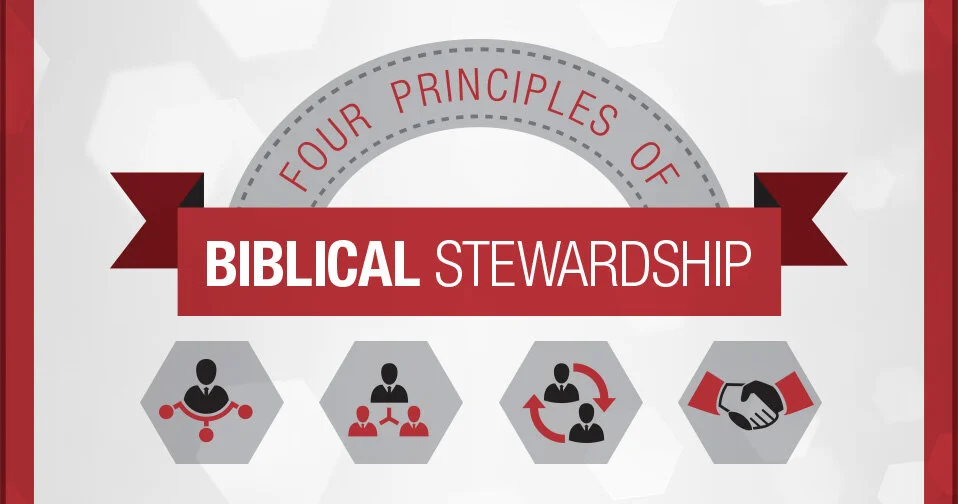
1.  You are a reckless giver, so much so that it could put you in financial risk at times

2.  You are exploited emotionally by others taking advantage of your generosity

3.  You do not feel like God owes you something because you have earned it

4.  You recognize that all you have is a gift of grace

Wait a minute, this is stewardship? This does not look like the stewardship I was trying to outline on that shower board all those years ago. Keller goes on to say that the standard for stewardship is the cross. . . whoa! That sounds crazy and imprudent to me. But that is the owner. . . radically generous. . . even to those who do not “deserve” it. . . even when it makes no sense to the world. . . even when it costs Him everything.

If God didn’t keep a tight grip on unlimited grace, then who am I to pinch every penny, even if I’m pinching for the “right” reasons? Generosity isn’t about gaining as much as you can in order to give more away. It isn’t even about giving away everything you have. It’s about acknowledging the free gift of love and grace you’ve already received from the one who owns everything—and in turn holding on loosely to whatever treasures he has placed in your hands.

Related articles

——

Frank Kelly III

CEO | Kelly & Associates Insurance Group

Frank serves as CEO of Kelly & Associates Insurance Group, Kelly & Associates Financial Services, KELLY Exchange Services and KELLY Integral Solutions—collectively known as Kelly Benefits.

As a group insurance administrator, broker, and consultant specializing in health care, Kelly & Associates Insurance Group has been recognized as the largest employee benefits administrator in Maryland and one of the largest in the mid-Atlantic region. Kelly Benefits has also developed an integrated payroll and workers’ compensation insurance solution that is growing rapidly. Since Frank was named President in 1994, Kelly Benefits has grown from a corporate client base of 1,000 to more than 10,000. Annualized premiums and payroll administered and under management have risen from $20 million to over $4 billion.

A long-time board member and past president of both the Baltimore Association of Health Underwriters and the Maryland Association of Health Underwriters, Frank III has earned professional designations as a Registered Employee Benefit Consultant, Registered Health Underwriter, Health Insurance Associate, Life Underwriting Training Council Fellow and Chartered Life Underwriter. Frank was honored as the BAHU person of the year in 2001 and inducted into the MAHU Hall of Fame in May 2012.

Frank obtained his insurance license in 1984 while still in college and worked at the company in telephone sales during the summer months. Two years later, after graduating from college, he became an account executive for small businesses in trade associations. In 1988, Frank was named Sales Manager and then in 1989, Vice President of Sales for the company. When he was promoted to Executive Vice President in 1991, he assumed responsibility for overall marketing and all operations of the company. In 1994, Frank was named President of KELLY; in 2007, he was named CEO.

Outside the office, Frank has been involved in many community and civic activities. He is past Chairman of the Board of the Baltimore County Chamber of Commerce, where he served as a Board member from 2001-2009. He was on the Baltimore County Department of Social Services Board for many years and served as its Chairman from 2003-2005. Frank also served as Chairman of the Maryland Fellowship of Christian Athletes and on FCA Lacrosse Leadership Boards for nearly 20 years as well as served on the FCA National Board of Trustees from 1997 to 2003 and 2014 to present. Frank was inducted into the FCA Hall of Champions in 2013 and the FCA Ring of Honor in 2016.

Frank also serves or has served on the Boards of Calvert Hall College High School, Calvert School, US Lacrosse Foundation, The Maryland Zoo in Baltimore, Living Classrooms Foundation, Cal Ripken, Sr. Foundation, Greater Baltimore Committee, AFRO Charities, Inc. and the World Vision Leadership Council. Frank was elected into his alma mater, Calvert Hall College High School, Hall of Fame in 2013, and was inducted into the US Lacrosse Greater Baltimore Chapter Hall of Fame in 2018.

Frank and his wife, Gayle, are currently the Chairs for the Helping Up Mission’s $61 million “Inspiring Hope” campaign. The Center will ultimately provide up to 210 women, struggling with poverty, homelessness and addiction, and their children a place to call “home” while receiving the help they need. Frank also recently helped lead and complete a campaign to build the FCA Park Heights football and cheerleading teams a new “Park Heights Saints Community Center” at 4804 Reisterstown Road in Baltimore, Maryland. The renovated rowhouse/center was dedicated on March 20, 2019. 

A 1986 graduate of Cornell University with a degree in business management, Frank was recognized as a Red Key Scholar Athlete, played football and captained the lacrosse team, where he was an All-Ivy League selection. His interest in lacrosse continued after college with several seasons of professional box lacrosse for the Baltimore Thunder of the Major Indoor Lacrosse League and many years with The Maryland Lacrosse Club, where he was an All-Club selection.  

Frank was an assistant football and lacrosse coach for many years at Calvert Hall College High School in Towson, Maryland and has coached youth teams in soccer, football, basketball, baseball and lacrosse. Frank and Gayle are the proud parents of Frankie and his wife, Acacia; Stephen; Jacqueline Lee and Joseph Kim. They live in Lutherville, Maryland.

Links: 

CONTRIBUTIONS TO FAITH DRIVEN ENTREPRENEUR

PODCAST CONTRIBUTOR (template to duplicate with devo)

Title

LINKS

CONTRIBUTIONS TO FAITH DRIVEN ENTREPRENEUR