








Ex-Felon, Redemptive Entrepreneur
Article originally hosted and shared with permission by The Christian Economic Forum, a global network of leaders who join together to collaborate and introduce strategic ideas for the spread of God’s economic principles and the goodness of Jesus Christ. This article was one of CEF’s 2019 White Papers.
— by Jay Hein
Can you imagine introducing yourself with your name and the one thing in life that brings you the most shame?
To attend CEF, we were asked to write a paper revealing our best ideas, along with a bio summarizing career highlights and a “3-2-1” list (favorite blogs/podcasts, ways to relax, and hoped-for legacy).
When someone leaves prison, they are not asked for such lovely things. Rather, they need to check a box noting their ex-felon status as a central aspect of their identity. This branding is often referred to as a “second sentence”—the stigma and real restrictions that accompany the formerly incarcerated in job interviews, housing applications, school field trip permission slips, and more.
My colleague Bryan Kelley experienced a “second sentence” episode at the White House recently. The irony here is quite rich. Bryan is CEO of the Prison Entrepreneurship Program (PEP) and he was invited to participate in a White House event celebrating recent congressional adoption of the president’s criminal justice reforms. But Bryan was stopped at the gate because Secret Service would not grant him security privileges to access the property.
Bryan is undeterred. The White House experience only fueled his desire to replace second sentences with second chances. And there is no better time to turn this vision into reality. Criminal justice reform has become a rare instance where Washington, D.C.’s policymakers are actually getting something done in this era of divided politics.
A recent Wall Street Journal editorial board column, titled “A Jailbreak for Bipartisanship,” lauded congressional passage of the First Step Act. This legislation took a big turn from punishing criminals and protecting society from them toward restoring ex-felons and preparing them to return to our communities as neighbors.
We strive to empower our men to move from being tax consumers to taxpayers; from gang leaders to servant leaders; and from felons to real fathers and philanthropists.
Bryan Kelley, CEO and 2014 Graduate
The PEP Model
If laws are the hardware of prison reform, then reentry programs are the software that runs on it. Thoughts leaders from Harvard University’s Michael Porter to American Enterprise Institute’s Arthur Brooks have cited PEP, which is the leading “software” solution in the reentry market today.
PEP’s model focuses on Christ-centered character formation for those entrepreneurs interested in transforming their hustle from illegal trade to redemptive entrepreneurship. The process starts with inmate recruitment from 80 prisons scattered across the state of Texas. (Yes, Texas has the distinction of being the industry leader in America’s mass incarceration epidemic.)
Over 2,000 inmates compete a 20-page application annually; finalists are then given a study packet and a 50-question test. This process yields 400–500 selected applicants who are transferred to a prison unit offering the PEP program. With a 5% acceptance rate, PEP’s selectivity rivals top-ranked colleges and universities in the United States.
PEP’s in-prison services feature three phases:
-
A three-month Leadership Academy that reshapes character via 20 hours of classroom time per week and an intensive curriculum instilling 10 driving values (integrity, accountability, wise stewardship, love, fun, fresh start outlook, servant-leader mentality, innovation, execution, and excellence).
-
A six-month mini-MBA where participants develop business plans, work with executive volunteers, and complete a college-level entrepreneurship curriculum.
-
Participants then pitch their business plans before a panel of judges over several competitive rounds. The program concludes with a ceremony attended by family members where graduates receive an entrepreneurship certificate from Baylor University.
To prepare for successful life reentry in addition to business success, PEP staff provide coaching to support the process of reconciliation between participants and their family members.
Upon release from prison, PEP Transition Coordinators pick up graduates at the gate and supply extensive support services such as transportation, counseling, emergency financial assistance, etc. Approximately 65% of PEP graduates choose to live in one of PEP’s five transition homes in Houston or Dallas.
PEP also hosts a weekly “eSchool” taught by executives, MBA candidates, and university professors. Study topics include, but are not limited to, strategic thinking, marketing, leadership, finance and accounting, and technology. An eSchool graduate who launches a small business qualifies for a $500 award from PEP to cover start-up costs. PEP offers other entrepreneurial support services including access to loans.
The Results
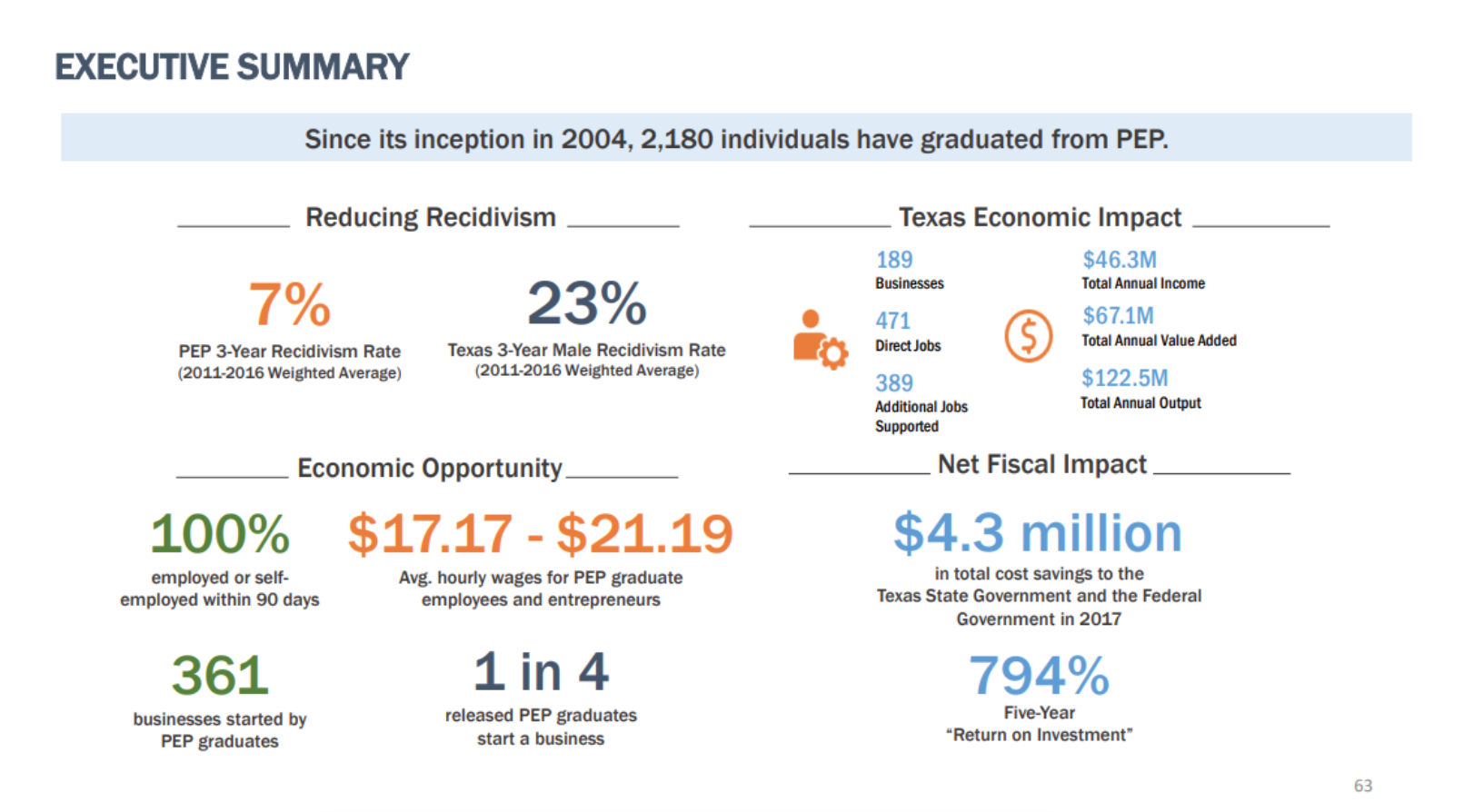
Harvard University’s Initiative for a Competitive Inner City (founded by Michael Porter) evaluated the PEP model and found that “ex-felons who start their own businesses create and annual economic impact of $122.5 million across the state of Texas.” This success story is compounded when you consider there is an estimated $4 million annual savings to taxpayers given PEP’s dramatically reduced recidivism rates compared the national average.
Kim Zeuli, who co-authored the Harvard report, noted “ICIC evaluates entrepreneurial support programs at other organizations across the country. The quality of the entrepreneurial training and support PEP provides matches programs at some of the most effective organizations we evaluate. The results speak for themselves in terms of business start-up and success rates.” Harvard’s findings are summarized in the following chart:
JP Morgan Chase provided funding for the Harvard’s study of PEP’s success. Carolyn Watson, director of philanthropy for Chase’s Houston office, said, “It’s time we start removing barriers that prevent returning citizens from getting a job, building a business and creating a better, law-abiding life. Once their debt to society is paid, it is both morally just and economically advantageous to help ex-offenders find gainful employment and develop businesses. The key is to develop economic opportunities to help themselves and the community.”
Impact Investing Is the Key to the Future
I am privileged to work alongside Bryan Kelley and longtime PEP chairman Mike Humphrey to replicate PEP in other states and to create a new business model featuring Earned Income Ventures and a PEP investment fund for alumni businesses.
Mike launched the first earned income strategy for PEP in Houston. Following a couple-decades long career operating a private equity fund, Mike created Communitas Auto Group (CAG) LLC and purchased the rights to become the exclusive franchise operator for Auto-Lab across Texas. The Auto Lab stores create high quality career opportunities for PEP graduates and a recurring revenue stream for PEP.
Mike and I are now investigating new earned income opportunities and we’re raising capital to invest in qualifying businesses being operated by PEP graduates. There were 361 businesses established by PEP graduates when Harvard’s study was produced. A half dozen of those produce $1 million in sales or revenue.
If access to capital is hard for most start-ups, imagine the challenge fundraising can be for ex-felons. Said one 2014 graduate to the Harvard researchers, “There are all types of stumbling blocks and obstacles coming out of a place as dark as prison. Getting a loan is difficult; you have a gap on your resume. Once the background check comes back, people shut doors on you without asking any questions. Society doesn’t give you an opportunity.”
Through expanding earned income ventures and opening an operating a PEP Fund for alumni business, we seek to deliver the opportunity our redemptive entrepreneurs desire. We are also helping strengthen PEP as an entrepreneurial support organization featuring three key domains:
-
Management Education – e.g., strategic planning and organizational development
-
Access to Capital – e.g., finance skills and guidance on qualifying for loans and pubic/corporate contracts
-
Social Networks – e.g., establish peer network and increase visibility/credibility in business community
The field of redemptive entrepreneurship is being effectively championed by CEF delegates Henry Kaestner and Luke Roush. Given the personal redemption being experienced by PEP graduates and the redeeming qualities of their businesses, it is an honor to give these future CEF delegates a new way to introduce themselves… as redemptive entrepreneurs.
——
[Special thanks to Danny Müller for the cover photo]