Mark DeYmaz

Pastor and Author

Mark DeYmaz is the founding pastor of the Mosaic Church of Central Arkansas, multi-ethnic and economically diverse church where significant percentages of Black and White Americans, together with men and women from more than 30 nations, walk, work and worship God together as one.

A recognized leader in the emerging Multi-ethnic Church Movement, his first book, Building a Healthy Multi-ethnic Church (Jossey-Bass/Leadership Network, 2007), provides the Biblical mandate for the multi-ethnic church and outlines seven core commitments required to bring it about. The book was chosen as a finalist in 2008 for a Christianity Today Book of the Year Award and for a Resource of the Year Award sponsored by Outreach Magazine, in both cases a nominee in the Pastoral Leadership category.

In his second book, Leading a Healthy Multi-ethnic Church: Mixing Diversity Into Your Local Church (Zondervan/Leadership Network, 2010, 2013), Mark identifies seven common challenges of a multi-ethnic church and demonstrates, through sound exegesis of Scripture, culture, and experience, how to overcome the obstacles. Mark’s latest book (in iBook format) is entitled, The Multi-ethnic Christian Life Primer is the first personal devotional and small group study on multi-ethnic life and church designed for people in the pews. Available in iTunes and from www.mosaixresources.com.

In addition, he is a contributing editor for Outreach magazine, and as well a contributing editor for Leadership Journal. He is also a co-founder, and currently the Executive Director of the Mosaix Global Network, an organization dedicated to inspiring unity and diversity in the local church throughout North America and beyond. He posts regularly on Glue, his personal blog. Mark is a former member of Little Rock’s Racial and Cultural Diversity Commission and past chair of the city’s Faith Alliance.

Mark and his wife, Linda, have been married for 21 years and together they have four children – Zack, Emily, Will and Kate. Linda is the author of two books, including Mommy, Please Don’t Cry (Multnomah, 1996), an anointed resource providing hope and comfort for parents who grieve the loss of a child.

CONTRIBUTIONS TO FAITH DRIVEN ENTREPRENEUR

Designing Workplaces to be More Human

This article was originally published here by Denver Institute

— by Jeff Haanen

We spend about a third of our waking lives at work. And yet, for the majority of people, work is not much more than a paycheck. We feel lonely, especially men. We feel like there’s a gap between our job responsibilities and our own potential. We often feel exhausted and question whether our work is making any meaningful difference.

How might we reimagine what it means to be fully human in our working lives?

Here are five aspects of what I think it means to be human, and, as a result, what I believe we need to focus on if we’re going to build workplaces that really invest in human potential.

Humans are emotional and spiritual.

It’s tough to avoid it. Fear, anger, joy, surprise, sadness, disgust, elation – every day we’re a mix of emotionsMy guess is that today, before leaving for work, you experienced at least a few of these emotions. One philosopher has made the case that fundamentally, we are creatures of desire. Dostoyevsky said it well: we crave nothing so much as something to worship. Our emotional and spiritual lives are woven tightly together.

Yet how many workplaces really acknowledge – and embrace – the fact that that we feel, we believe, we worship? Even rarer: who really takes the time and effort to invest in the deep emotional and spiritual health of their employees?

We see the cost when our co-workers are unhealthy – disengagement, addiction, distraction. A full 1 in 5 U.S. adults experience mental illness each year. But do we deeply care about facing our own shadows honestly and creating workplaces where our hearts experience deep peace? 

Humans are relational.

From our very first breath to our last, we are surrounded by people. Relationships are both the greatest sources of joy and pain in our lives.

The ability to relate well to others – what workforce development professionals call “soft skills” – is consistently the most important skill employers are looking forEmotional intelligence also happens to be the skill needed for high level leadership.

Yet, how difficult it is to work alongside other human beings!The inability to deal with conflict, our own lack of self-awareness, and a growing loneliness epidemic in America all contribute to the deep challenges we face in our families and workplaces.

Yet each of us longs for community; we long to know others, and be known. We weren’t designed to be alone. 

Humans are makers.

From the earliest recorded history, humans made things. Tents, musical instruments, tools, weapons, pots, homes. “We are made in the image of the Maker,” says dramatist and playwright Dorothy Sayers. Work is, and always has been, a fundamental part of what it means to be human. Culture is made by what we make, and the meaning we derive from what we’ve made.

In the modern world, we’re constantly surrounded by other people’s work. Coffee cups, drywall, iPhones, books, concrete, electrical outlets, mops, pacifiers. Though some may imagine a day when machines take all of our jobs, history just doesn’t bear it out. Every time technology displaces jobs, we find other things to create. We are creators by nature.

Yet again, there’s so much that hinders our ability to do good work. Distraction, lack of autonomy, insufficient time, low wages, unequal access to opportunity.  To make things worse, professionals especially have nearly divinized work as our sole source of worth and identity. 

Who are the employers who invest in people’s ability to do excellent work, while holding work in its proper place alongside family and community?

Humans are thinkers.

As young children, each of us were naturally curious about the world. We wanted to know. We wanted to learn. And now, as adults, we are in a constant state of debating what is true and good. Ideas matter.

In the circles I run in, it’s now out of fashion to acknowledge that we’re intellectual beings. But any cursory reading of history shows us that ideas matter. Just a review of the wars of the twentieth century – what some have called the age of ideologies – shows this to be true. Those who claim they just want “practical action steps” and don’t care much for “heady matters” are often the most controlled by the ideas of those who’ve gone before them.

In a global economy that changes so quickly, none of us can afford to stop learning. Yet in our jobs, more often than not, we become technicians. We become good at one thing – like processing mortgages or writing marketing copy – yet often are in the dark about the majority of the world. It’s hard to find opportunities to become generalists, and recover the range that we delighted in as children.

Where are the workplaces that encourage curiosity? Where are the organizations that ask employees to read outside of their field, listen to lectures on a regular basis, and really encourage broad, diverse thinking?

Humans are city-builders.

This, too, is ancient. Not only do we work, but we work together. And as soon as we work, we form companies. And when we form companies, we realize that we need governments to safeguard those companies, and the rights that underpin them. We also need systems of education to form the next generation of workers and citizens. We need doctors to heal, craftsmen to build, and salesmen to sell. Before you know it, we have built cities.

As much as I’d like to avoid politics, we really can’t. Humans naturally form a polis when we work together. We must find ways to understand each other, live alongside each other, and provide for the needs of each other. “All men are caught in an inescapable network of mutuality, tied in a single garment of destiny,” said Martin Luther King Jr. “Whatever affects one directly, affects all indirectly.” Aristotle once said, “Man is a being best suited to living in a polis [city].”

Humans are intrinsically civic creatures. So, we’re forced to ask questions about not just our own needs, but also the needs of others. What does it mean for us to build just systems? What is a good society? And a question I often ask myself: are our workplaces a part of that answer, or are they a part of the problem?

My question for you is this: are you thinking theologically, embracing relationship, creating good work, seeking deep spiritual health, and serving others sacrificially?

Though in a secular workplace, you can’t always use theological language, you can take a look at your work environment or company and ask good, honest questions, such as:

  • Do we invest in deep emotional and spiritual health?

  • Do we encourage real friendship and relational wholeness?

  • Do we create conditions for people do their best work?

  • Do we stimulate broad thinking about the key issues of our day?

  • Do we really care about our city, especially the vulnerable?

Sometimes integrating faith and work can seem overwhelming. But you do have a choice. You can shrink back, or you can act. You can accept the status quo, or you can choose to be motivated by doing your small part in the healing of God’s broken world. You can assume “work is work,” or you can imagine, in community, what might be.

You could even print off these five questions and bring them up at your next team meeting. It may just convince them that work can be more than a paycheck. 

Related articles

Spirit of Faith

At the end of every podcast, we like to ask our guests to share what God has been teaching them in this season of life. This week’s guest is Mark DeYmaz.

2 Timothy 1:7

For the Spirit God gave us does not make us timid, but gives us power, love and self-discipline.

God has not given us a spirit of fear, but of power, love, and a sound mind. That has been a verse that sustained me certainly over the past 40 plus days in this current pandemic because I love the interplay of that verse. God has not given us a spirit of fear.

We have a spirit of faith. We have the Holy Spirit with us. We have a spirit of faith. But it goes on to say that that is a spirit of faith, power, love and of sound judgment or of self-discipline. 

And I love that verse both in terms of this time of pandemic and others, because it says, yes, we have faith, but we also exercise self-discipline, sound judgment. And that’s how God always works. 

I mean, how do people get saved? God just doesn’t write John 3:16 on the Rocky Mountains. He says, hey you. You go and tell people about me. So God in his sovereignty has set up the partnership. Yes, it’s him, but it’s also us on all of these things, from salvation to these money matters of the church.

 So, yes, we proceed by faith. But we also do it with sound judgment, wisdom, a sound mind, if you will. And together with God’s faith and a sound mind is what gets us power and love and helps us advance a credible gospel in an increasingly diverse, painfully polarized, and cynical society. 

[ Photo by Dimitri Houtteman on Unsplash ]

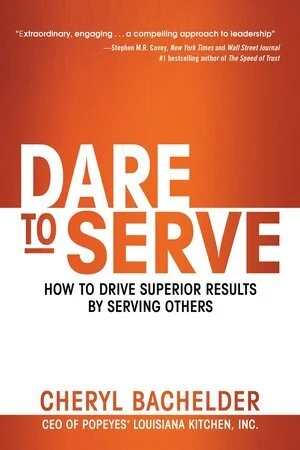
Dare to Serve by Cheryl Bachelder

We continue to count down the Top 100 Books for Faith Driven Entrepreneurs with…

Dare to Serve

by Cheryl Bachelder

Cheryl Bachelder joined an ailing restaurant chain and turned it into the darling of the industry—by daring to serve the people in her organization well. In Dare to Serve, former Popeyes CEO Cheryl Bachelder shows that leading by serving is a rigorous and tough-minded approach that yields the best results.

When she was named CEO of Popeyes in 2007, the stock price had slipped from $34 in 2002 to $13. The brand was stagnant, the team was discouraged, and the franchisees were just plain angry. Nine years later, restaurant sales were up 45 percent, restaurant profits had doubled, and the stock price was over $61. Servant leadership is sometimes derided as soft or ineffective, but this book confirms that challenging people to reach a daring destination, while treating them with dignity, creates the conditions for superior performance.

Click on the book cover to check out the Reviews and Purchase at Amazon


Reconciliation, the church, and economic justice

This article was originally published here by Made to Flourish

— by Luke Bobo 

These three phrases — reconciliation, economic wisdom, and the church — belong together. Why? Let’s begin with a definition of reconciliation. Brenda Salter McNeil’s book, Roadmap to Reconciliation: Moving Communities into Unity, Wholeness and Justice, helps us.

McNeil, featured as one of the 50 most influential women to watch by Christianity Today in 2012, and associate professor of reconciliation studies in the School of Theology at Seattle Pacific University, defines reconciliation as “…an ongoing spiritual process involving forgiveness, repentance and justice that restores broken relationships and systems [institutions] to reflect God’s original intention for all creation to flourish.”

Click here to read the full article!

Related articles

——

[ Photo by Tabea Damm on Unsplash ]

Health & Wealth Matters: How Do We Respond to the Effects of Coronavirus and Lockdown?

This article was originally published here by Mats Tunehag

— by Mats Tunehag

There is good news and bad news. We can rejoice that the biggest lift out of poverty in the history of mankind has happened in our generation. Since 1990 more than a billion people have risen out of extreme poverty, and a large part of these in China and India, not through aid but trade, not by handouts or charity. Growing small and medium size businesses are key factors to this good news.

The bad news is that due to the corona virus, restrictions and lockdown measures, we risk a major global setback. United Nations, World Food Program, International Labor Organization, International Food Policy Research Institute, Business Sweden, and others are painting horrifying scenarios on a macro-scale: Around 50 million children could fall into extreme poverty. Hundreds of millions of jobs may be lost. 260 million face starvation, and three dozen countries risk famine. 2.7 billion workers are affected by the lockdown measures. Most vulnerable are people in the informal sector, and in India alone 400 million workers now face greater impoverishment. 50 – 70 percent of the population in 20 countries in Africa will run out of money and food after a 14-day quarantine.

When sales in clothes retailers like H&M went down around the globe, two million workers in the garment industry in Bangladesh lost their jobs. Their fate is similar to a message I received from a friend in Myanmar: “What this (lockdown) has meant for poor people, who are part of the informal economy, is no work, no money and therefore no food. There is no government social security net and certainly no savings.”

It may be, as the Stanford professor and Nobel Prize winner Michael Levitt recently stated: “When we come to look back on this, the damage done by lockdown will exceed any saving of lives by a huge factor.” [1]

In the face of these grim predictions, there is more good news! People and nations have fought pandemics before, risen out of abysmal poverty and conquered dreadful diseases. So, what can we learn?

“In 1575, plague descended on Milan. The city’s bishop, St. Charles Borromeo, hastened both to action and to prayer. Indeed, he exemplified the maxim, beloved of Dorothy Day and others, to ‘work as though everything depended on ourselves, and pray as though everything depended on God’.” [2]

Bishop Borromeo had a holistic worldview, working with God and people to meet physical, social, economic and spiritual needs. He persuaded rich people to help the poor. He created and staffed hospitals and quarantine houses. He instituted social distancing policies and had a particular love and care for orphaned infants. He moved church outdoors, to mitigate risk of spreading the disease. But he also created jobs or supported a large number of laid-off workers.

Borromeo realized that the plague didn’t cause just one problem, and thus there was not just one solution. He raised funds, and tackled immediate needs like hunger and healing. He also sought dignifying and long-term solution by creating jobs. While acknowledging and dealing physical health issues, and identifying socio-economic needs, he also addressed the spiritual welfare of the people. We must learn from his holistic views and multi-dimensional solutions.

Because jobs are not just a matter of income or survival; work is an issue of human dignity. What is the best way to help a poor child? Give the parents a job! Charity has a place, and relief efforts are needed. But for a long-term solution we need a paradigm shift in thinking and praxis, from handouts to job creation, from mainly non-profit responses to for profit solutions.

There is a need to embrace work as good, and we must acknowledge that business is a vocation (from ‘vocare’ – calling). Business has a higher purpose beyond mere sustenance or just financial returns.

“Entrepreneurs, managers and all who work in business, should be encouraged to recognise their work as a true vocation and to respond to God’s call in the spirit of true disciples. In doing so, they engage in the noble task of serving their brothers and sisters and of building up the Kingdom of God.” [3]

Like Borromeo, we seek holistic transformation of people and societies. That includes seeking a positive impact on multiple bottom lines for multiple stakeholders as we do business.

As the Business as Mission Manifesto (2004) states: “We recognise that there is a need for job creation and for multiplication of businesses all over the world, aiming at the quadruple bottom line: spiritual, economical, social and environmental transformation.” [4]

Worldview matters and ideas have consequences. We have too many examples of devastating ideology driven policies with limited regards for consequences. One can compare the health and wealth of people and nations with the same culture and languages like South and North Korea, and West and East Germany. We can witness how a potentially rich country like Zimbabwe has gone from being a bread basket to a basket case in southern Africa. The oil rich Venezuela is another tragic example of how disregard for basic wealth creation principles has destroyed a country.

The disastrous and murderous socialist policies of Mao came to an end in the late 1970’s when Deng Xiaoping opened up for business and led the country to a path out of poverty towards prosperity. He defended his non-communist but pragmatic approach by saying: it doesn’t matter if the cat is black or white as long as it catches mice.

At the other end of the spectrum we have Israel. It is an example of a small nation with limited natural resources and with hostile neighbors, which in our lifetime has been transformed to a prosperous world-leading innovator.[5] Another example is Singapore which was poor and became independent as recently as 1965. But they learned from Israel. Today it is another world-leading country; well functioning, green, safe, clean, and prosperous.

Consequently, we need to be mindful of the consequences of the corona virus and global lockdown measures. But we should also learn from the past, from successes and failures, from Borromeo to Singapore and its prime leader for decades – Lee Kuan Yew[6]. We need to affirm the intrinsic value of work and business, and its power to restore and create health and wealth. We need ‘ora et labora’, to pray and work.

As stated in the Wealth Creation Manifesto[7] from 2017: “Wealth sharing should be encouraged, but there is no wealth to be shared unless it has been created. The purpose of wealth creation through business goes beyond giving generously. Business has a special capacity to create financial wealth, but also has the potential to create different kinds of wealth for many stakeholders, including social, intellectual, physical and spiritual wealth. Wealth creation through business has proven power to lift people and nations out of poverty. Wealth creation must always be pursued with justice and a concern for the poor.”

We know that businesses can be strong transformational agents for the common good. As Pope Francis says: “Business is a noble vocation, directed to producing wealth and improving the world. It can be a fruitful source of prosperity for the area in which it operates, especially if it sees the creation of jobs as an essential part of its service to the common good.” [8]

The need for God honoring and people serving businesses will increase during and after the pandemic.[9] Thus we must continue to affirm, equip and deploy men and women, young and old, on all continents, to grow, shape and reshape businesses with God and for the common good. We also need to build an eco-system of leaders from business, government and civil society, so different kinds of wealth can be created and health restored. And we must include the church. To that end, let me conclude with the appeal from the Wealth Creation Manifesto“We call the church to embrace wealth creation as central to our mission of holistic transformation of peoples and societies.

Related articles

Footnotes

[1] “The Worldwide Lockdown May Be the Greatest Mistake in History”, by Dennis Prager. https://www.realclearpolitics.com/articles/2020/05/05/the_worldwide_lockdown_may_be_the_greatest_mistake_in_history_143119.html

[2] Catholicism in the Time of Coronavirus, by Stephen Bullivant Word on Fire, 2020

[3] Vocation of the Business Leader, published by the Pontifical Council for Justice and Peace

[4] https://bamglobal.org/lop-manifesto/

[5] Recommended reading: “Start-up Nation: The Story of Israel’s Economic Miracle”, by Dan Senor & Saul Singer

[6] Recommended reading: “From Third World to First: The Singapore Story – 1965-2000”, by Lee Kuan Yew

[7] Three years ago, we concluded a global consultation on The Role of Wealth Creation for Holistic Transformation, of people and societies. Our findings were summarized in the Wealth Creation Manifesto, now available in more than a dozen languages. matstunehag.com/wealth-creation/

[8] Laudato Si’, 129

[9] See also “The Coronavirus Pandemic and BAM: Seven Things We Can Do

https://businessasmission.com/the-coronavirus-pandemic-and-bam-seven-things-we-can-do/

——

[ Photo by Jason Strull on Unsplash ]