Scott Harrison

Founder | Charity:Water

Scott spent almost 10 years as a nightclub promoter in New York City before leaving to volunteer on a hospital ship off the coast of Liberia, West Africa as a volunteer photojournalist.

Returning home to New York City two years later, he founded the non-profit organization charity: water in 2006. Turning his full attention to the global water crisis and the world’s 785 million people without clean water to drink, he created public installations and innovative online fundraising platforms to spread international awareness of the issue.

In 13 years, with the help of more than 1 million donors worldwide, charity: water has raised $450 million and funded 51,400 water projects in 28 countries. When completed, those projects will provide over 11 million people with clean, safe drinking water.

Scott has been recognized on Fortune magazine’s list of 40 Under 40, Forbes’ Impact 30, and Fast Company’s 100 Most Creative People in Business, where he earned the #10 spot. He is currently a World Economic Forum Young Global Leader and author of the New York Times Bestselling book Thirst.

Scott lives in New York City with his wife Viktoria, son Jackson and daughter Emma.

CONTRIBUTIONS TO FAITH DRIVEN ENTREPRENEUR

The Mindset of God-Honoring Leaders

— by Leadership Edge Inc.

God-Forged Mindsets for God-Honoring Leaders

God builds godly character in us by guiding and enabling us to choose righteousness throughout the years of our lives. The internal effect of godly character is that it reforms our mindset and our will.  For example, as we grow to choose truth over deceit, this begins to slowly work its way into our perspective and decision-making (mindset) and in our choices (will).

This paper will focus on ways that God forges our mindset as an effect of the godly values (righteousness) that He plants in us. A formal definition of mindset is a fixed mental attitude or disposition that predetermines a person’s responses to and interpretations of situations. In the Bible, God gives us several clear examples of the importance of our mindset.

At a critical point in Christ’s ministry, in which He is instructing his disciples on His upcoming crucifixion, he confronts and rebukes one of his closest followers because of that person’s misguided mindset. The follower was Peter, and the confrontation comes immediately after Peter rebukes Jesus for saying that He will go to Jerusalem, suffer assault by the religious leaders, be killed and resurrected in three days. When Jesus confronts Peter, He says to him, “Get behind me, Satan! You are a hindrance to me. For you are not setting your mind on the things of God, but on the things of man.” Jesus’ words are one of the strongest rebukes by Him recorded in the New Testament. His rebuke is not merely for Peter’s words, but moreover for the mindset behind his words. Peter had not set his mind on the things of God but only on the things of man.

Peter heard Christ’s prophetic words of his imminent death and resurrection. As these words landed into his mind that he had set on the things of man, he heard them not as the fulfillment of God’s plan for our forgiveness and salvation, but rather as an unthinkable sequence of events that would disrupt Christ’s ministry. This mindset was so dominant in his thinking that it fueled his audacity to rebuke Christ.  His was a dominant and deeply entrenched mindset that misdirected how he understood and acted in that context.

So what makes up a godly mindset?  Philippians 2:1-11 gives us the answer. Verse 2 gives us two specific aspects of this mindset:  being of the same mind and being of one mind.  These particulars tell us that the mindset that God calls us to is one that is shaped by and in sync with Christian community. We know from Paul’s and Barnabas’ disagreement concerning John Mark that being of the same mind or being of one mind is not always achieved.  However, Proverbs 18:1-2 warns us that doing our thinking separated from others is often a cover for selfish willfulness and assertiveness. This is precisely why Philippians 2:3-4 calls us to do nothing from selfish ambition or conceit and to not look only to our own interests. A godly mindset is one that counts others as more significant than ourselves and that looks out for the interests of others.

To have a godly mindset, God must give us grace and guidance as we work out our thinking as a member of the Christian community. This requires humility and submissiveness as well as at times, patience and courage.

Philippians 2:5-11 shows us a picture of what this mindset looks like. It looks like Jesus. We’re to “… have the same mindset as Christ Jesus” (v. 5, NIV). He perfectly models being of the same mind and being of one mind with God the Father in all things, including the plan for humankind’s salvation.  Christ’s mindset required humility and submissiveness, as well as patience and courage. He aimed to honor His Father by counting us as more significant than Himself and sacrificing Himself in looking out for our interests.

It is Christ’s mindset that God wants us to have. This mindset moves us away from understanding and acting according to man’s perspective and toward understanding and acting according to God’s perspective.  This is the mindset that God wants for every God-honoring leader.

If our mindset is the thought framework that informs how we understand our context and decide accordingly in it and if God wills for us to have the same mindset as Christ’s, then we must understand other aspects of Christ’s mindset that God gives us in His Word. At Leadership Edge, we’ve observed five perspectives that God builds into most of the leaders that we’ve served. These perspectives guide these leaders as to how to understand and assess their various spheres of influence. Each of these was modeled perfectly by Christ.

The Glory and Honor of God in All Things

Many New Testament passages speak of God the Father giving honor and glory to Christ His Son.  Christ Himself spoke of this often. Many New Testament passages also identify our purpose as being to bring honor and glory to God. It is important to note that two times immediately before Christ’s crucifixion, He states that His goal is to bring glory to the Father. After He enters Jerusalem in the days leading up to his betrayal and crucifixion, Christ says, “Now is my soul troubled. And what shall I say? ‘Father, save me from this hour’? But for this purpose I have come to this hour. Father, glorify your name.” Then a voice came from heaven: “I have glorified it, and I will glorify it again.” (John 12:27-28). And in what is known as Christ’s high priestly prayer, which He prayed the night before His death, He prays the following, “I glorified you on earth, having accomplished the work that you gave me to do.” (John 17:4). Because of this overarching mindset that God be glorified through His faithful obedience, it is no surprise that the prayer that Jesus taught His disciples to pray begins with, “Our Father in heaven, hallowed be thy name.” (Matthew 6:9).

We see a mindset of the glory and honor of God in all things as the foundational mindset for God-honoring leaders. This is the mindset of Paul, who while imprisoned for his faithful obedience in Christ, wrote the following, “… as it is my eager expectation and hope that I will not be at all ashamed, but that with full courage now as always Christ will be honored in my body, whether by life or by death.” (Philippians 1:20). It is this mental and willful commitment, fueled by God’s grace, that is both foundational to and overarches all other Christian mindsets and obediences.

The development of this mindset in a leader puts him/her in daily tension with the world, their own flesh, and the devil.  All three of these are set every day against God being honored or glorified in anything. It is in the context of this daily tension that the value of God’s honor and glory in all things is hardened into a mindset, as over and over again during the course of the day, small choices are made against the pull of the world, their own flesh, and the devil and for God’s honor and glory at any cost and in all areas. This mindset is reflected in the command from Scripture that says, “So, whether you eat or drink, or whatever you do, do all to the glory of God.” (I Corinthians 10:31).

Leaders who read their contexts according to a God-honoring, God-glorifying mindset stay aware of the following:

  1. Leaders who live and lead for the glory and honor of God must be vigilant to see those boundaries that cannot be crossed in their decisions and actions.

  2. These leaders realize that this mindset can be eroded as they give into expedient or self-serving actions.

  3. Diminished awareness of the vibrancy of Christ in their lives and isolation from interactions with others who will sharpen them can also lead to the erosion of this mindset.

  4. Leaders who live and lead for the glory and honor of God find the strength to do so, not ultimately in themselves but in God, their Father, who strengthens them to stand.

The other four mindsets described below flow out of and are dependent upon a mindset of God’s honor and glory in all things. All five of these mindsets require God-given, disciple-choosing courage to follow when stakes are high and faith and faithfulness are costly.

Humility

A mindset of humility continually points us to see our dependence upon God for everything and to come to Him with our needs. This perspective is at the core of God-honoring leadership because it honors God as we humble ourselves and trust Him for all that we need in life (Micah 6:6-8; Philippians 4:6-7).  Scripture tells us that a mindset of humility is like a mindset of wisdom (Proverbs 11:2; 22:4).

When humility becomes a mindset, it guides us to understand ourselves as servants and to act as servants in the contexts in which God leads us (Philippians 2:3-11). We come to realize that as Scripture says, our humility is honored by God with the grace that we need in all of life (I Peter 5:5; James 4:6).

The way that humility moves from being a value to a mindset is as, by His grace, we choose over and over again to humble ourselves, to serve God and others and then see the blessing He brings to us and others through doing so.

Christ is the perfect example for us of humility; this is wonderfully explained in Philippians 2:5-11.  Moreover, as stated earlier, we’re called by God to have His mindset of humility (Philippians 2:5).  By His grace, over time, leaders grow to honor him as humility becomes a daily mindset and practice.

Wisdom

A mindset of wisdom guides us to assess our contexts according to God’s Word and God’s character and to act accordingly. Proverbs 3:5-6 points us to this as it says, “… do not lean on your own understanding.  In all your ways acknowledge Him …”  God-honoring leaders learn to look at life through God’s eyes, not merely through their own, because they realize that their perspective is always limited.  Paul speaks of this limited human perspective in I Corinthians 13:12 that says “now (in this life) we see in a mirror dimly … Now I know in part …” 

God-honoring leaders over time build a habit of understanding the circumstances of all their relationships—marriage, family, career, community and church as the Bible tells us God sees them.  They do so out of their reverence for the Lord (The fear of the Lord is the beginning of wisdom. Psalm 111:10). They seek God’s wisdom as they make decisions, both small and large. These leaders realize that God has given them a brain and reasoning capacity. However, they also realize that now they see in a mirror dimly and only know in part (I Corinthians 13:12). They recognize their need for God’s wisdom and by His grace, habitually seek it and live according to it.  In this way, wisdom becomes a mindset for them.

Christ is the perfect example of this mindset. On the one hand, the Bible says that He is the wisdom of God (I Corinthians 1:24).  On the other hand, the Bible also tells us that while on earth, Christ continually looked to His Father to guide His judgment, speech and actions (John 5:19; 5:30; 6:38; 8:28; 12:49-50; 14:10).  Christ’s practice of looking to His Father in all things is a picture of His humility and submissiveness to God in all things. Christ exemplifies for us a model of living in reverence of God, which is the beginning of wisdom.

Intentionality

The Oxford Dictionary of English defines intentionality as “the fact of being deliberative or purposive.” Intentionality for a Christian leader is born out of a deep belief that one’s life has a God-given, biblically stated purpose for which God empowers us and to which we’re accountable to God to accomplish. Christian author and social critic Os Guinness speaks of this purposefulness as consisting of a primary and secondary calling from God. The primary calling is that we are called “by Him, to Him and for Him.”  The secondary calling is that “everyone, everywhere and in everything should think, speak and live and act entirely for Him.”  In Leadership Edge mentoring we get at purposefulness with our Personal Vision Statement: By God’s grace, to step forward as God’s man/woman, in my spheres of influence, to serve His purposes, for His glory

To honor God with our lives and leadership, we must tenaciously pursue the purposes to which God calls us. This conviction leads us to daily choices of intentionality in our speech and actions and in how we spend our resources, such as our time, talent, treasure and focus.  Paul gives us vivid examples of this sort of intentionality in passages such as I Corinthians 9:19-27, Philippians 3:7-14 and II Timothy 4:7. Hebrews 12:1-3 similarly actively portrays this kind of intentionality.  Intentionality becomes a mindset as by God’s grace, we daily choose against the misdirections for the world, our flesh and the devil and choose to live all of our lives for Him.

The Bible says that Jesus set His face as He moved toward His betrayal, persecution, death and resurrection. This phrase set His face is most likely informed by Isaiah 50:7 that says, “… I have set my face like a flint.”  Christ’s purpose was to honor His Father by going to Jerusalem and there have God’s wrath poured out upon Him so that we may be forgiven and deemed righteous by God. His was a mindset of flint-like intentionality. By His grace that empowers our daily choices, ours is to be the same.

Resilience

A mindset of resilience guides us to understand adversity and failure as a context in which God can restore and improve us as we trust in Him, draw our strength from Him and do what he calls us to do.

Proverbs 24:16 tells us that the righteous falls seven times and rises again, but the wicked stumble in times of calamity. All people stumble and fall; all at times fail.  The challenge is to, by the grace of God, get back up and keep getting back up through the years of life. Sometimes we fall due to our foolishness and sin and either give up or pridefully get back up with an unrepentant heart or an uncorrected mind. At other times we fall due to hurtful things done to us from which we give up, grow embittered or strike out with anger. Regardless of the source and effect of the fall, the challenge is to get back up and to do so by the grace of God.

Godly wisdom (God’s perspective on life and all that occurs in it), humility (our deep dependence upon God for everything) and intentionality (our commitment to live out His purposes for us) must temper the Christian leader’s resilience.  As this occurs, he understands how to get back up, goes to God for the strength to do so and understands why he must keep getting back up. Choosing daily to get back up by wisdom, humility and intentionality is how resilience grows from being an occasionally practiced value to a default mindset. Paul gives us a vivid description of what this looks like in II Corinthians 4:7-12, 16-18.

Christ exemplified resilience as He daily confronted the ignorance, selfishness, foolishness, sinfulness and evil of humankind during His earthly life. One wonders if His repeated times alone in prayer (Mark 1:35 and Luke 5:16) were partly due to His need for His Father’s strength to push through the above-mentioned failings of those around Him. Christ’s resilience was not getting back up due to fallings and failings. His resilience was a perseverance through all that would distract Him from honoring His Father through securing our salvation (Hebrews 12:2-3). In this again, He is our perfect example. May His resilient perseverance fuel us to daily choose to, by His grace, get back up and move forward to that which He has called us.

The mindset of a Christian leader daily guides us to understand our context as God does and to act in it as would please Him. We are to develop our mindset in a Christian community with Christ as our primary model. Biblical values become a God-honoring mindset as, by His grace, we daily choose to think and live according to them. Over the last 26 years, we’ve seen God consistently build the mindset of wisdom, humility, intentionality and resilience in the lives of hundreds of leaders. In all of this, may He be honored and glorified.

Related articles

——

[ Photo by David Marcu on Unsplash ]

Visions of Vocation by Steven Garber

We continue to count down the Top 100 Books for Faith Driven Entrepreneurs with…

Visions of Vocation

by Steven Garber

Is it possible to know the world and still love the world?

Of all the questions we ask about our calling, this is the most difficult. From marriages to international relations, the more we know, the harder it is to love. We become cynics or stoics, protecting our hearts from the implications of what we know. But what if the vision of vocation can be recovered―allowing us to step into the wounds of the world and for loves sake take up our responsibility for the way the world turns out?

Garber offers a book for everyone everywhere―for students, for parents, for those in the arts, in the academy, in public service, in the trades and in commerce―for all who want to discover the virtue of vocation.

Click on the book cover to check out the Reviews and Purchase at Amazon


Robert Fukui

Founder | Power Couples by Design

Born in Hawaii and son of a preacher, Robert received his bachelor’s degree in marketing from San Jose State University. He developed his marketing skills with the likes of Coca-Cola, Novartis Pharmaceutical and Bristol-Myers Squibb over 25 years. Over the course of his professional career, he has been privileged to be instrumental in the launch of six major brands, personally responsible for over $150 million in revenue and a recipient of national sales and leadership development awards. His successful experience in sales/marketing through ever-changing economic conditions has positioned him to be able to assist privately held, family businesses achieve similar success. In April 2016, he founded i61, inc. which is a consulting firm whose mission is to see transformation in marriages, communities, cities and nations they serve. His company focuses its efforts on improving the efficiencies of marketing, sales, and organizational leadership from a Kingdom perspective. In January 2019, Robert partnered with his wife, Kay Lee, to launch Power Couples by Design™. Created for couples in business, it is a breakthrough consulting and coaching program designed to equip couples to improve their communication and conflict resolution abilities while developing growth strategies for their business. Their objective is to build Thriving Marriages and Prosperous Businesses. Robert has been married for 14 years to Kay Lee Fukui. They reside in Pasadena, CA and have a little Yorkie named Pippa.

LINKS

Power Couples by Design

Facebook @PowerCouplesByDesign

Instagram @PowerCouplesByDesign

Linkedin

CONTRIBUTIONS TO FAITH DRIVEN ENTREPRENEUR

Innovation Anthropology

The art and study of Mashups for creating game-changing

— by Dr. Paul Campbell

Have you ever wondered what made people like Thomas Edison, Steve Jobs, and Elon Musk so innovative? Why they seemed to have been able to keep coming up with game-changing technologies over and over again? As an Innovation Anthropologist, I have rigorously studied many of the innovative historical breakthroughs which have had the most significant impact on society. My original hypothesis was that each of these pioneering innovators possessed a rare creative gene that the rest of us common folk could only learn from but never truly replicate. What I discovered, however, was that the complicated answer I was searching for was really just a simple one. As it turns out, the clue to their genius could be found at my dinner table, almost literally under my nose.      

As of 2016, there are 118 confirmed elements on the periodic table. Individually many of these elements are useless, that is until you combine or mash them up together. For example, sodium is a silver-white reactive metal and is part of the alkali metal group. When combined with chlorine, a toxic and lethal compound, you get sodium chloride; otherwise known by its more common name, salt. In other words, like a chemist, when you learn to combine various ideas, disciplines and previous innovations you too can come up with new game-changing products and services. In this article, you will learn how to develop the skills of a Mashup Practitioner. You will also learn how some of the greatest innovators throughout history have used the power of the Mashup to create tremendous advancements in human flourishing. Let us now consider an early practitioner of the Mashup, Johannes Gutenberg.

Wine, Ink, and the Printed Book

It is hard to imagine what the world might look like today without the contributions of Johannes Gutenberg’s printing press. Before his invention, knowledge hoarding was frequently leveraged as a weapon of control by society’s elite class. Put differently, the printing press reduced the barriers to the acquisition of knowledge by decreasing the cost of book production. For the first time in history, knowledge by way of the written word was readily accessible to the common man. This, of course, led to a crack in the wall between the haves and have-nots. As such, it would not be a stretch to state that no other invention has had a greater impact on human flourishing than Gutenberg’s. But how truly innovative was his idea?

All of the needed technologies to build the printing press already existed for hundreds of years before Gutenberg’s birth. For example, roughly 1200 years before he was ever a twinkle in his mother’s eye, the Chinese invented ink (which was a mixture of pine soot, oil, and gelatin). The Chinese also created woodblock printing in the early second century and moveable typeset in the tenth century. In reality, his real genius was the Mashup he created when adding the screw press (used in wine and olive oil production) to these Chinese innovations. This simple addition to the printing process became one of the most significant advancements in human flourishing. Moreover, from a historical perspective, it has been observed that without the invention of the printing press the Renaissance may have never happened. Speaking of the Renaissance, let us now consider another great Mashup Practitioner, Leonardo da Vinci.

Art, Science, and the Human Heart

Many of us know Leonardo da Vinci by his tremendous gift for art. However, after a closer look at his life, it becomes clear that his greatest talent actually was his highly developed skill as a Mashup Practitioner. As a self-taught learner, his insatiable curiosity led da Vinci to also study architecture, science, music, mathematics, engineering, literature, anatomy, geology, astronomy, botany, writing, history, and cartography. This acquisition of knowledge by way of books, combined with his rigorous and disciplined scientific observations, led da Vinci to blend these various disciplines to create breakthrough insights and innovations. A great example of this was his prediction of how the bottom of the aorta, known as the sinus of Valsalva operated. 

Five hundred years before Brian Bellhouse and his team of engineers used computers to observe how the sinus of Valsalva functioned in 1969, Leonardo combined his interest in engineering, anatomy, science, and art to predict how the sinus of Valsalvas revolving impetus ejected blood from the heart. “How did he do it without modern day computers,” you might ask? To prove his theory, he built a glass model of the aorta and pumped water through it. As it turns out, what made Leonardo da Vinci a Renaissance Man instead of an ordinary one was his extraordinary ability to Mashup his curiosity about ordinary everyday things and turn them into revolutionary breakthroughs. Let us now consider an example from recent history.

Rockets, Science, and Medicine

Dr. Gavriel Iddan is a former rocket scientist for Rafael Advanced Defense Systems. While at Rafel, he specialized in the sophisticated electro-optical devices for guided missiles. However, a conversation during a sabbatical in the United States would lead to a career change from building instruments of death to creating technologies which preserve life. Speaking with his Bostonian gastroenterologist neighbor who was suffering from a undiagnosed stomach pain, Iddan stumbled upon a breakthrough Mashup. He thought, “What if I could re-engineer my miniaturized camera system to be used inside the human body?” This question led Iddan and his team to develop the Endoscopic Capsule, which is a disposable pill-sized camera that passes straight through the digestive tract and continuously broadcasts images to an external receiver. Essentially, Iddan’s invention is a Mashup of Mashups. The Endoscopic capsule, otherwise known as the Pillcam, combined Joseph Nicéphore Niépce’s photograph (1825), Ada Lovelace’s and Charles Babbage’s mechanical computer (1837), William Brockedon’s medical pill (1843) and built on the ideas of Basil Hirschowitz’s and Larry Curtiss’s fiber-optic endoscope (1957). 

Put simply, innovation is more often than not an exercise in Mashing up ideas, concepts, and existing technologies, rather than coming up with purely new ones. To be clear, innovation doesn’t just happen. However, what Johannes Gutenberg, Leonardo da Vinci, and Dr. Gavriel Iddan have demonstrated is that if you leverage this timeless principle of the Mashup, you too can drive innovation within your context. Let us now unpack three disciplines to becoming an effective Mashup Practitioner, that is, develop deep curiosity, challenge unchallenged norms, and getting out of your functional silo. 

Develop deep curiosity 

At some point in time everything that you know now had to be learned. Our educational institutions, however, have conditioned many of us to only look for the right answers as opposed to developing lifelong learning or curiosity. As a result, we stop asking questions that foster innovative breakthrough. Consider if you will, how quickly we learned in kindergarten that the teacher only gives rewards for right answers, not for curious minds. Curiosity is not knowing, it is exploration. It asks questions that lead to more questions, thereby leading to new insights. Curiosity, in other words, is the seed of innovation. It is also a skill that one can develop.

An excellent example of how to develop deep curiosity is to ask open-ended questions. Sales professionals learn this discipline because it leads to further insights about their customers. Another way to develop curiosity is to keep track of how many curious questions you ask per week. You can ask about people, processes or things. The key is to ask more questions than you would otherwise try to have answers. The bottom line is that without curiosity there can be no breakthroughs. 

Challenge unchallenged norms

Epistemology, that is, the study of knowledge, is a discipline which highlights how “tribal knowledge” or “social norms” are created. Many times, these social norms are unconsciously passed down through observed behaviors from generation to generation. As a Mashup Practitioner, however, we must be like the young girl in the anecdotal story of the ham, where she asked her mother why she cut the ends of the ham off before cooking it.  Although currently counter-cultural within our context, we must learn to challenge unchallenged norms or risk missing out on our next big game-changing breakthrough.

There are two disciplines which greatly help with challenging unchallenged norms. The first discipline is known as innovation anthropology, that is, the study of innovation from a societal and historical lens. This discipline is a way to reverse engineer the innovation to understand the intended as well as the unintended use case for the technology itself. It asks, why was this technology created or idea formed to begin with? How did the culture inform its design? How could the technology or idea be combined or repurposed in today’s context to create new products or services? The second is known as metacognition, that is, thinking about your own thinking. Metacognition helps you to understand how your own biases can blind you from breakthrough innovations. This forward-thinking approach is not intuitive and must be developed as a discipline for one to become an effective Mashup Practitioner.            

Get out of your functional silo

Fredrick Winslow Taylor’s Scientific Management and Henri Fayol’s 14 Principles of Management were both breakthroughs in productivity through specialization during the Industrial Revolution. With little changing since they put their ideas down on paper, both Taylor and Fayol are considered to be the fathers of modern-day management. Although the two made significate contributions to the practice of management, they were unfortunately also the fathers of the modern-day corporate silo. These silos necessarily were created by the specialization of work and the power distance of managers. The creation of these silos has had an unintended consequence in the process of creating breakthrough innovations.  For example, the burger maker who specializes in making and flipping burgers, may only ask “how can I make more and flip more burgers” rather than asking the question “should I be reinventing the hamburger sandwich itself” or “is there a demand for more burgers”, that is, “should I be innovating the dining experience to still include burgers”?

The byproduct of many of these productivity gains by specialized workers has led to a reduction in innovative breakthrough capability within many organizations. This reduction of innovative capacity is further increased when you add the effects of power distance to the mix. Put simply, productivity is producing greater output. Breakthrough innovation, on the other hand, is creating new things to become productive at. 

To be clear, I am not implying that Taylor’s and Fayol’s models do not have any value, instead I am pointing out that as a Mashup Practitioner you will have to intentionally jump over corporate silos and disciplines in order to drive truly breakthrough innovations. Steve Jobs knew this, which is why he redesigned Pixar headquarters for, as he put it, “serendipitous encounters” with people from different disciplines and functions within the Pixar organization. Moreover, at Apple, Jobs would often bring together multiple disciplined teams to help design many of their breakthrough innovations. The lesson here is if you want to drive breakthrough innovations within your context, you have to talk to people who are not working in it. 

In conclusion, I leave you with a few thoughts. What would your organization look like if it developed more Mashup Practitioners? What kind of competitive edge would your firm gain if your team developed a deep curiosity, the willingness to challenge unchallenged norms and your people intentionally got out of their specialized silos to think through new applications of their functional knowledge and expertise? The idea of the Mashupis simple, yet its execution has tremendous implications upon the future of your organization.  

Related articles

——

[ Photo by timJ on Unsplash ]

Avoiding Entrepreneurial Bias Traps

— by Mike Sharrow

On January 28, 1986 the world watched as the US Space Shuttle Challenger burst into flame mid-flight, tragically resulting in the loss of 7 astronauts.  It was an A-team, on a multi-billion-dollar launch vehicle, supported by some of the greatest minds embarking on a well-thought out plan.  All of that was infuriatingly compromised by the intersection of a climate factor and 1 seemingly insignificant part (O-ring).  Worse yet, there was a whistle-blowing team member who was dismissed.  Every leader, every venture – regardless of how well capitalized, strategized and planned – has O-ring vulnerability (video).  


Jim Collins famously highlighted in his management classic Good to Great that one of the hallmarks of enduringly great businesses was their capacity to “embrace the brutal facts.”  He pithily chronicled companies that had meteoric success followed by crippling demise with epitaphs like “they didn’t like the answers [advisors] gave them, so they [dismissed] it.”  His research found that one of the dominant themes for great companies was that breakthrough results come about by a series of good decisions, diligently executed and accumulated one on top of another.  His team found that “the moment a leader allows himself to become the primary reality people worry about, rather than reality being the primary reality, you have a recipe for mediocrity, or worse.”  Does your team have a discipline of embracing the brutal facts?

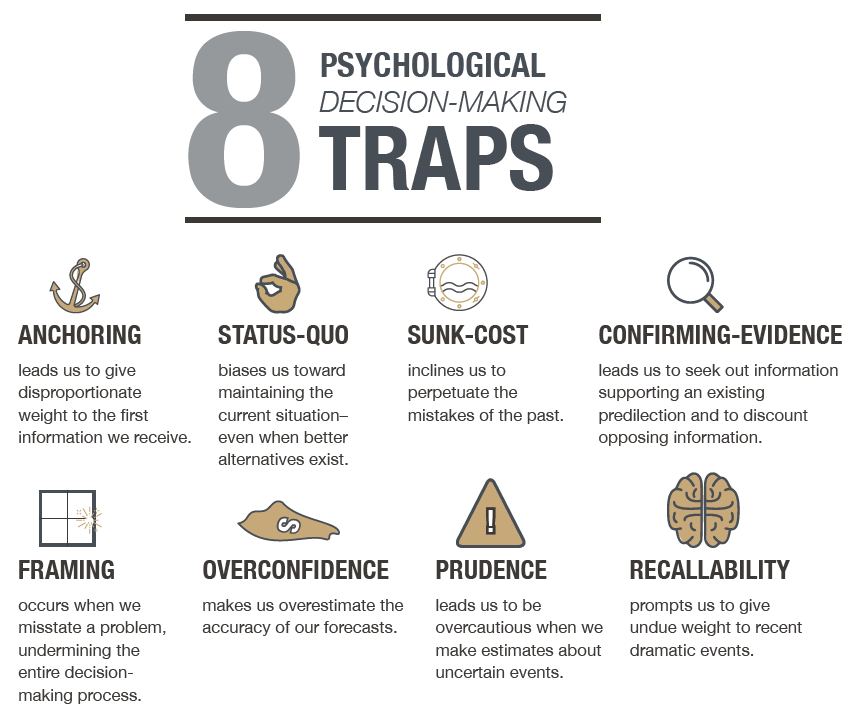
Entrepreneurs by nature are predisposed to optimism.  You wouldn’t take the risk of utter failure and the marathon of late nights, sweat equity, risk-bearing pursuits without a deep sense of optimism in “the plan.”  There’s a different between unbridled optimism (what the Bible describes as reckless zeal), and “informed optimism.”  Success is rarely hinging up such simple, binary factors of is it a good or bad idea – rather, it’s dynamically nuanced by factors like when, how, why, and what else is also true.  There are psychological bias factors common to all of us – but these liabilities can be minimized if we lean into the light, embrace inconvenient feedback and establish systems of constructive accountability.  Which of the 8 major decision-making bias traps are you or your team most prone to?

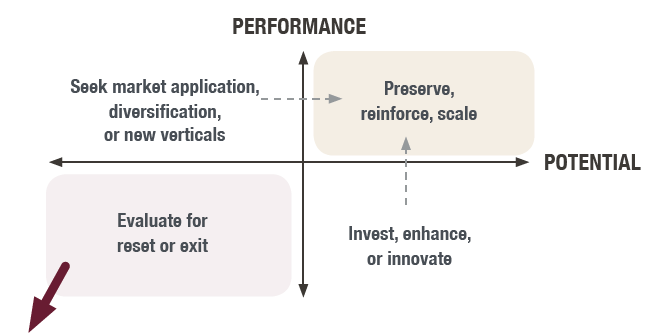
When discussing this very issue with thousands of C12 members across 300+ peer advisory groups in early 2019, we found the same line of thinking must be tested against how we evaluate people, products, business units and strategies.  Borrowing from the talent top-grading thinking, we found this 2×2 matrix and set of questions constructive: 

For whatever or whoever falls into the bottom left quadrant, we can ask ourselves

a series of questions to determine whether we should invest in efforts to improve

its position or prune altogether.

— Can the issue be fixed?

— Has enough time passed to demonstrate the problem is not a season that may organically pass?

— Have previous efforts been devoted to the issue and failed?

— What is the subject’s disposition and trajectory?

— What is the cost of not dealing with that person or product?

— Am I falling into one of the eight psychological traps of decision-making?

Consider this story by an entrepreneur who realized that in order to scale her growing ecommerce business while also scaling a flourishing marriage, Christ-walk and home life she would have to cut a profitable business unit despite all sense of “I can do it all!”  (Case Study)

As is often true, our greatest strengths can be our greatest liabilities left unchecked.  The very optimism and bias for the possible is likely what fueled much of your success.  How will you harness Biblical wisdom to ensure that the very accelerant for success is not the contaminant for your faith-driven endeavor?

Related articles

——

[ Photo by Justin Wei on Unsplash ]